

The “ISO 11114 Gas cylinders – Compatibility of cylinder and valve materials with gas contents” standard, published by the International Organization for Standardization (ISO), consists of the following sub-sections published under the same title:
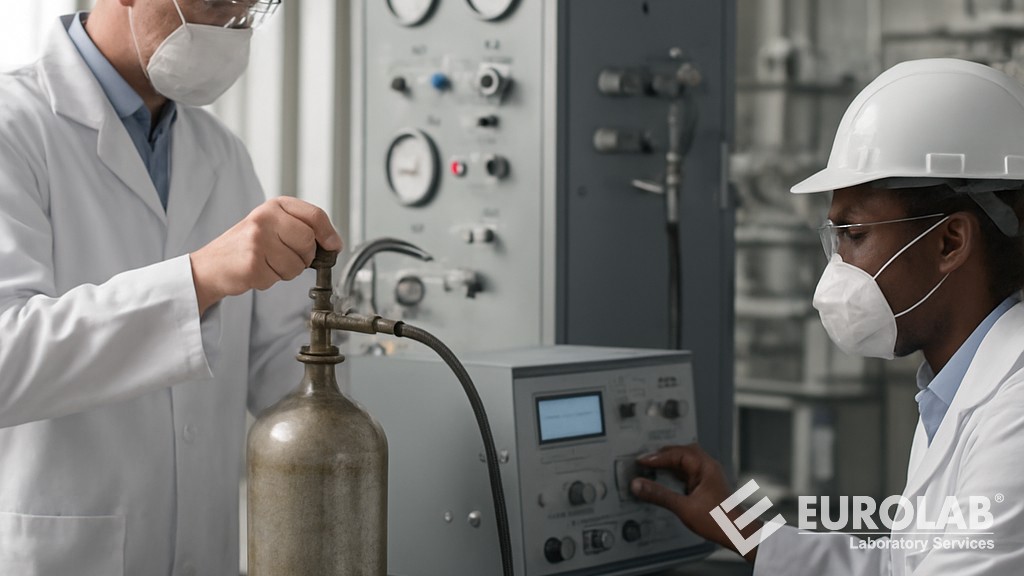
Industrial, medical, and specialty gases (e.g., high-purity gases, calibration gases) can be transported or stored in gas cylinders. A fundamental requirement for the materials used to manufacture such gas cylinders and valves is compatibility with the gas content. The compatibility of cylinder materials with the gas content has been proven through many years of practical application and experience. Current national and international regulations and standards do not fully cover this issue. This standard is based on existing international experience and knowledge.
The compatibility of most materials used in the manufacture of gas cylinders and valves is specified in this standard. Other materials whose compatibility is not specified in this standard may be used provided that all aspects of compatibility have been assessed and verified by an authorized person.
The most commonly used metallic materials for cylinders (among others) are carbon manganese steel, chromium molybdenum steel, chromium molybdenum nickel steel, stainless steel, and aluminum alloys, as specified in the following standards:
The most commonly used metallic materials for valve bodies and parts in contact with the internal gas are brass and other similar copper-based alloys, carbon steel, stainless steel, refined nickel and nickel alloys, copper-beryllium, and aluminum alloys.
This standard addresses the effect of gas on altering material and mechanical properties (e.g., chemical reaction or change in physical state). Basic material properties (normally obtainable from the material supplier), such as mechanical properties necessary for design purposes, are not considered. Other factors, such as the quality of the supplied gas, are also not taken into account.
The compatibility data given relates to single-component gases, but may also apply to gas mixtures. This standard does not apply to cryogenic liquids (ISO 21010 standard applies in this regard).
Non-metallic materials must be suitable for the intended service. For cylinder liners, they are suitable if their compatibility is stated as acceptable in the tables given in the standard, or if the required properties have been satisfactorily proven by a qualified person through tests or long and reliable experience. When plastic liner materials are used, metallic protrusions must be used. The ISO 11114-1 standard applies to the compatibility of metallic protrusions.
If coated materials are used, the suitability of the combination is assessed and approved after all technical aspects have been evaluated and verified by an authorized person. These technical aspects include, but are not limited to, the compatibility of the coating material with the intended gas, the durability of the coating throughout its intended service life, and its gas permeability.
In principle, a small amount of test material is heated in pressurized oxygen. To determine the autogenous ignition point, pressure and temperature are continuously recorded, at which point a sudden increase in temperature and pressure is observed (this point is called the autogenous ignition temperature).
Test samples must be prepared in a way that prevents contamination. Test samples can be in liquid or solid form. In the case of solid materials, the material should be broken into fine particles. A sample mass between 0,06 g and 0,5 g is used for each test. This mass should be adjusted taking into account the volume of the test reaction chamber. A 0,5 g sample has been found suitable for a test reaction chamber with a volume between 30 cm³ and 250 cm³.
The requirements of this standard do not apply if at least one of the following conditions is met for the intended gas service:
In such cases, the partial pressure should not exceed 0,25 MPa (2,5 bar). In this situation, it is possible to design the cylinder for normal (non-effervescent) gases.
The test methods described in this standard are applicable to all designed operating pressures. The test is performed at room temperature, not lower than the designed operating pressure. All tests are performed to assess hydrogen embrittlement, taking into account the conditions to be encountered in the intended application. The composition of the gas under test should not be less than the maximum embrittling gas concentration in the intended application. The tests are performed for the purpose of selecting steel for hydrogen/embrittling gas and mixing cylinders.
The described test methods are:
This standard is designed to determine the compliance of materials with the risks defined in the ISO 11114-2 standard and to evaluate materials not listed. Two types of tests can be performed:
To determine the suitability of materials for a particular primer, tests must be carried out on cylinders in accordance with this standard. Tests on samples should be performed solely to compare different plastic materials (e.g., to select the most suitable material), or to check whether some areas of the primer penetrate more than others, or both.
Testing on discs or samples is difficult in Type 5 cylinders. Therefore, testing on cylinders is recommended. Certain substances (e.g., moisture, sulfur compounds) may have a positive or negative effect on material performance, and this should be considered when designing and conducting tests. These substances may be present in the gas, released by the plastic materials, or both. Analysis of the test gas should be recorded before and after testing to detect any potential contamination (e.g., moisture, sulfur compounds).
For many years, our organization, with its competent and experienced staff, has been understanding the needs of its customers, providing the advanced testing services they require, and assisting in the establishment, implementation, and improvement of management systems. Within this framework, we also provide testing services to businesses in accordance with the "ISO 11114 Gas cylinders - Compatibility of cylinder and valve materials with gas contents" standard.
To get an appointment, to get more detailed information or to request an evaluation, you can ask us to fill in our form and reach you.

