

Dynamic mechanical analysis is a technique used to study and characterize materials. It is very useful for studying the viscoelastic behavior of polymers. During the analyses, a cyclic stress is applied to the sample and the strain in the material is measured, thus allowing the complex modulus to be determined.
The sample's responses to stress, temperature, frequency, time, atmosphere and other values are often variable, resulting in changes in the complex modulus. This approach is used to detect the glass transition temperature of the material and to determine the transitions corresponding to other molecular motions.
A thermomechanical analysis applies a constant static force to a material and monitors the material's change and reports dimensional changes as temperature or time changes. Whereas, dynamic mechanical analysis applies an oscillating force to the sample at a certain frequency and reports changes in stiffness and damping. Both detect transitions, but dynamic mechanical analysis is much more sensitive.
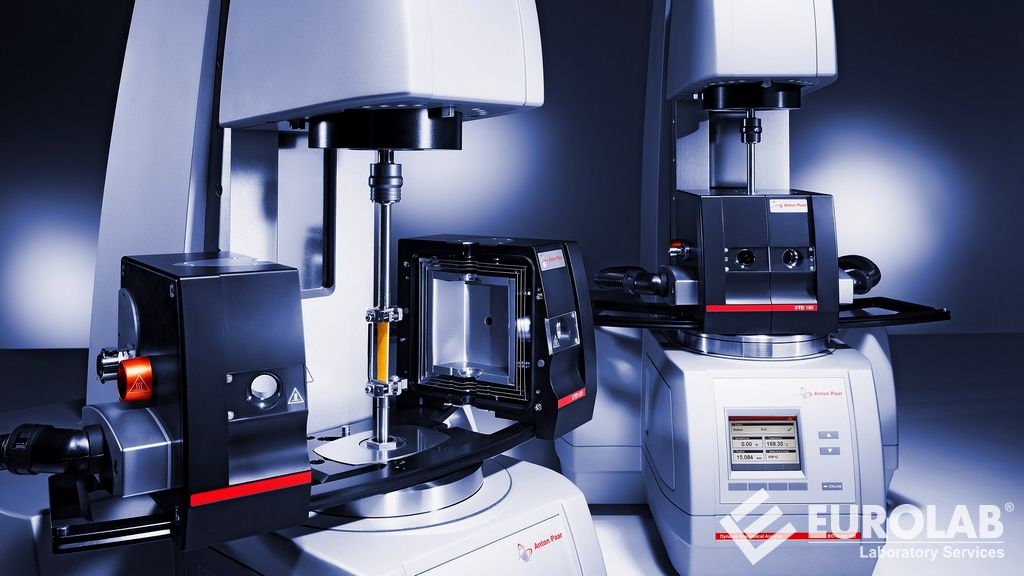
In the dynamic mechanical analysis method, a cyclic deformation is applied to the sample and the sample is subjected to a controlled stress. For a known stress, the sample deforms by a certain amount. How much the sample deforms is related to its hardness. A force motor is used to generate the cyclic wave and this is transmitted to the sample via a drive shaft. The stiffness and damping of the sample are measured by dynamic mechanical analysis.
Generally, the dynamic mechanical analysis method is used for the measurement of various polymer materials using different deformation modes. There are tensile, compression, double bend bending, three-point bending and shear modes, and the most suitable type should be selected depending on the sample shape, modulus and measurement purpose. In this analysis method, viscoelastic properties such as storage modulus, loss modulus and loss tangent are determined and their dependence on temperature and frequency is analyzed.
The analysis of the glass transition temperature and the dependence of the module on temperature are determined by the temperature distribution measurement. By simultaneous measurement of temperature distribution and frequency distribution, relaxation events such as glass transition, side chain relaxation and local mode relaxation are observed. This approach provides information about the molecular structure and molecular motion of polymers.
Our organization also provides DMA dynamic mechanical analysis services with its trained and expert staff and advanced technological equipment, among the numerous test, measurement, analysis and evaluation studies it provides for businesses in various sectors.
To get an appointment, to get more detailed information or to request an evaluation, you can ask us to fill in our form and reach you.

