FN-QB-058 Hard Copper (Hard Aluminum) and Insulation Layer - DV Test Outline
The standard “FN-QB-058 Hard copper (hard aluminum) and insulation layer - DV test outline” describes the terminology definitions, DV test outline, and test methods for hard copper (hard aluminum) and insulation layers from Farasis Energy (Ganzhou). This standard applies to hard copper (hard aluminum) and insulation layers used in lithium-ion power battery modules and battery packs from Farasis Energy (Ganzhou), including raw materials and finished products.
For the purposes of this standard, the following definitions apply:
- Electrical connection components: These are components used to connect the battery main circuit, protect the external output current of the battery system, and act as conductors. Commonly used types include cables, flexible copper strips, and aluminum busbars. Conductive materials directly affect electrical connection performance, with copper and aluminum being the most commonly used. Depending on different processing techniques, they are classified as flexible copper strips, rigid copper busbars, flexible aluminum strips, copper cables, and aluminum cables. Cables are generally not recommended due to bending radius and cost factors.
- Basic protection: This refers to avoiding direct contact with live parts under normal conditions.
- Insulation withstand voltage: The maximum AC or DC voltage that can be continuously applied between the input and output terminals, input terminals and chassis, and output terminals and chassis.
- Rigid copper busbar: A long conductor made of copper or copper alloy material, die-cut from rigid copper sheets with a rectangular or rounded cross-section. It is used for current transmission in circuits and for connecting electrical equipment. Its conductivity meets the requirements of the GB/T 5585.1 standard.
- Rigid aluminum busbar: A long conductor made of aluminum or aluminum alloy material, die-cut from rigid aluminum sheets with a rectangular or rounded cross-section. It is used for current transmission in circuits and for connecting electrical equipment. Its conductivity meets the requirements of the GB/T 5585.2 standard.
- PVC sheathing: Polyvinyl chloride, possessing excellent dielectric and good mechanical properties. It does not have a fixed melting point; it begins to soften at 80-85 degrees Celsius.
- Comparative tracking index: Used to evaluate the tracking resistance of solid insulation material surfaces under the combined effect of an electric field and a humid or contaminated environment.
Material performance requirements have been defined as follows:
- The outer surface color of the copper busbar should be orange RAL2003-RAL2011, and there should be no noticeable color difference on the surface.
- The copper busbar should have a clean overall appearance, free from grease stains, dirt, or other residues that would affect its look.
- The copper busbar should appear sound, free from scratches, dents, damage, cracks, deformations, or other manufacturing defects.
- Copper busbars require product identification labels on the packaging surface, including product name, material code, production batch number, and factory inspection qualification information.
- The performance of hard copper (hard aluminum) and insulation layer materials must comply with the requirements given in the table within the standard.
The main test methods defined in this standard are:
- Insulation layer material flame retardant rating test
- Conductivity test
- Insulation layer abrasion resistance
- Dielectric strength test
- Powder coating hardness test
- insulation test
- Strength test
- Temperature rise test
- Comparative tracking index test of insulation layer
- Insulation layer elongation at break
- Cross-cut test
- Low temperature test
- Constant humid heat test
- Thermal shock test
- Aging of the insulation layer
- Neutral salt spray test
These tests verify that the insulation layer can withstand a certain high voltage without failure, ensuring electrical safety, leakage prevention, and reliability under overvoltage conditions (e.g., voltage surges). They detect defects in the insulation surrounding rigid copper or aluminum conductors, such as nicks, thinning points, contaminants, or manufacturing defects.
Rigid tensile conductors are used for higher strength in overhead or power cables, but this design validation test primarily focuses on insulation performance.
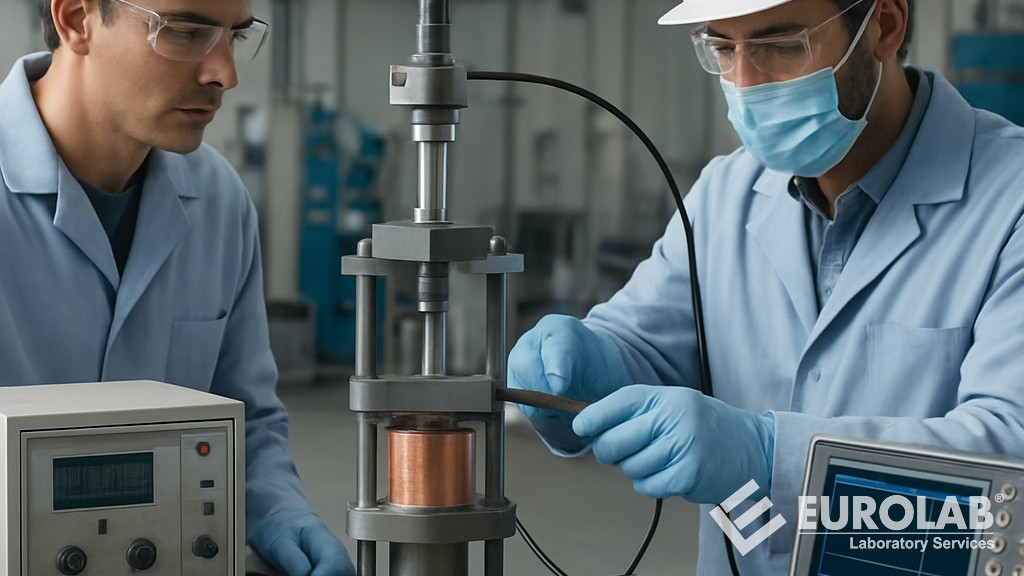
The test methods defined in the FN-QB-058 standard generally conform to standards such as UL 1581, IEC 60502, or ASTM methods. Essentially, these tests follow this process:
- Sample preparation: Processed cable samples are used (usually 5-10 meters long). The ends are stripped to expose the conductors. For submersion methods (common for cables), the middle section is immersed in a water bath (salt water optional for conductivity), leaving the ends exposed. The water acts as the grounding electrode.
- Test setup: The conductor (solid copper or aluminum) is connected to a high-voltage source. Its outer surface is grounded (via a water bath, metallic foil wrapped around the insulation, or shielding if available). For multi-core cables, testing is performed between the conductor and ground/shielding, or phase-to-phase if necessary.
- Voltage application: AC or DC voltage is applied (AC is more common for production, DC is suitable for field/post-assembly). Typical voltages:
- Low voltage cables (maximum 1 kV): 1-5 kV (e.g., 2-3 times the nominal voltage + 1000 V).
- Medium voltage: Higher depending on insulation thickness/value.
The voltage should be increased gradually (e.g., 500 V/s) until the test level is reached. The hold time is typically 1 minute (or 60 seconds for AC, longer for some DC tests).
- Acceptance criteria: There should be no dielectric failure (flash discharge, arc, or breakdown). The leakage current should be below the limit (e.g., 1-10 mA depending on the standard). There should be no excessive corona or partial discharge. Visual inspection for damage and optional insulation resistance check are performed after testing.
- Safety and equipment: A Hipot test device with a current cut-off setting is used. The test is performed in a controlled environment (room temperature, dry environment unless immersion is specified). Safety protocols must be followed (enclosed space, grounding).
The main differences between hard copper and hard aluminum are:
- The conductive material affects the conductivity and mechanical properties, but does not directly affect the DV test voltage (which depends on the insulation type/thickness).
- Aluminum may require larger cross-sections and potentially thicker insulation for equivalent current carrying capacity, but the test procedure remains similar.
For many years, our organization, with its competent and experienced staff, has been understanding the needs of its clients, providing the advanced testing services they require, and assisting in the establishment, implementation, and improvement of management systems. Within this framework, we also provide testing services to businesses in accordance with the “FN-QB-058 Hard copper (hard aluminum) and insulation layer - DV test outlines” standard.



