

The ISO 9227 Corrosion tests in artificial environments - Salt spray tests standard, published by the International Organization for Standardization (ISO), describes salt spray test methods included in corrosion tests performed in artificial environments.
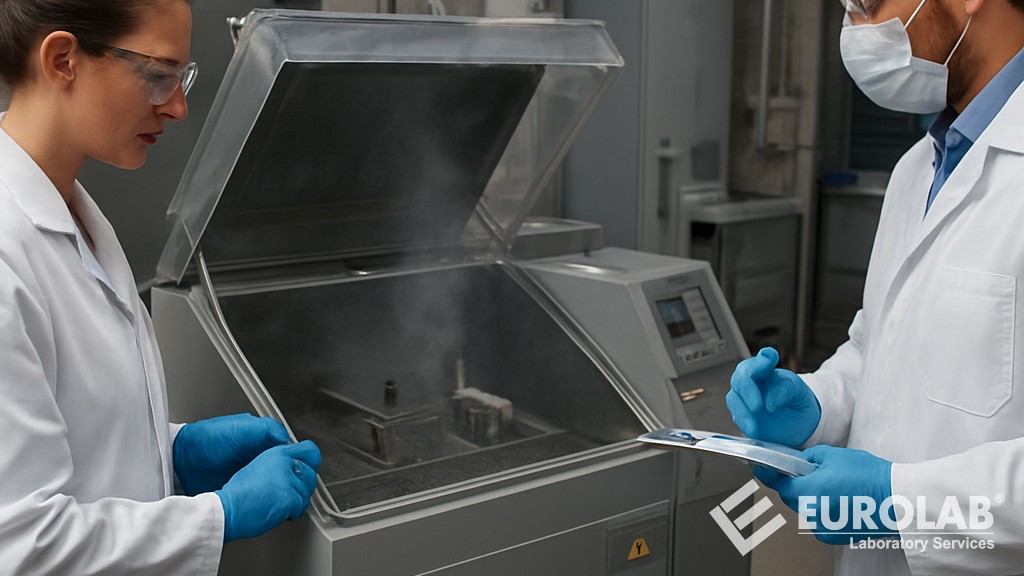
Copper accelerated acetic acid salt spray (CASS) tests are used to evaluate the corrosion resistance of metallic materials, whether or not they have permanent or temporary corrosion protection. They also describe the method used to assess the corrosiveness of the test chamber environment. This method does not specify the dimensions or types of test specimens, the exposure time to be used for a particular product, or the interpretation of the results. Such details are provided in the relevant product specifications.
Salt spray tests are particularly useful for detecting discontinuities such as pores and other defects in certain metallic, organic, anodic oxide, and conversion coatings.
The neutral salt spray (NSS) test is particularly applicable to the following:
The acetic acid salt spray (AASS) test is particularly useful for testing copper-nickel-chromium or nickel-chromium decorative coatings. It has also been found suitable for testing anodic and organic coatings on aluminum.
The copper accelerated acetic acid salt spray (CASS) test is useful for testing copper-nickel-chromium or nickel-chromium decorative coatings. It has also been found suitable for testing anodic and organic coatings on aluminum.
All salt spray methods are suitable for checking whether the quality of a metallic material, with or without corrosion protection, is preserved. They are not designed to be used as a comparative testing tool to rank different materials against each other according to their corrosion resistance or to predict the long-term corrosion resistance of the material being tested.
The ISO 9227 standard defines three variants of the salt spray test, differing in terms of solution composition, pH value, and aggressiveness:
All tests involve continuous exposure in a closed chamber, where the saline solution is formed into a fine mist and deposited onto the samples at a rate of 1-2 mL/80 cm2 per hour.
The equipment used in the tests is a corrosion test chamber containing atomizers, heaters, and collectors to ensure uniform spray distribution and abrasiveness. Samples are cleaned, placed at an angle of 15-25 degrees from the vertical to prevent droplet accumulation, and positioned so that they do not obstruct each other. They are then subjected to continuous spraying at controlled temperatures and collection rates. After exposure (the time specified in the product standards, e.g., 24-1000 hours), the samples are examined for rust, blistering, or other corrosion. This standard includes methods for verifying the abrasiveness of the chamber using reference samples.
The advantages of these methods are as follows:
The limitations of these methods are as follows:
In summary, the ISO 9227 standard includes methods for evaluating the corrosion resistance of metallic materials, whether uncoated or protected with coatings such as metallic, organic, anodic oxide, or conversion layers. The primary purpose of this standard is to provide a controlled, accelerated corrosion environment using salt spraying (also known as salt mist or salt vapor) to assess how well materials can withstand corrosive attacks. It is particularly effective for detecting defects such as pores, cracks, or discontinuities in coatings.
The ISO 9227 standard remains a cornerstone of corrosion testing due to its simplicity and effectiveness in controlled comparisons. For critical applications, it is often supplemented by field tests or advanced cyclical methods.
For many years, our organization, with its competent and experienced staff, has been understanding the needs of its clients, providing the advanced testing services they require, and assisting in the establishment, implementation, and improvement of management systems. Within this framework, we also provide testing services to businesses in accordance with the "ISO 9227 Corrosion tests in artificial environments - Salt spray tests" standard.
To get an appointment, to get more detailed information or to request an evaluation, you can ask us to fill in our form and reach you.

