

The German Standards Institute (DIN) standard, “DIN 53579 Testing of flexible cellular materials - Indentation test on finished parts,” describes a non-destructive method for determining the indentation stiffness of flexible molded foams with a minimum thickness of 10 mm. Using this method, the indentation force for a given indentation displacement can be expressed in Newtons, or the indentation displacement for a given indentation force can be expressed in millimeters.
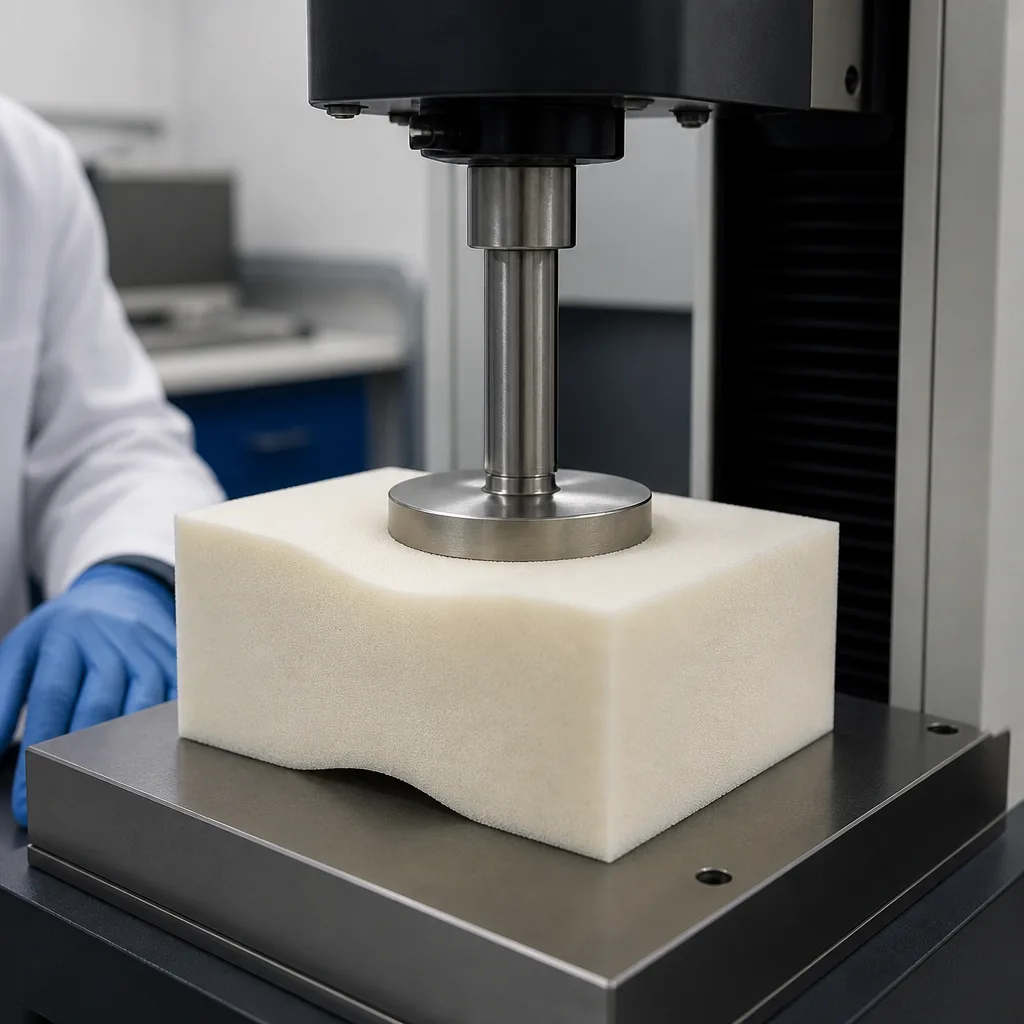
This method is suitable for conducting tests directly on molded parts. The test specified in this standard is not suitable for determining the stiffness of extruded profiles, commonly referred to as sponge rubber or expanded rubber.
The DIN 53579 standard includes a method for determining the indentation stiffness of finished parts made from flexible molded cellular materials such as polyurethane foams and other soft elastic foams.
This standard specifies a non-destructive indentation test performed directly on finished components (not on test specimens cut from the material). This method is applicable to flexible molded foams with a minimum thickness of 10 mm.
This test is particularly important in sectors where the comfort, support, and durability of the foam are crucial, including:
This method measures how the foam responds to local pressure and simulates real-world loading conditions on the actual product instead of standardized blocks.
The DIN 53579 standard focuses on indentation hardness and, depending on the accepted procedure, can specify one of two main values:
This test is typically performed by pressing a cylindrical or spherical indentation tip (piston) into the foam surface at a controlled speed. It measures the force-displacement relationship without damaging the part.
Unlike the relevant international standard “ISO 2439 Flexible cellular polymeric materials - Determination of stiffness (indentation technique)” (which tests indentation stiffness in foam samples and includes specific parameters), the DIN 53579 standard primarily defines the test procedure and equipment. The precise test parameters (e.g., indentation tip size, indentation depth, force levels, number of cycles) are usually defined in the product specification or by the customer (e.g., automotive original equipment manufacturer factory standards).
Other standards related to DIN 53579 include:
Many car manufacturers refer to the DIN 53579 standard for seat foam quality control or adapt it to their own internal specifications.
Manufacturers and testing laboratories use this standard for the following purposes:
Testing equipment typically includes universal testing machines with specialized compression plates or recessed ends suitable for soft foams.
Wear resistance is a critical property for materials exposed to friction and abrasion, such as tires, conveyor belts, shoe soles, and industrial seals. The DIN 53579 standard helps manufacturers and engineers determine how well a material can withstand surface wear during mechanical impact, ensuring durability and performance in real-world applications.
The main objectives of the DIN 53579 standard are as follows:
In principle, the DIN 53579 standard typically uses a method similar to a rotating cylindrical drum device. This process generally follows these steps:
Wear resistance is inversely proportional to volume loss:
Test equipment generally includes the following:
Sample requirements are as follows:
The DIN 53579 standard is widely used in the following sectors:
This standard is considered important for the following reasons:
In conclusion, DIN 53579 plays a vital role in evaluating the wear resistance of rubber materials. By providing a consistent and repeatable testing method, it helps industries select the right materials for applications where friction, wear, and longevity are critical factors.
For many years, our organization, with its competent and experienced staff, has been understanding the needs of its clients, providing the advanced testing services they require, and assisting them in the establishment, implementation, and improvement of management systems. Within this framework, we also provide testing services in accordance with the DIN 53579 standard.
To get an appointment, to get more detailed information or to request an evaluation, you can ask us to fill in our form and reach you.

