

The standard "ASTM E1050-19 Standard Test Method for Impedance and Absorption of Acoustical Materials Using a Tube, Two Microphones, and a Digital Frequency Analysis System" developed by the American Society for Testing and Materials (ASTM) describes a test method that involves the use of an impedance tube, two microphone positions, and a digital frequency analysis system to determine the normal incident sound absorption coefficients and normal specific acoustic impedance ratios of materials. The procedure for accrediting a laboratory to perform this test method is included in the annex of the standard (Annex A1).
For the purposes of this standard, the terms and definitions given in ASTM C634 apply.
This test method is similar to the standard test method “ASTM C384-04 Standard Test Method for Impedance and Absorption of Acoustical Materials by Impedance Tube Method” in that an impedance tube is used with a sound source connected at one end and a test specimen mounted at the other end. However, the measurement techniques of the two methods are fundamentally different.
In this test method, plane waves are generated in the tube using a broadband signal from a noise source instead of a discrete sinusoid from an oscillator. The decomposition of the stationary sound wave pattern into its forward and backward traveling components is accomplished by simultaneously measuring the sound pressures at two spaced points on the sidewall of the tube. By processing the complex data array from the measured transfer function, the calculation of normal incident absorption coefficients for the acoustic material is accomplished.
Quantities are determined as functions of frequency at a resolution determined by the sampling rate of the digital frequency analysis system. The usable frequency range depends on the tube diameter and the distance between microphone positions. An extended frequency range can be achieved by using tubes of various diameters and microphone spacings. This test method is intended to provide a much faster measurement technique than the ASTM C384-04 standard test method.
This test method can be applied to measure the sound absorption coefficients of absorbing materials at the normal incidence angle, i.e. 0 degrees. It can also be used to determine specific impedance and acceptance ratios. The properties measured by this test method are useful in fundamental research and product development of sound absorbing materials.
Normal incident sound absorption coefficients can be quite useful in situations where the material is placed in a small acoustic space close to a sound source, such as a tightly packed machine enclosure.
This test method permits comparison of relative values of sound absorption when it is impractical to obtain large samples for accurate random event measurements in the reverberation chamber. Estimates of random event absorption coefficients can be obtained from normal impedance data for locally responsive materials. The locally responsive classification includes fibrous materials with high internal losses. Formulas have been developed to convert sound absorption characteristics from normal to random for both locally responsive and collectively responsive materials.
The measurements described in this test method can be made with high precision, but these measurements can be misleading. Uncertainties of magnitude greater than those obtained from the measurements may arise from other sources. Care should be taken to adequately sample irregular materials.
The shape and area of each sample should be the same as the pipe section. The sample should fit snugly into the holder, not so tightly that it bulges in the middle, nor so loose that there is a gap between the holder and the edge. It is recommended that circumferential cracks and gaps be filled with Vaseline or modelling clay. For the reasons stated in this standard, it is desirable that the sample has a relatively flat surface.
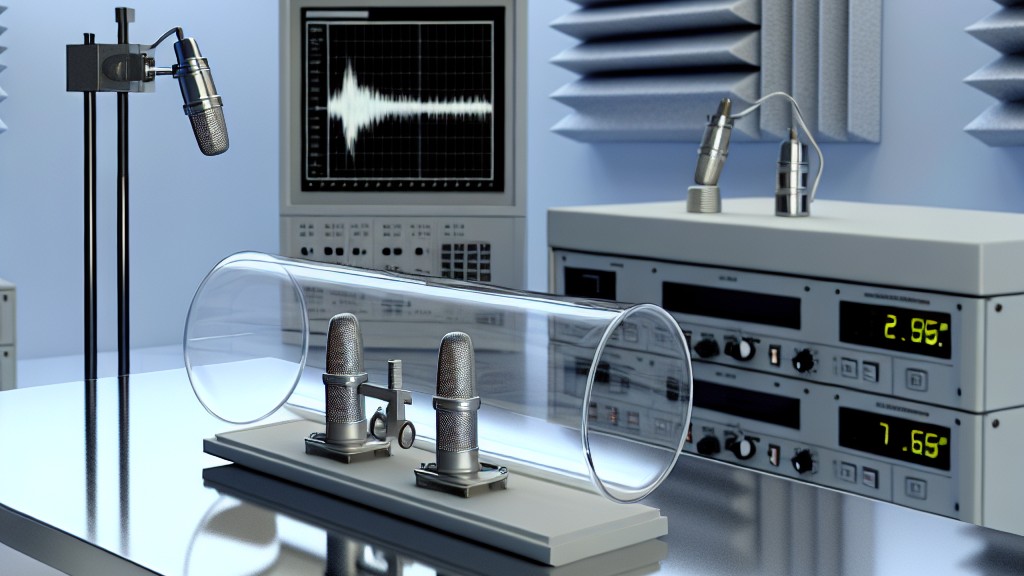
The device used in these tests is a hollow cylinder or tube with a test sample holder at one end and a sound source at the other. Microphone ports are mounted at two or more points along the wall of the tube. A two-channel digital frequency analysis system is used for data collection and processing.
Our organization, which has been trying to support businesses from every sector with its testing, measurement, analysis and evaluation studies carried out in a wide range for years, has a strong staff that closely follows the developments in the world in the field of science and technology and constantly improves itself. In this context, testing services are also provided to businesses in accordance with the standard "ASTM E1050-19 Standard test method for impedance and absorption of acoustic materials using a tube, two microphones and digital frequency analysis system".
To get an appointment, to get more detailed information or to request an evaluation, you can ask us to fill in our form and reach you.

