

The standard “ASTM D6611-16 Standard test method for wet and dry yarn-on-yarn abrasion resistance” developed by the American Society for Testing and Materials (ASTM) describes a procedure for measuring the abrasion resistance properties of manufactured fiber yarns under dry and wet conditions. This test method is applicable to manufactured yarns used in rope making.
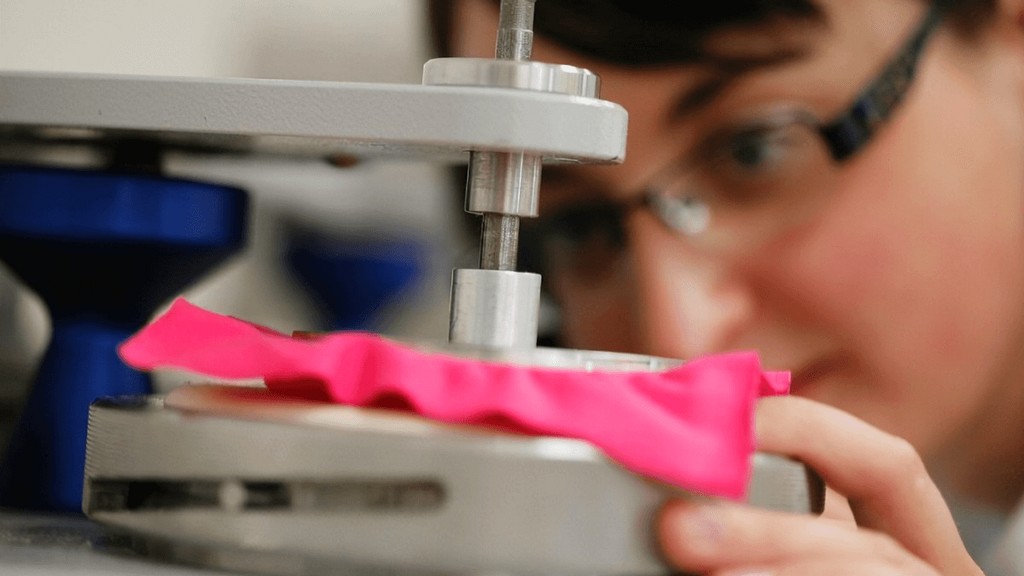
In testing, a piece of yarn is wound in contact with itself between three pulleys positioned in a defined geometry to create a specific angle of intersection. A weight is attached to one end of the yarn to apply a prescribed tension. The other end is pulled back and forth with a defined stroke at a defined speed until the yarn breaks due to abrasion on itself within the wound area. The yarn abrasion test can be performed in the dry or wet state.
This test method is designed to test the dry and wet abrasion resistance of manufactured fiber yarns. This test method is particularly useful for ropes designed for use in marine environments. The test method has been used with yarns having linear densities ranging from 70 to 300 tex, but can also be used with yarns outside these ranges.
It is known that the friction between the yarn and the yarn has a significant effect on the wear resistance. The test method described in the D3412 standard is used to determine the coefficient of friction.
This test method is intended to provide additional data for specific applications such as those mentioned above and is not intended for quality control or test reports.
If there are differences of practical importance between the test results reported for two or more laboratories, comparative tests should be performed using competent statistical assistance to determine whether there is a statistical bias between them. At a minimum, the test samples used should be as homogeneous as possible, taken from material from which different test results were obtained, and randomly assigned in equal numbers to each laboratory for testing. Other materials with established test values may be used for this purpose. Test results from two or more laboratories should be compared using a statistical test for unpaired data at a probability level chosen before testing.
If a bias is found, the cause must be found and corrected, or future test results must be adjusted to account for the known bias.
This test method is performed at one or more applied tensions, which may depend on the yarn material and size. The number and magnitudes of applied tensions and the number of eight sample sets are usually agreed upon in a material specification or contract order. Guidance for determining the appropriate number and magnitudes of applied tensions is included in the standard annex (Annex A2).
The yarn-on-yarn abrasion tester is schematically shown in the standard and consists of:
Among the numerous tests, measurements, analyses and evaluation studies that our organization has carried out for businesses in various sectors, it also provides testing services defined in the “ASTM D6611-16 Standard Test Method for Wet and Dry Yarn-on-Yarn Abrasion Resistance” standard with its trained and expert staff and advanced technological equipment.
To get an appointment, to get more detailed information or to request an evaluation, you can ask us to fill in our form and reach you.

