

The German Standards Institute (DIN) standard, “DIN 53363 Determination of tear resistance of plastic films and sheets by the trouser tear method,” describes a test method for determining the resistance of plastic film to tear propagation under specified conditions. This method is applicable to products that, due to their softness, do not break when clamped between the holders of a tensile testing machine. The test procedure allows for the comparison of samples taken from different products, provided that the sample thicknesses do not differ by more than 10 percent.
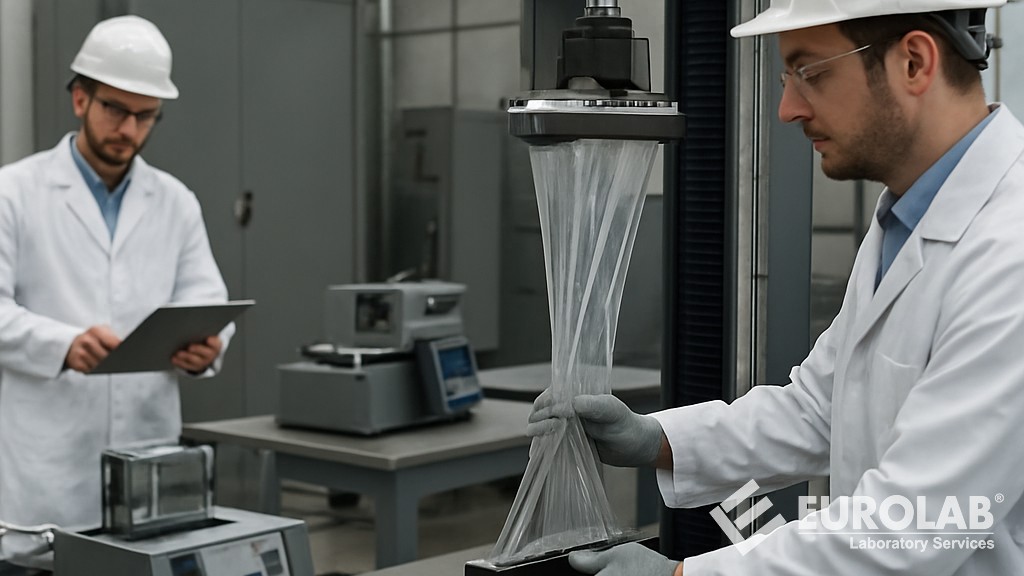
This standard is particularly important in material testing of flexible plastics, such as packaging films, tarpaulins, artificial leather substrates, and other thin polymer sheets where tear resistance is a critical performance characteristic.
According to the DIN 53363 standard, the primary purpose of the test is to measure how much force a plastic film can withstand under controlled conditions before tearing propagation occurs. This method is particularly helpful in evaluating the durability of materials in applications where films may be subjected to stress that causes cutting, puncturing, or tearing (e.g., packaging, agricultural films, or technical textiles).
This method is suitable for the following:
This standard defines the test for trouser tearing with a pre-cut (single tear test) or the trapezoidal tear test. This test essentially follows these steps:
The basic parameters are as follows:
This method differs from tensile strength tests (for example, the DIN EN ISO 527 series of standards which measure elongation and fracture strength without prior shearing).
The DIN 53363 standard test method is compatible with international equivalent standards such as “ISO 34-1 Rubber, vulcanized or thermoplastic - Determination of tear strength - Part 1: Trousers, gussets and crescent test pieces”, which includes the trouser tear method for rubber/plastics, and “ASTM D1813 Standard test method for measuring the thickness of leather specimens”, which includes the trouser tear method for thin films. However, the DIN 53363 standard is still used as a reference, particularly in European industries, in product specifications, test reports, and legacy technical documentation.
Plastic film manufacturers (e.g., PE, PP, PVC films) use this test for the following purposes:
In short, tear strength is a crucial mechanical property that indicates how well a material can resist the propagation of a tear once it has begun. This test is widely used in industries such as packaging, automotive interiors, construction membranes, and technical films, where thin plastic materials need to maintain their structural integrity under stress. The primary aim of the DIN 53363 standard is to provide a reliable and repeatable method for measuring the force required to sustain a tear after the initial cut or notch is created in a plastic film.
Understanding tear resistance helps manufacturers in the following areas:
The materials typically subjected to this test include:
The DIN 53363 method measures the force required to expand an existing tear in a specimen. The basic principle is as follows:
When evaluating the results, the average tear strength is calculated. The force required to propagate the tear is reported as tear resistance. Sometimes the result is normalized according to thickness or width.
Equipment used in the tests includes:
Samples are generally tested in two ways:
This helps to evaluate the anisotropy common in plastic films.
The DIN 53363 standard is particularly useful for evaluating thin plastic films used in demanding applications. Its main industrial benefits include:
For example, in packaging, higher tear resistance means the film is less likely to tear during handling or shipping.
For many years, our organization, with its competent and experienced staff, has been understanding the needs of its clients, providing the advanced testing services they require, and assisting them in the establishment, implementation, and improvement of management systems. Within this framework, we also provide testing services in accordance with the DIN 53363 standard.
To get an appointment, to get more detailed information or to request an evaluation, you can ask us to fill in our form and reach you.

