

The standard “ASTM C1291 Standard Test Method for High-Temperature Tensile Creep Strain, Creep Strain Rate, and Creep Time to Failure for Monolithic Advanced Ceramics” developed by the American Society for Testing and Materials (ASTM) describes a test method for determining the tensile creep strain, creep strain rate, and creep time to failure for advanced monolithic ceramics at elevated temperatures, typically between 1073 and 2073 K.
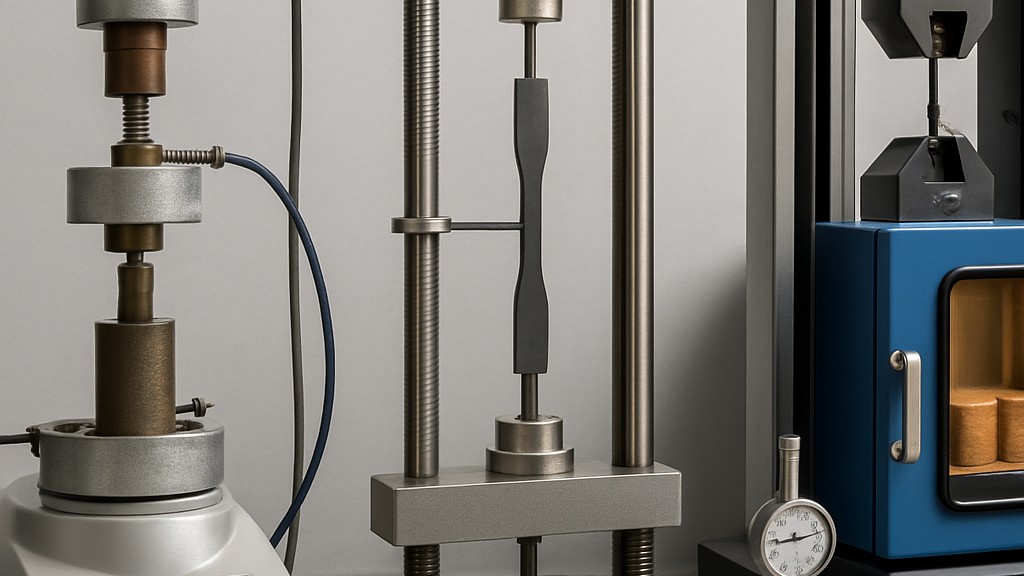
A variety of test specimen geometries are included in this standard. Creep strain at a constant temperature is evaluated from direct measurements of gauge length elongation over the test period. The minimum creep strain rate, which may be constant with time, is evaluated as a function of temperature and applied stress. Creep time to fracture is also included in this test method.
This test method is for use with advanced ceramics that behave macroscopically as isotropic, homogeneous, continuous materials. While this test method is designed for use on monolithic ceramics, whisker- or particle-reinforced composite ceramics and low-volume fractional staple fiber-reinforced composite ceramics may also meet these macroscopic behavior assumptions. Continuous fiber-reinforced ceramic composites do not behave macroscopically as isotropic, homogeneous, continuous materials, and this test method is not recommended for these materials.
Creep tests measure the time-dependent deformation under force at a specified temperature and therefore the force-carrying capacity of a material for limited deformations. When interpreted correctly, creep-rupture tests provide a measure of a material's force-carrying capacity as a function of time and temperature. The two tests complement each other in defining a material's force-carrying capacity for a specific time period. When selecting materials and designing parts for service at elevated temperatures, the type of test data used depends on the force-carrying capacity criteria that best define the material's serviceability.
This test method can be used for materials development, quality assurance, characterization, and design data generation.
High-strength, monolithic ceramic materials, typically characterized by small grain sizes (up to 50 μm) and bulk densities close to their theoretical density, are candidates for structural applications that carry loads at high temperatures. These applications include components such as turbine blades that are subjected to stress gradients and multiaxial stresses.
Data for design and prediction purposes should be obtained using any suitable combination of test methods that provide the most relevant information for the applications being considered. It is noted here that ceramic materials tend to shrink more rapidly than they do in compression. This difference results in time-dependent changes in the stress distribution and neutral axis position when tests are performed in flexure. Consequently, deconvolution (deconvolution, filtering) of flexural creep data to obtain the constitutive equations required for design cannot be achieved without some uncertainty regarding the form of the creep equations and the magnitude of the creep rate in tension relative to the creep rate in compression. Therefore, creep data for design and life prediction should be obtained in both tension and compression, as well as at the expected service stress state.
In short, ASTM C1291 is a specification that plays a key role in evaluating the durability of decorative concrete materials when subjected to freeze-thaw cycles. This standard is considered important for the following reasons:
In short, the ASTM C1291 standard is important because it provides a scientifically supported method for assessing whether decorative concrete can withstand the stresses of freeze-thaw cycles. This makes it a critical tool for ensuring durability, safety, and quality in areas where concrete is exposed to harsh weather conditions.
Our organization, which has been supporting businesses across all sectors for years through a wide range of testing, measurement, analysis, and evaluation activities, boasts a strong team of employees who closely follow global developments in science and technology and are constantly improving themselves. In this context, we also provide testing services in accordance with the "ASTM C1291 Standard Test Method for High-Temperature Tensile Creep Strain, Creep Strain Rate, and Creep Time to Failure for Monolithic Advanced Ceramics."
To get an appointment, to get more detailed information or to request an evaluation, you can ask us to fill in our form and reach you.

