

The European standard “EN 1936 Natural stone testing methods - Determination of true density, apparent density and total and open porosity” describes methods for determining the true density, apparent density, open and total porosity of natural stone.
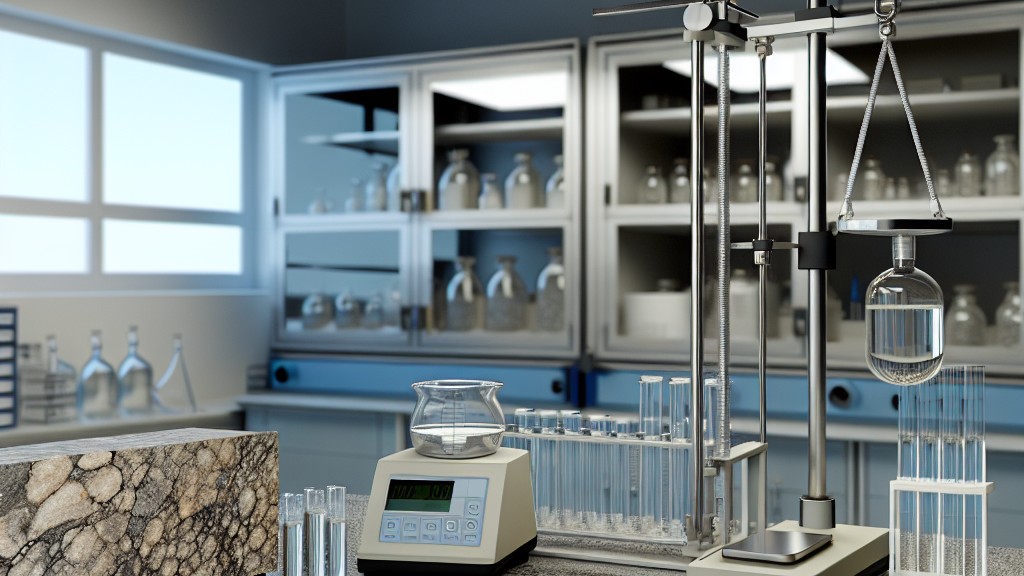
When performing tests, in principle, after drying to constant mass, the apparent density and open porosity are determined by vacuum-assisted water absorption and immersion weighing of the samples. True density and total porosity require the sample to be ground into powder.
For the purposes of this standard, the following definitions apply in addition to the terms and definitions given in EN 12670:
The main equipment used in these tests includes:
When preparing samples, sampling is not the responsibility of the testing laboratory unless specifically requested. A minimum of six samples representative of the body of the stone being tested should be selected.
Test specimens may be cylindrical, cube or prismatic and shall be obtained by diamond cutting or coring. Their apparent volume, calculated by geometric measurements, shall be at least 60 ml. In addition, the surface area/volume ratio shall be between 0,08 mm-1 and 0,20 mm-1. Specimens prepared for the determination of compressive or flexural strength may be used if they meet the surface/volume ratio.
Samples shall be dried at 70 degrees plus/minus 5 degrees until a constant mass is reached. This is assumed to be achieved when the difference between two weighings over an interval of 24 plus/minus 2 hours is not greater than 0,1 percent of the mass of the sample. Samples shall be kept in a desiccator until room temperature is reached.
When testing open porosity and apparent density, each sample is weighed, then placed in a discharge vessel and the pressure is gradually reduced to 2,0 kPa plus/minus 0,7 kPa = 15 mm plus/minus 5 mm of mercury. This pressure is maintained for 2 hours plus/minus 0,2 hours to eliminate air in the open pores of the samples. Demineralized water at 20 degrees plus/minus 5 degrees is slowly introduced into the bubble (the rate of rise of the water should be such that the samples are completely immersed for at least 15 minutes). The pressure of 2,0 kPa plus/minus 0,7 kPa is maintained during the introduction of water.
When all samples have been immersed, the container is brought back to atmospheric pressure and the samples are left submerged for another 24 hours plus/minus 2 hours at atmospheric pressure. Then, for each sample:
In the case of natural stones with visible voids (e.g. travertine), the apparent volume is determined by measuring the dimensions of the samples to the nearest millimetre.
When testing true density, the differences between true and apparent density and between open porosity and total porosity are very small for dense, low porosity stones. For these stones, it is sufficient to determine the apparent density and open porosity. In the case of control of supplies, the decision to skip the determination of true density is agreed upon between the parties.
This standard defines two methods for determining true density: the pycnometer (Method A) and the Le Chatelier volumetric meter (Method B). The first method is more accurate but requires a lot of time. In case of disagreement, it is recommended to use it as a reference method. The Le Chatelier volumetric meter method is less accurate but is easy and quick to perform and can be used for production control.
Our organization has a strong staff that closely follows the developments in science and technology in the world and constantly improves itself. Among the numerous test, measurement, analysis and evaluation studies provided for businesses in various sectors, there are also testing services in accordance with the standard “EN 1936 Natural stone testing methods - Determination of true density and apparent density and total and open porosity”.
To get an appointment, to get more detailed information or to request an evaluation, you can ask us to fill in our form and reach you.

