

The standard “EN ISO 11431 Construction and civil engineering sealants - Determination of adhesion and cohesion properties of sealants after exposure to heat, water and artificial light”, developed by the International Organization for Standardization (ISO) and later published as a European standard within the scope of harmonization efforts, describes a method for determining the adhesion and cohesion properties of sealants after periodic exposure to heat and artificial light, followed by exposure to water at a specific temperature.
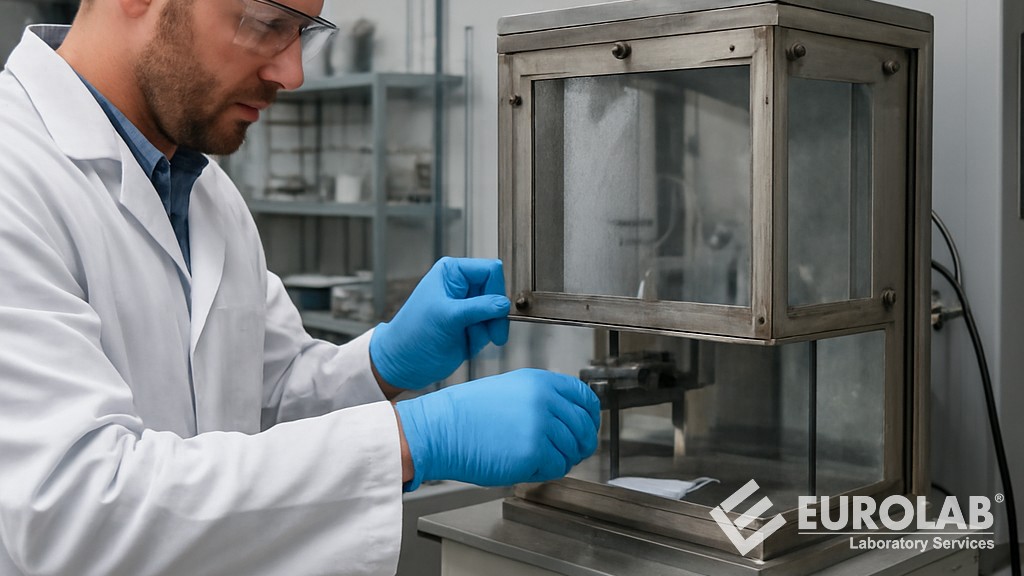
EN ISO 11431 is an international standard that specifies a laboratory test method for evaluating how well a sealant maintains its adhesion and cohesion when used in glazed joints exposed to harsh environmental conditions. This standard is crucial for manufacturers, architects, specifiers, and testing laboratories evaluating the long-term performance of sealants in curtain walls, structural glazing, insulating glass units, and other weather-exposed glazing applications.
The described test method simulates the real conditions to which a sealant is subjected in a glazed joint:
These three stressors are applied simultaneously for a specific period (usually 4 weeks, 672 hours, but longer periods may be specified). The aim is to accelerate aging and reveal the following potential weaknesses:
During test specimen preparation, sealant is applied to the joints between two substrates (typically glass and anodized aluminum spacers). The specimens are cured under standard conditions (23 degrees Celsius and 50 percent relative humidity, 28 days, or according to the manufacturer's instructions). The assembled test specimens are placed in special frames within a weatherproof enclosure, with one side exposed to xenon light through a glass panel and the other side submerged in water and circulated with hot air.
Exposure conditions have been defined as follows:
After the exposure period, the samples are removed and conditioned for 24 hours at 23 degrees Celsius and 50 percent relative humidity. They are then stretched to their breaking point (normally 100 percent elongation or breaking point) and examined in terms of the following aspects:
Many European technical approvals (ETAs) and national regulations refer to the EN ISO 11431 standard when classifying sealing materials for structural glazing or weather resistance. The classification commonly used in practice is as follows:
Some specifications require 1.008 hours or even 2.000 hours of exposure without adhesive degradation.
The EN ISO 11431 standard is considered one of the most important and demanding durability tests for sealants used in glass and facade applications. The reasons for its practical importance are as follows:
This standard is the only standard test that simultaneously combines heat, water, and UV radiation through glass. Due to this triple aggression, this standard is considered the best accelerated predictor of 20-30 years of field performance.
This makes the test an effective quality filter for specifiers and facade consultants.
In conclusion, the ISO 11431 standard is the most rigorous and realistic durability test for glass sealants and is the passport required for a sealant to be used in structural glazing, weatherproof insulation materials, and insulating glass units in Europe and many parts of the world. It is the strongest evidence that a sealant will reliably perform for decades under real exposure conditions.
For many years, our organization, with its competent and experienced staff, has been understanding the needs of its clients, providing the advanced testing services they require, and assisting them in the establishment, implementation, and improvement of management systems. Within this framework, we also provide testing services in accordance with the EN ISO 11431 standard.
To get an appointment, to get more detailed information or to request an evaluation, you can ask us to fill in our form and reach you.

