

The standard “ASTM F3295-18 Standard guide for impact testing of total disc prostheses” developed by the American Society for Testing and Materials (ASTM) is intended to provide guidance on evaluating the wear and fatigue characteristics of total disc prostheses under cyclic impact conditions.
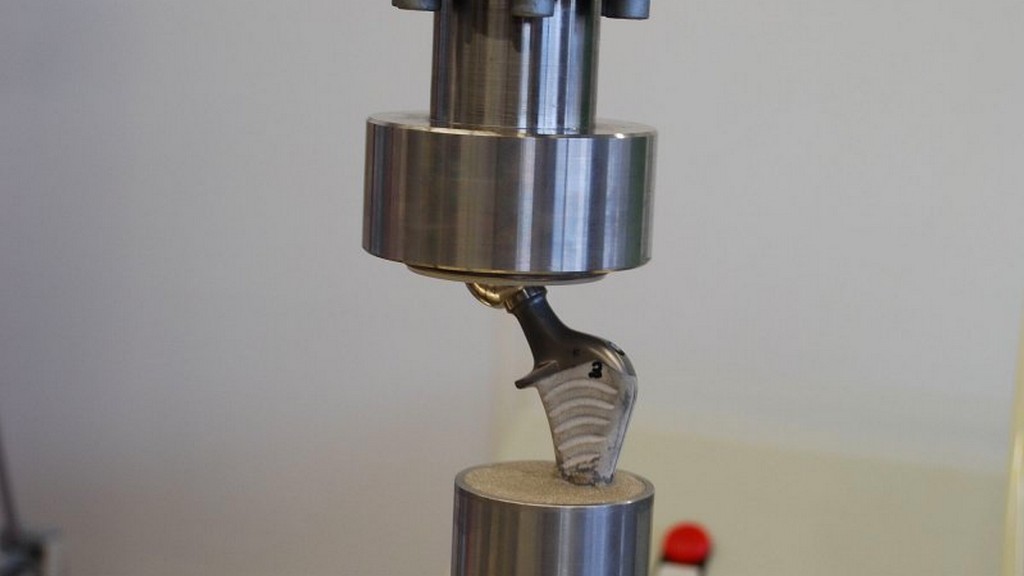
This guide describes the impact testing of devices with articulating components. The user is cautioned that the methods described herein are intended to produce an impact condition that may or may not demonstrate clinical performance and may or may not be consistent with the intended use of the device, and this should be taken into account when interpreting the data. Clinically, total disc prostheses should always be implanted in accordance with the labeling and manufacturer's instructions for use.
Impaction has been observed in retrievals of several total disc prosthesis designs, but impaction is not necessarily associated with device or clinical failure. The purpose of this guideline is to explore possible impaction-induced wear and mechanical failure modes associated with device design, as well as possible mechanical failure modes associated with clinical events such as subsidence, malpositioning, and improper implant sizing. Mechanical failure may or may not be associated with functional failure.
Before using this guide, the user should identify the bearing and non-bearing characteristics of the intervertebral disc (IVD) prosthesis and evaluate the performance of the intervertebral disc prosthesis under Mode 1 wear using the “ASTM F2423-11 Standard guide for functional, kinematic and wear evaluation of total intervertebral disc prostheses” or the “ISO 18192-1 Implants for surgery - Wear of total intervertebral disc prostheses - Part 1: Loading and displacement parameters for wear testing and corresponding environmental conditions for testing” standard. This standard is not intended to provide guidance on Mode I testing.
The purpose of this guideline is to evaluate the compression in intervertebral disc prostheses, regardless of the intended region of the spine (cervical or lumbar), material or material combinations (ceramic, metal, polymer), and bearing type (fixed or mobile).
The purpose of this guideline is to provide a comparison of the wear and fatigue characteristics of intervertebral disc prostheses when tested under specified conditions.
In brief, this guide provides a general approach to developing impact test parameters for total disc or intervertebral disc prostheses and outlines the key steps in developing, conducting, and interpreting impact tests.
This guideline can be used to develop test parameters to evaluate the fatigue and wear behavior of intervertebral disc prostheses under impact loading. However, it should be recognized that there are likely to be many possible impact conditions for a given intervertebral disc prosthesis.
The user should attempt to determine the clinically relevant and geometrically probable impact conditions that could lead to wear and fatigue damage to the intervertebral disc prosthesis and those dictated by the design and impact wear test parameters. The user should also attempt to select the device size that will represent the worst case for the selected impact conditions and parameters.
The user should consult and utilize available sources of information to determine impact test parameters that produce clinically relevant impact wear and damage for intervertebral disc prostheses. Previous clinical experience with device design may assist in developing impact test parameters through device recall and analysis of radiographs. However, previous clinical experience with the intervertebral disc being tested should not be considered a prerequisite for performing impact testing.
Among the numerous testing, measurement, analysis and evaluation studies that our organization has provided for businesses in various sectors, it also provides testing services defined in the “ASTM F3295-18 Standard guide for impact testing of total disc prostheses” standard with its trained and expert staff and advanced technological equipment.
To get an appointment, to get more detailed information or to request an evaluation, you can ask us to fill in our form and reach you.

