

A European standard “EN 2563 Aerospace series - Carbon fibre reinforced plastics - Unidirectional laminates - Determination of apparent interlaminar shear strength” describes a method for determining the apparent interlaminar shear strength of carbon fibre reinforced plastics in the form of unidirectional laminates by means of bending testing.
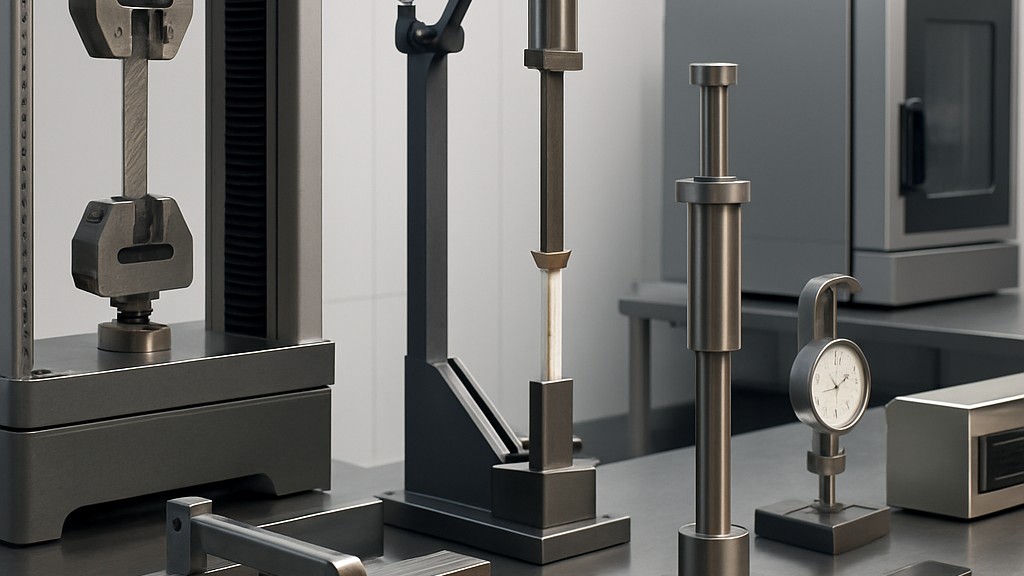
This method is designed for samples where the length is parallel to the fiber direction. The method is also applicable to carbon fiber-reinforced plastics in the form of woven fabrics. In the case of cross-ply laminates consisting of layers oriented in different directions, the results obtained with the formula given in this standard can only be used to compare laminates with the same layering.
For the purposes of this standard, apparent interlaminar shear strength refers to the maximum shear stress calculated at half the thickness of the specimen at the moment of initial fracture.
This method essentially involves determining the resistance to delamination under shear forces parallel to the laminate layers. For this determination, a rectangular specimen is subjected to a bending test on two supports. The load is applied to the center of the specimen via a loading nose located between the supports. This test provides information about the quality of the resin-fiber bond.
Samples for tests are taken from panels prepared according to EN 2655 standard.
Conditioning is carried out in accordance with the following conditions:
During the test, the width is measured to the nearest 0,01 mm at the center of the specimen. The height is determined by calculating the arithmetic average of three thickness measurements taken at the center of the specimen along the width to the nearest 0,01 mm. The distance between supports is measured to the nearest 0,1 mm.
For qualification testing and in case of dispute, the distance between supports should be adjusted according to the formula given in the standard:
For tests performed at temperatures other than ambient, the time between conditioning and the start of the test must meet the following conditions:
The specimen is placed in the test fixture, ensuring its axis is perpendicular to the supports. The specimen is loaded uniformly. The load is recorded as a function of time or displacement of the loading nose. The load at fracture is recorded.
If a specimen fractures in shear approximately along the neutral fiber axis, the interlaminar shear strength is calculated using the formula given in this standard. If a specimen fractures in bending or plastic deformation, the result obtained using the formula given in this standard is not the true shear stress at fracture. This result can only be used for comparison with results from a series of tests on the same subject.
The EN 2563 standard is a European standard that specifies the method for determining the apparent interlaminar shear strength of fibre-reinforced plastic composites using the short-beam method.
This standard provides a standard test procedure for:
Interlaminar shear strength represents a material's ability to resist shear between layers (laminas). It is particularly critical in layered materials such as carbon fiber or glass fiber composites, where delamination can be a significant failure mode.
This standard is deemed necessary for the following reasons:
Carbon fiber-reinforced plastics are composite materials made from a polymer matrix, usually epoxy, reinforced with carbon fibers. The carbon fibers provide exceptional strength and stiffness, while the polymer matrix bonds the fibers and distributes the loads. This combination results in a lightweight, strong, and durable material, making it ideal for high-performance applications.
The main properties of carbon fiber reinforced plastics are:
Unidirectional laminates are composite materials in which all reinforcing fibers are aligned in a single direction within a matrix, typically a polymer such as epoxy. This alignment gives the laminate high strength and stiffness along the fiber direction, but much lower properties perpendicular to it. They are used in applications such as aerospace, automotive, or sporting goods where specific directional strength is required, such as beams or structural components. The fibers, typically carbon or glass, are embedded in the matrix to hold them together and transfer loads.
Our organization, which has been supporting businesses across all sectors for years through a wide range of testing, measurement, analysis, and evaluation activities, boasts a strong team of employees who closely follow global developments in science and technology and are constantly improving themselves. In this context, we also provide testing services in accordance with the EN 2563 Aerospace series - Carbon fiber-reinforced plastics - Unidirectional laminates - Determination of apparent interlayer shear strength standard.
To get an appointment, to get more detailed information or to request an evaluation, you can ask us to fill in our form and reach you.

