

ASTM C1113/C1113M Testing the Thermal Conductivity of Refractory Materials by Hot Wire Method (Platinum Resistance Thermometer Technique)
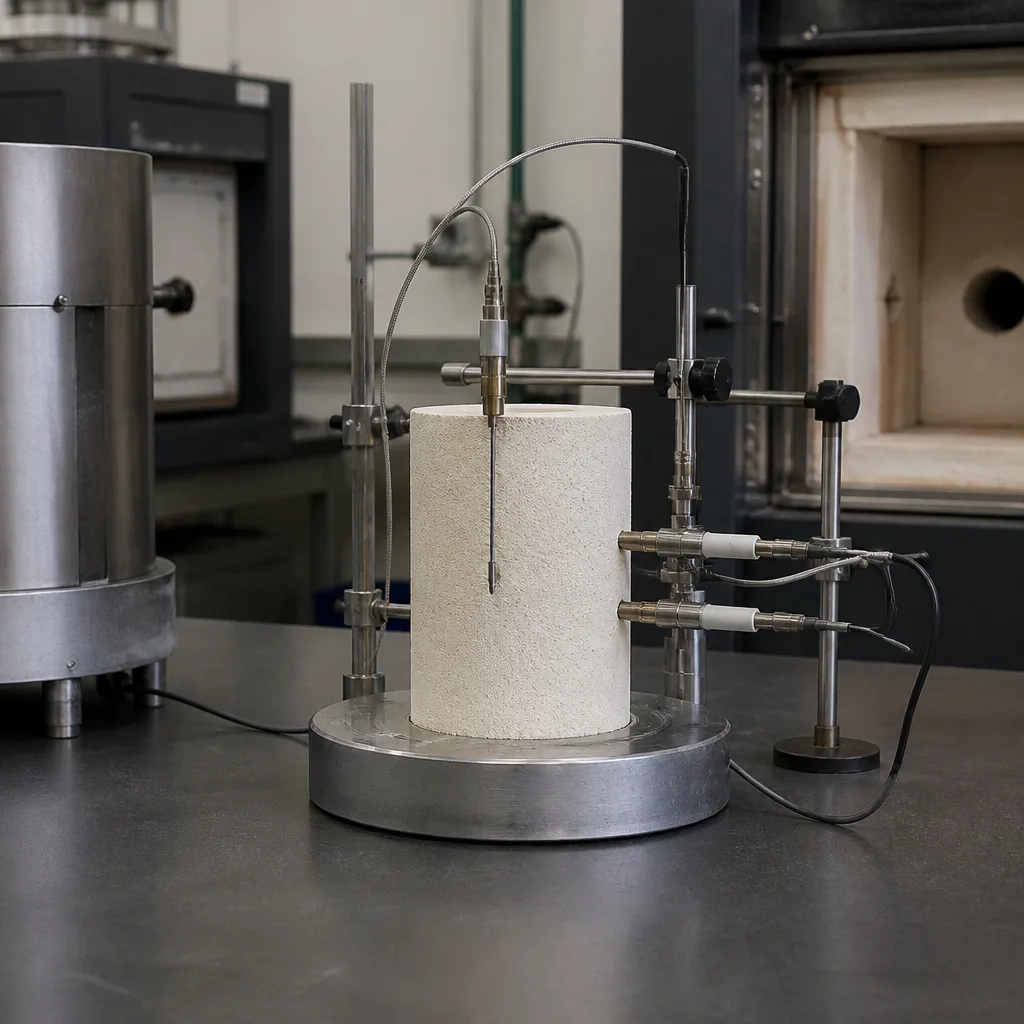
The ASTM C1113/C1113M standard, developed by the American Society for Testing and Materials (ASTM), describes a test method for determining the thermal conductivity of carbon-free, dielectric refractories.
Applicable refractories include refractory bricks, refractory casting materials, plastic refractories, compression mixes, powder materials, granular materials, and refractory fibers.
Thermal conductivity values can be specified from room temperature up to 1500 degrees, or up to the maximum service limit of the refractory or the temperature at which the refractory is no longer a dielectric.
This test method is valid for refractories with values lower than 15 W/m·K.
In general, accurate measurements of anisotropic materials, especially those containing fibers, are difficult, and the use of this test method for such materials should be agreed upon between the relevant parties.
The ASTM C1113/C1113M standard, a widely recognized international standard, provides a standardized procedure for measuring the thermal conductivity of carbon-free, dielectric refractories using the transient hot-wire method with a platinum resistance thermometer.
This standard applies to a wide range of refractory and insulation materials, including:
This standard is generally suitable for materials with thermal conductivity values below 15 W/m·K. Measurements can be taken from room temperature up to 1500 degrees or up to the maximum operating temperature of the material or the point at which it loses its dielectric properties. Unless the parties agree on its use, this standard is generally not ideal for highly anisotropic materials (e.g., those with oriented fibers).
The hot-wire technique is a transient, intermittent isothermal method (unlike steady-state methods such as water-cooled calorimetry approaches described in ASTM C201 or ASTM C182 standards).
The working principle is as follows:
This method allows for temperature measurements to be taken instead of averaging temperature values along large gradients.
Industries that rely heavily on high-temperature insulation and refractories use this standard extensively. These include:
Advanced testing laboratories offer standard-compliant testing services for product development, quality control, and material certification.
The ASTM C1113/C1113M standard is essential because it provides a standardized method for evaluating the thermal performance of liquid thermal insulation materials, particularly coatings or paints, that are marketed as energy-saving or heat-reducing products. More specifically, this standard helps with the following:
In short, the ASTM C1113/C1113M standard is important because it transforms thermal insulation performance from a marketing claim into measurable engineering data.
In conclusion, this testing method remains a critical tool for engineers and manufacturers working with high-temperature insulation, helping to optimize energy efficiency and thermal performance in challenging industrial environments.
For many years, our organization, with its competent and experienced team, has been understanding the needs of its clients, providing the advanced testing services they require, and assisting them in the establishment, implementation, and improvement of management systems. Within this framework, we also provide testing services in accordance with the ASTM C1113/C1113M standard.
To get an appointment, to get more detailed information or to request an evaluation, you can ask us to fill in our form and reach you.

