

The American Society for Testing and Materials (ASTM) standard "ASTM F1440-92 Standard Practice for Cyclic Fatigue Testing of Non-torsion Metal Stem Hip Arthroplasty Femoral Components" describes a method for fatigue testing of metal stemmed femoral components used in hip arthroplasty. The described method is intended to be used to evaluate the comparison of various designs and materials used for stemmed femoral components used in arthroplasty. This practice covers procedures for performing fatigue tests using a periodic constant amplitude force (as a strain function).
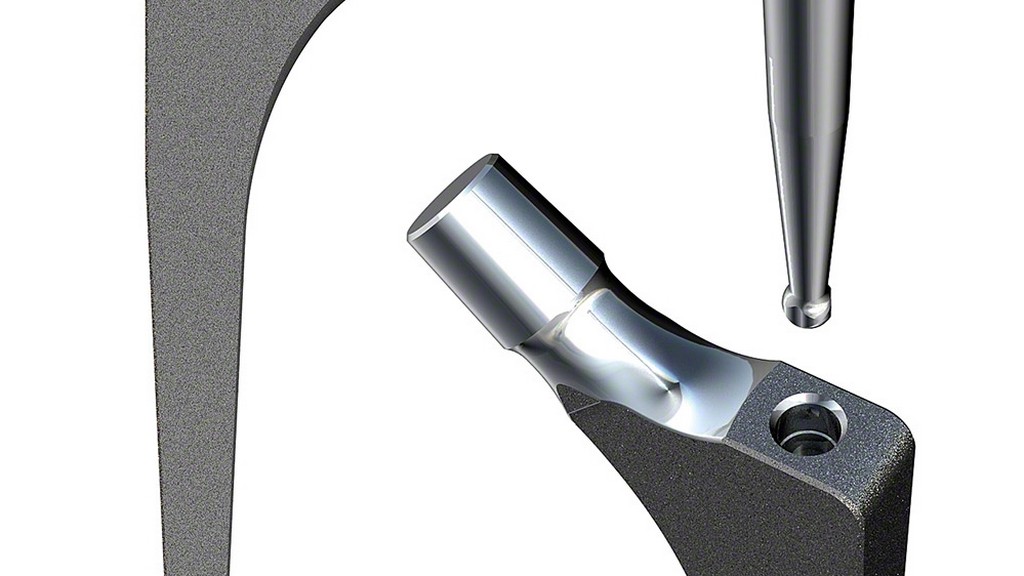
This test method is primarily applicable to one-piece prostheses and modular components. Prostheses should have no anterior/posterior arch and a nearly flat cross-section in the distal 50 mm of the stem. This application may require modifications to accommodate other femoral stem designs.
For the purposes of this standard, the following terms and definitions apply:
This application can be used to characterize the effects of materials, manufacturing, and design variables on the fatigue resistance of femoral components with metallic stems subjected to cyclic loading for a relatively large number of cycles. The proposed test assumes a worst-case situation where proximal support for the stem is lost. It is also recognized that for some materials the environment may have an effect on the response to cyclic loading. The test environment used and the rationale for its selection should be described in the report.
It is recognized that actual in vivo loading conditions are not constant amplitude. However, there is insufficient information to establish standard load spectra for femoral components with metallic stems. Accordingly, a simple periodic constant amplitude force is recommended.
For fatigue data on femoral stems to be useful for comparison, they must be reproducible between different laboratories. Consequently, the establishment of uniform procedures is essential.
The selected sample must have the same geometry as the final finished product and the handle must be in its final finished condition.
The specimen should be confined within a rigid cavity by a suitable grout. A common grout used is in situ polymerized poly methyl methacrylate (PMMA, bone cement). The minimum thickness of the grout should be 1 cm. Although bone cement is the recommended grout, other materials may be used provided they do not interact chemically or mechanically with the test specimen.
Test fixtures should be constructed so that the load application line is in the anterior/posterior symmetry plane of the supported portion of the stem. Test fixtures should be constructed so that the load application line passes through the ball center.
A low friction mechanism with ball or roller bearings should be incorporated into the loading apparatus to minimize loads that are not perpendicular to the cantilever plane. An example of such a mechanism is included in the standard appendix (Annex X1).
Among the numerous testing, measurement, analysis and evaluation studies that our organization has provided for businesses in various sectors, our organization also provides testing services defined in the standard “ASTM F1440-92 Standard practice for cyclic fatigue testing of non-torsion metal stem hip arthroplasty femoral components” with its trained and expert staff and advanced technological equipment.
To get an appointment, to get more detailed information or to request an evaluation, you can ask us to fill in our form and reach you.

