

The standard "ISO 9292 Manganese ores and concentrates - Determination of total iron content - 1,10-Phenanthroline spectrometric method" developed by the International Organization for Standardization (ISO) describes a spectrometric method for the determination of total iron content in manganese ores and concentrates using 1,10-phenanthroline. This method is applicable to products having total iron content between 0,1 percent (m/m) and 15 percent (m/m). This international standard should be considered together with the standard "ISO 4297 Manganese ores and concentrates - Methods of chemical analysis - General instructions".
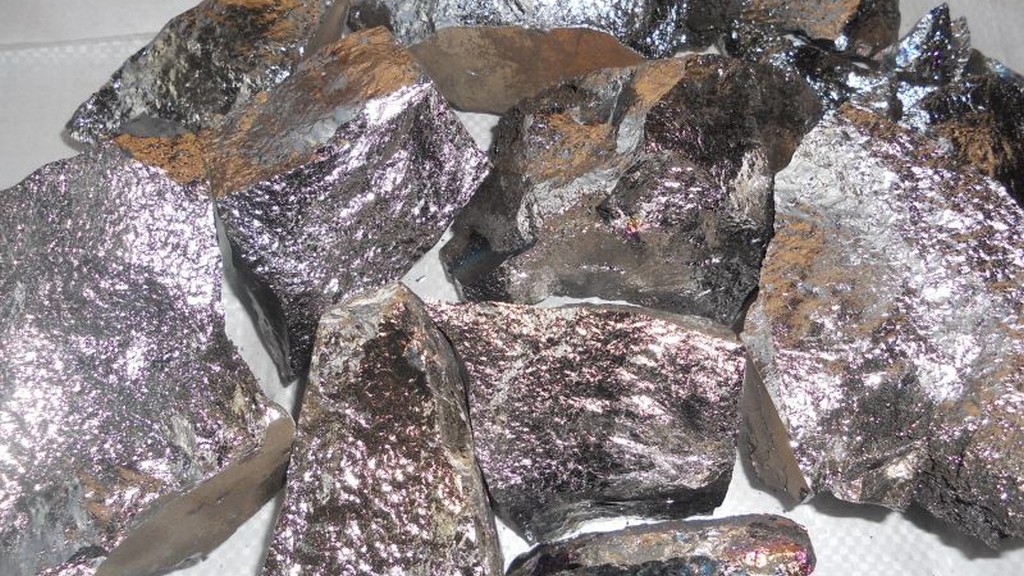
This testing method is based primarily on the following principles:
This method is based on the formation of a colored complex of iron with 1,10-phenanthroline (pH value 4-5) as a result of the reduction of iron (III) to iron with hydroxylammonium chloride.
In addition to ordinary laboratory equipment, the following equipment is used in these tests:
For analysis, a laboratory sample with a particle size of minus 4296 µm, taken in accordance with the ISO 1-4296 standard and prepared in accordance with the ISO 2-100 standard, is used.
The mass of the test sample selected from the table given in the standard is weighed several times according to the expected total iron content. In addition, a blank test is carried out in parallel with the samples under the same conditions.
To decompose the test piece, place the test piece in a 300 ml beaker, moisten with water, and add 30 ml of hydrochloric acid. The beaker is covered with a watch glass and slowly heated to decompose the sample. The watch glass is rinsed and the solution is diluted with warm water to about 50 ml.
The insoluble residue is filtered through a medium-textured filter paper with a small amount of pulp. The filter is washed with the residue 4 to 5 times with hot hydrochloric acid and 4 to 5 times with hot water. The filtrate and washings are collected in a 300 ml beaker and stored as the mother solution.
When processing the residue, the filter containing the residue is transferred to a platinum crucible, the paper and residue are dried and ignited at 500 degrees to 600 degrees. The crucible is allowed to cool, the residue is moistened with a few drops of water, 3 to 4 drops of sulfuric acid are added, then 5 ml to 6 ml of hydrofluoric acid are added and evaporated to dryness. The crucible is cooled, 2 g of potassium pyrosulfate or potassium hydrogen sulfate are added to the residue and melted at 600 degrees to 650 degrees until a clear melt is obtained. The crucible is allowed to cool, the melt is filtered in the mother liquor while heating, then the crucible is removed and rinsed with water. The solution is cooled and transferred to a 250 ml single-mark volumetric flask, diluted to the mark with water and mixed.
When preparing the solution for spectrometric measurement, for ores with an iron content of up to 0,8 percent, a 10 ml portion of the solution is taken, for ores with an iron content of more than 0,8 percent, a 5 ml portion of the solution is taken, transferred to a 100 ml single-mark volumetric flask and 50 ml of water is added. 5 ml of hydroxyl ammonium chloride solution is stirred, left for 5 minutes, then 10 ml of buffer solution and 10 ml of 1,10-phenanthroline solution are added. Stirred and left at room temperature for 1 hour or at 30 degrees for 15 minutes. The solution is cooled, diluted with water to the mark and mixed.
For spectrometric measurement, the absorbance of the test solution is measured using the spectrometer set to maximum absorbance (wavelength 508 nm to 512 nm) or the photo electro colorimeter (wavelength 480 nm to 520 nm) with a light filter attached as a reference against water.
Finally, the absorbance reading for the test solution is converted to total iron content by means of the calibration chart and the absorbance reading for the blank test is subtracted. The total iron content expressed as mass percent is calculated.
Among the numerous testing, measurement, analysis and evaluation studies that our organization has provided for businesses in various sectors, it also provides testing services defined in the “ISO 9292 Manganese ores and concentrates - Determination of total iron content - 1,10-Phenanthroline spectrometric method” standard with its trained and expert staff and advanced technological equipment.
To get an appointment, to get more detailed information or to request an evaluation, you can ask us to fill in our form and reach you.

