IS 1528-1 Determination of Pyrometric Cone Equivalent (PCE) or Softening Point for Refractory Materials
The standard “IS 1528-1 Methods of sampling and physical test for refractory materials - Part 1 Determination of pyrometric cone equivalent (PCE) or softening point” published by Bureau of Indian Standards (BIS) describes a procedure for determining the pyrometric cone equivalent (PCE) or softening point of refractory materials.
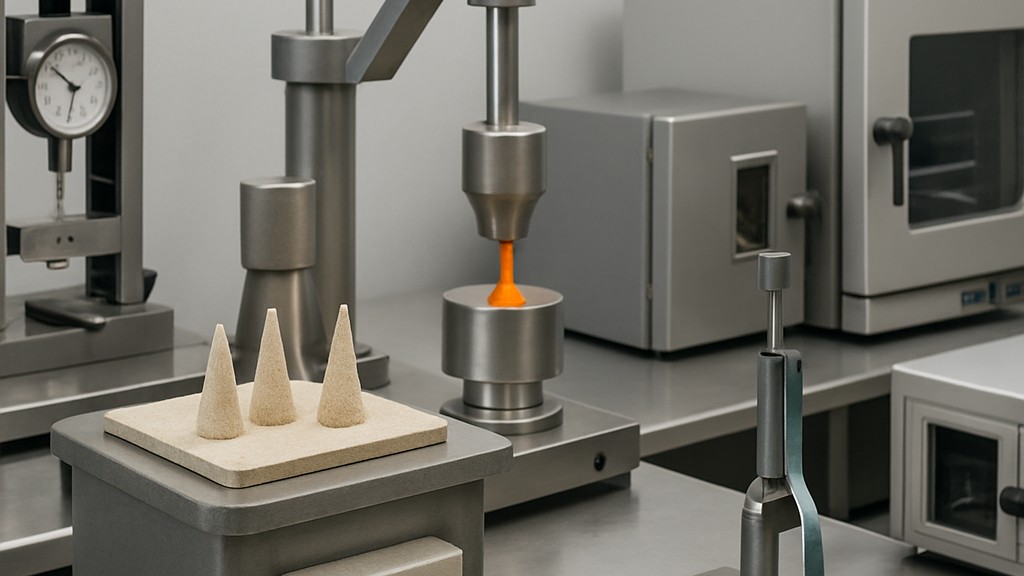
The purpose of the test method described is to determine the softening point of refractory materials by comparing test cones prepared from the refractory material under test with standard pyrometric cones. A furnace of a type capable of maintaining a neutral or oxidizing atmosphere should be used for these tests.
Test pieces prepared from raw materials that undergo significant changes during reheating must be stabilized by heating before their refractoriness can be determined. Clays, in particular, should be calcined at approximately 1000°C. After calcination, the test pieces must comply with the requirements of this standard.
- Baked shapes: 1 kg of material is taken. In the case of bricks or shapes, a composite sample is obtained from bricks or fragments of a series of test pieces taken for other tests, and these fragments are reduced in size by rollers or jaw crushers adjusted to pass pellets no larger than 5 mm in diameter. Precautions must be taken to prevent contamination of the sample with steel particles during crushing or grinding. The quantity is reduced by one-quarter at different stages of grinding, resulting in a test sample of approximately 50 g. The entire material is ground using a suitable grinder or agate mortar to pass through a 212-micron sieve. A magnet should be used to remove iron particles introduced during the grinding and crushing processes, but the materials themselves are magnetic. To prevent excessive reduction of fine particles, these are removed by frequently dropping the sample through the sieve during the reduction process, and the coarser particles are continued until the entire sample has passed through the sieve.
- Dry monolithic materials: Samples of unformed materials such as plastic refractories, compaction materials, and refractory cements should be shaped and fired in a manner appropriate to the material and conditions of use. The firing temperature should be stated in the test report.
For mortar, samples are prepared using dry monolithic materials, and any liquid components, if any, are added at the appropriate rate. In all cases, crushing and grinding must be performed to prevent the introduction of foreign matter. Careful mixing must be performed at each stage to ensure that the contents of the test pieces are truly representative of the samples.
The test cone is prepared as follows:
- Molding: The prepared sample is thoroughly mixed and after adding a sufficient amount of alkali-free dextrin or glue and water, test cones are placed in a tetrahedron-shaped metal mold, preferably made of brass, with a diameter of 8 mm on the sides of the base and a height of 25 mm.
- Sintering: While dry, if necessary, the test cones are pre-combusted at a temperature not exceeding 1000 degrees in order to sinter them to a hard condition that will permit handling.
The steps of the testing method are as follows:
- Test cones and standard pyrometric cones are mounted on a plate using a binder material, as shown in the table below, which shows the properties of typical standard cones used. Both the plate and the binder material should be of a composition that will not affect the fusibility of the cones.
- The cones are mounted with their bases embedded in the plate to a depth of approximately 3 mm, with one surface inclined toward the center of the plate and at an angle of 82 degrees to the horizontal. The test cones are placed around the outer edge of the plate, with standard cones spaced between them whenever possible.
- The test plate, containing the test pieces and the attached pyrometric reference cones, is placed in the uniform temperature zone of the furnace. Reducing conditions in the furnace must be avoided during heating. Care must be taken to prevent the flame from directly striking the cones or the cone plate. The furnace is checked periodically for uniform heat distribution.
- Over a period of 1,5 to 2 hours, the temperature of the furnace is raised to 200 degrees below the estimated refractoriness temperature of the test material.
- The temperature is increased at a rate of 2,5 degrees per minute or as specified by the cone manufacturer. Heating is maintained so that the deviation from the specified temperature rise curve is less than 10 degrees at any given time.
- The softening of the cone is indicated by the top bending and the tip of the cone touching the plate surface.
- The softening point is reported in terms of the standard pyrometric cone closest to the test cone in terms of softening time. If the test cone softens after one cone but before the next, approximately midway between the two, the softening point should be reported. If the test cone begins to bend at an early cone but does not bend downward at a later cone, this should be reported.
- The standard pyrometric cone equivalents of standard cones are included in the table titled “Reference temperature and cone definitions”.
The sampling procedure and conformity criteria should be as specified in the IS 1528-7 standard.
Our organization, which has been supporting businesses across all sectors for years through a wide range of testing, measurement, analysis, and evaluation activities, boasts a strong team of employees who closely follow global developments in science and technology and are constantly improving themselves. In this context, we also provide testing services in accordance with the "IS 1528-1 Sampling and Physical Test Methods for Refractory Materials - Part 1: Determination of Pyrometric Cone Equivalent (PCE) or Softening Point" standard.



