

The European standard "EN ISO 17872 Paints and varnishes - Guidelines for the application of scratch marks through coatings on metallic panels for corrosion testing," subsequently published by the International Organization for Standardization (ISO), describes methods for scratching coated steel or test pieces for corrosion tests where the coating system has been applied in dry film thicknesses of less than 500 μm. This standard is a guide only and is based on the results of a collaborative trial without any subsequent corrosion testing to determine the suitability of the scratch marks introduced for such tests.
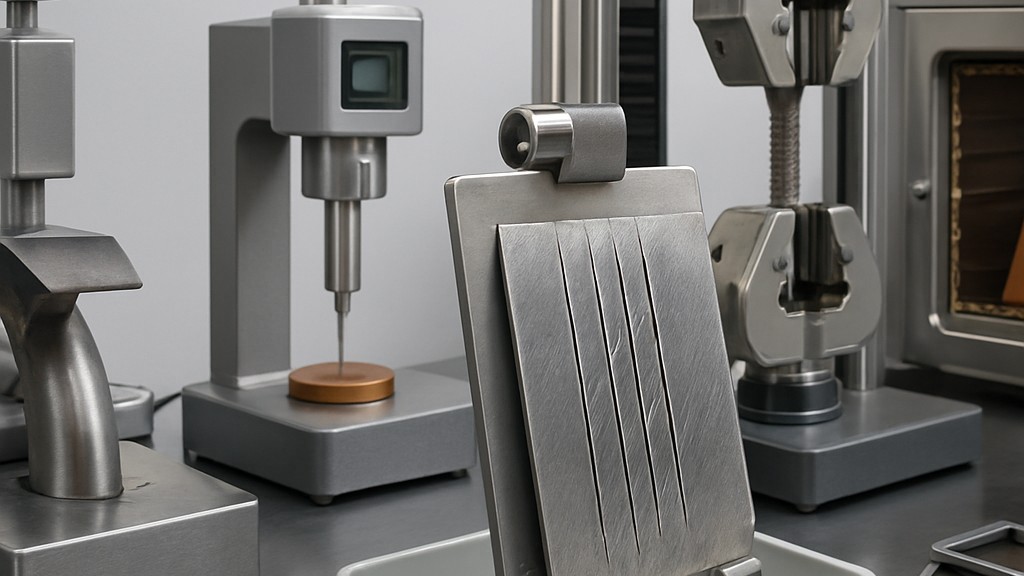
This standard covers the drawing of metallic panels or test pieces (whether or not chemically treated) made from the following materials:
This standard does not cover scratching of electroplated metal or coated aluminum panels.
Many international standards address corrosion tests where etching marks are deposited onto a metallic substrate through a coating. However, the method of etching (etching pattern, tools) is not standardized across these standards.
The main purposes of deliberately damaging a coating prior to corrosion testing are to:
Preliminary research has shown that a variety of scratch tools are used, both in shape and size. These differences are observed both between and within countries. The effect of using different tools is to create scratch marks with varying cross-sectional shapes, depths, and exposed metal areas. These differences significantly influence the test results obtained during corrosion tests, as the purpose of adding scratch marks to a coating system is to allow the oxygen and electrolyte present during the exposure test to reach a well-defined and active metal surface.
The exact method used to add the trace depends on the coating type and thickness. However, in all cases, it is preferable for the cross-section to be as smooth as possible, to expose the metallic substrate evenly, and to leave no coating on the exposed substrate.
The ISO 17872 standard specifies a procedure for deliberately introducing incised marks (cuts or scratches) through layers of paint or varnish applied to metal surfaces as part of corrosion test procedures. This standard applies to coated metallic test panels with a dry film thickness of less than 500 μm.
No subsequent corrosion tests were performed to verify whether the drawing marks performed reliably in such tests.
The latest update of this standard includes several improvements:
The ISO 17872 standard is important because it ensures that scratch-induced corrosion testing is consistent, repeatable, and scientifically valid. The key reasons for this standard's importance are:
A well-defined scratch simulates a realistic defect (e.g., scratch or crack) and allows manufacturers to observe how corrosion spreads through these weak points.
This standard ensures that corrosion testing procedures meet internationally accepted practices.
As a result, the ISO 17872 standard improves consistency and clarity in how scratch marks are applied in corrosion testing. By standardizing the method, from the shape of the scratch to the type of instrument used, it helps ensure more reliable and comparable corrosion testing across laboratories and industries.
Our organization, which has been operating for many years and meticulously follows global developments in science and technology, employs a team of experienced professionals and a broad infrastructure to conduct testing, measurement, and analysis in a wide range of areas for businesses across all sectors. In this context, we also provide testing services in accordance with EN ISO 17872 Paints and varnishes - Guidelines for the application of traces of drawing through coatings on metallic panels for corrosion testing.
To get an appointment, to get more detailed information or to request an evaluation, you can ask us to fill in our form and reach you.

