

Tear resistance testing is applied in the plastic film, paper and textile industries. Tear resistance is the measurement of a sample's ability to resist tearing. This test is significantly affected by the speed of the test. For acceptance testing purposes, tear propagation resistance is common in materials such as paper and rubber. Tear resistance in textiles includes the load required to propagate a single tear tongue type tear. The modulus of rupture is reported as N/mm2 or megapascal (MPA).
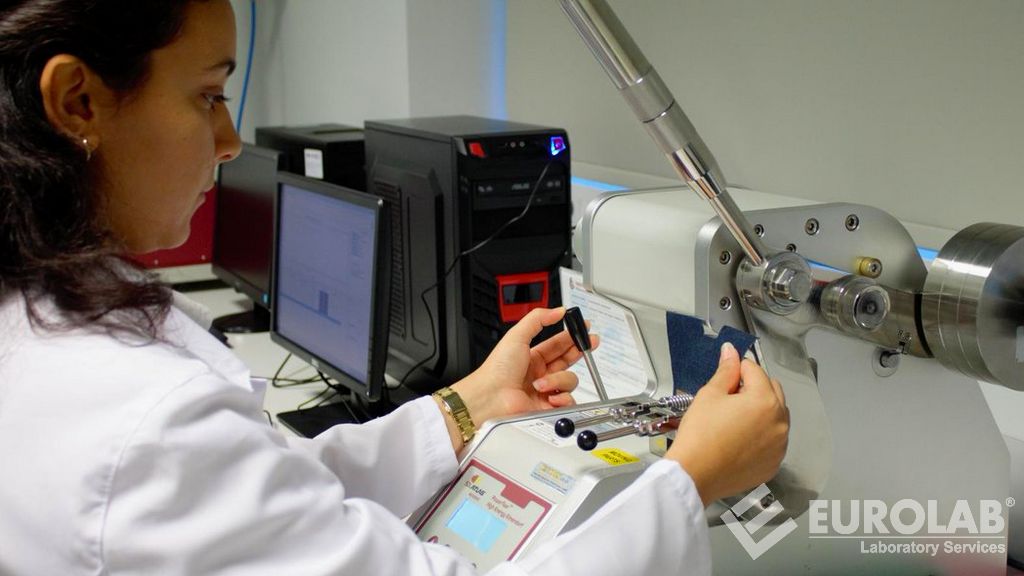
In general, the standard referenced in these tests is ASTM D1682 Standard test methods for breaking load and elongation of textile fabrics. In this standard developed by the American Society for Testing and Materials (ASTM), tear modulus is defined as the force required to initiate or continue tearing a fabric in the weft or warp direction under certain conditions. A tear in a fabric or garment usually occurs gradually along a line and can be initiated by catching a moving fabric against a sharp object.
This standard has been replaced by the following standards:
The test method described in the ASTM D5035-95 standard covers grip and modified grip test procedures for determining the breaking strength and elongation of most textile fabrics. While the grip test procedure can be applied to woven, nonwoven and felt fabrics, the modified grip test procedure is mainly used for woven fabrics. This test method is not recommended for glass fabrics or knit fabrics and other textile fabrics with high stretch (more than 11 percent).
The test method described in the ASTM D5035-95 standard covers slit strip and cut strip test procedures to determine the breaking force and elongation of most textile fabrics. Rolled strip test is applied to woven fabrics, cut strip test is applied to non-woven fabrics, felt fabrics and dipped or coated fabrics. This test method is not recommended for knit fabrics or other textile fabrics with high stretch (more than 11 percent).
Our organization also provides tear module testing services with its trained and expert staff and advanced technological equipment, among the numerous test, measurement, analysis and evaluation studies it provides for businesses in various sectors.
To get an appointment, to get more detailed information or to request an evaluation, you can ask us to fill in our form and reach you.

