

Stress corrosion cracking is cracking resulting from the combined effects of tensile stress and a corrosive environment. The effects of stress corrosion cracking on a material generally range from dry cracking to the fatigue threshold of that material. The tensile stresses required may be in the form of directly applied stresses or residual stresses.
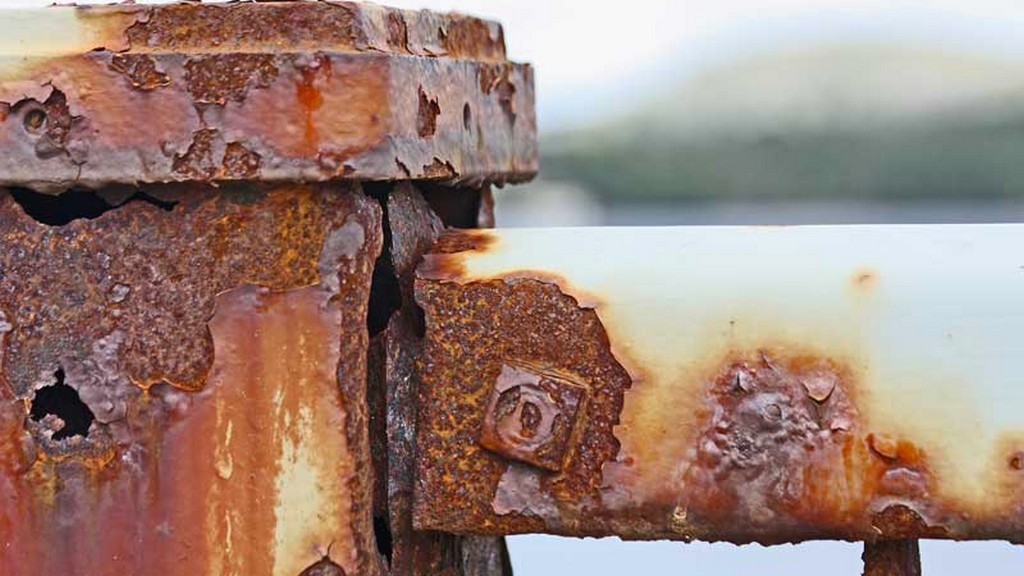
Cold working and forming, welding, heat treatment, machining and grinding can cause residual stresses. The magnitude and importance of such stresses are often underestimated. Residual stresses resulting from welding operations tend to approach the yield strength. Accumulation of corrosion products in confined areas can also produce significant stresses and should not be ignored. Stress corrosion cracking occurs most often in certain alloy-environment-stress combinations.
Usually, most of the surface remains unattacked, but there are fine cracks penetrating the material. In the microstructure, these cracks may have an intergranular morphology. Macroscopically, stress corrosion cracking fractures have a brittle appearance. Stress corrosion cracking is classified as an extremely nasty form of corrosion because such fine cracks can be very difficult to detect and the damage is not easily predicted.
Essentially, stress corrosion cracking is a slowly progressive cracking mechanism that affects metals and other materials under sustained tensile stress (applied or residual) in corrosive environments (aqueous or gaseous).
Stress corrosion cracking is characterized by subcritical crack propagation due to the combined simultaneous interaction of mechanical stress and environmental exposure. None of these factors, independently or in combination, result in stress corrosion cracking, but they may result in other types of material deterioration.
There are many forms of stress corrosion cracking that commonly affect pressure equipment in the oil refining, petrochemical and other heavy processing industries. These include, but are not limited to:
The damage morphologies of these different forms of stress corrosion cracking are very similar in nature, yet their propensity to develop in pressure equipment depends on many specific manufacturing and process operating variables, including material properties and chemistry, welding procedures, weld geometry, weld bed and heat-affected zone hardness/microstructure, original heat treatment, external environmental conditions, process stream composition, pH, temperature, operating stress level, and proximity to local stress concentrations.
As a result, equipment failures due to stress corrosion cracking continue to impact numerous industries.
The stress corrosion cracking test is designed to evaluate the susceptibility of metallic materials to cracking damage under the combined effects of tensile strength and corrosion in solutions containing hydrogen sulfide at elevated temperatures. This test is usually performed in accordance with the NACE TM0177 standard and requires a corrosion-resistant vessel, devices for measuring the temperature and pressure of the acid solution, a capacitor and other accessories.
The standard “NACE TM0177-2016 Laboratory testing of metals for resistance to sulfide stress cracking and stress corrosion cracking in H2S environments” developed by the National Association of Corrosion Engineers (NACE) describes a procedure for testing metals subjected to tensile stresses for resistance to cracking failure in low pH aqueous environments containing hydrogen sulfide (H2S). Under this standard, carbon and low alloy steels are generally tested for erosion-corrosion resistance at room temperature, where stress corrosion cracking susceptibility is typically high. For other alloy types, the correlation of erosion-corrosion susceptibility to temperature is more complex.
This standard describes the reagents, test samples and equipment to be used, discusses basic material and test sample properties and specifies the test procedures to be followed. This standard describes four test methods:
Among the numerous testing, measurement, analysis and evaluation studies carried out for businesses in various sectors, our organization also provides stress corrosion cracking testing services with its trained and expert staff and advanced technological equipment.
To get an appointment, to get more detailed information or to request an evaluation, you can ask us to fill in our form and reach you.

