

The standard “EN ISO 8510 Adhesives - Peel test for a flexible-adhesive-rigid test specimen assembly”, which is based on a European standard and later published by the International Organization for Standardization (ISO), consists of a number of subsections published under the same title. Namely,
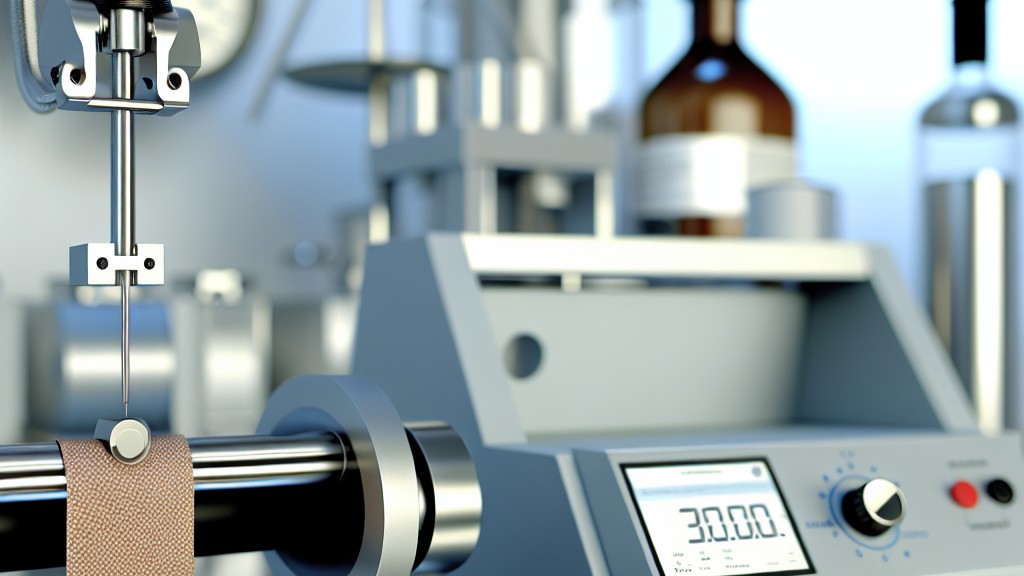
The 90 degree peel test is particularly suitable for less flexible bonded parts where the 180 degree peel test is not suitable because the bonded parts crack, break or delaminate.
When performing the test, a bonded assembly of two adhesives is prepared using the adhesive under test. The adhesives are then pulled at an essentially constant rate, starting at the open end of the bond, such that separation occurs gradually along the length of the bonded adhesives. The force is applied approximately perpendicular to the plane of the bond through the separated portion of the flexible adhesive.
The tensile testing machine (incorporating a roller peel device if a fixed peel angle of exactly 90 degrees is required) is capable of providing a tensile force with a fixed grip separation ratio. The machine is equipped with a force measuring system complete with a display and a recorder. The indicated force shall not differ by more than 2 percent from the actual applied force. The response time of the machine shall be short enough not to affect the accuracy with which the applied force at break can be measured. The force of the specimen at break shall be between 10 percent and 80 percent of the full-scale reading.
As shown in the figure given in the standard, two grips are used, one suitable for holding the rigid adhesive firmly and the other suitable for holding the flexible adhesive. The second grip should be self-aligning so that the force is applied perpendicular to the plane of the bond and should be connected to the sensor of the tensile testing machine by a wire at least 600 mm long.
The tensile testing machine capable of providing tensile force with a fixed grip separation ratio used in the tests shall be equipped with a force measuring system complete with an indicator and a recording device. The indicated force shall not differ by more than 2 percent from the actual applied force. The response time of the machine shall be short enough not to affect the accuracy with which the applied force at break can be measured. The force of the specimen at break shall be between 10 percent and 80 percent of the full-scale reading.
Two types of grips are used. One must be suitable for firmly clamping the rigid adhesive so that the plane of the bond is parallel to the applied force, and the other must be suitable for holding the flexible adhesive. The second grip must be self-aligning so that the force is applied parallel to the plane of the applied force.
The materials to be bonded must be thick enough to withstand the expected tensile force and their dimensions must be accurately measured and fully reported in the test report. The recommended thicknesses of test specimens are: metals 1,5 mm, plastics 1,5 mm, wood 3 mm, composite rubbers 2 mm. Other thicknesses agreed upon between the purchaser and supplier of the adhesive may be used. The hard adhesive shall consist of a flat strip of material with a width of 25,0 mm plus/minus 0,5 mm and a length of at least 200 mm.
The flexible adhesive shall be capable of being bent through 180 degrees without major irreversible dimensional change. Unless otherwise specified, the length of the flexible adhesive shall not be less than 350 mm. The width shall be either: the same width as the rigid adhesive or, for materials prone to wear, e.g. cotton duck, 5 mm wider on each edge.
Flexible adhesives can cause difficulties in mounting the test specimen and may lead to greater dispersion of the results than would otherwise be the case due to distortion or wear of the mesh during mounting and testing. The use of a flexible adhesive that is 5 mm wider than the rigid adhesive on each side is designed to reduce these effects.
At least 5 samples are tested.
Our organization, which has been trying to support businesses from every sector with its testing, measurement, analysis and evaluation studies carried out in a wide range for years, has a strong staff that closely follows the developments in the world in the field of science and technology and constantly improves itself. In this context, testing services in accordance with the "EN ISO 8510 Adhesives - Peel test for a flexible-adhesive-rigid test sample assembly" standard are also provided to businesses.
To get an appointment, to get more detailed information or to request an evaluation, you can ask us to fill in our form and reach you.

