

The standard "ASTM E2714-13 Standard test method for creep fatigue testing" developed by the American Society for Testing and Materials (ASTM) describes a test method for determining mechanical properties related to creep-fatigue deformation or crack formation in nominally homogeneous materials by the use of test specimens subjected to uniaxial forces under isothermal conditions. This standard covers fatigue testing with cycles that include strain rates or holding times long enough to account for cyclic deformation response and with cycles of crack formation affected by creep (and oxidation).
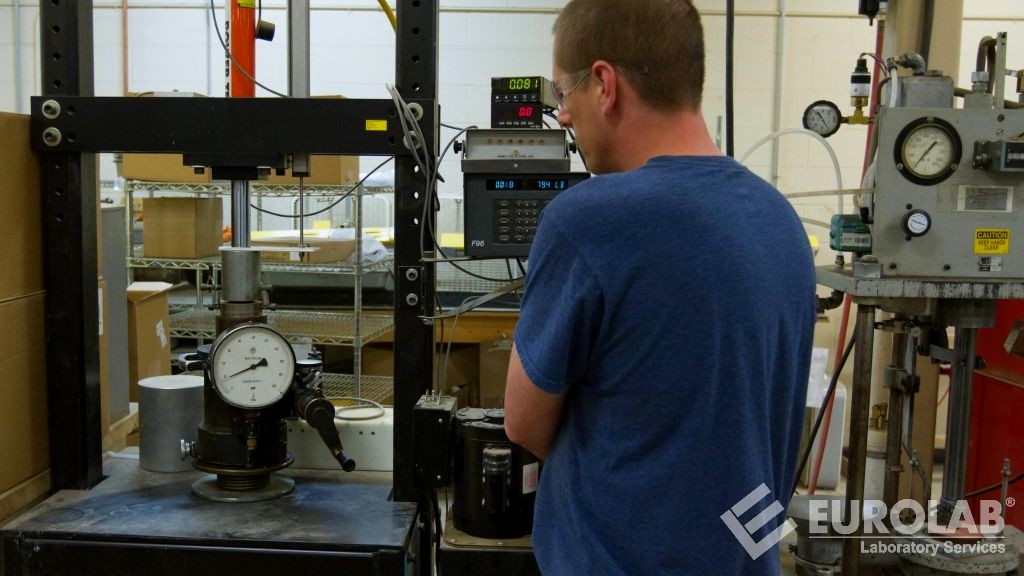
This method is designed as a test method for fatigue testing to support activities such as materials research and development, mechanical design, process and quality control, product performance and failure analysis. The cyclic conditions responsible for creep-fatigue deformation and cracking vary with material and temperature for a given material.
The use of this test method is limited to samples and does not extend to testing of full-scale components, structures, or consumer products.
This test method is intended to provide the material properties required for the evaluation of defect-free engineering structures containing features that are subjected to cyclic loading at temperatures high enough to cause creep deformation.
This test method is applicable to the determination of deformation and crack formation or nucleation characteristics as a result of constant amplitude strain controlled tests or constant amplitude force controlled tests. It is primarily concerned with the testing of round bar test specimens subjected to uniaxial loading under force or strain control.
The focus of the procedure is on tests in which creep and fatigue deformation and damage are produced simultaneously within a given cycle. It does not cover block cycle tests in which creep and fatigue damage are produced sequentially. Data that can be determined from creep-fatigue tests performed under conditions in which creep-fatigue deformation and damage are produced simultaneously include:
A crack is believed to have formed when it nucleates and propagates in an initially uncracked specimen to a specified size detectable by a specified technique. For the purpose of this standard, the formation of a crack is evidenced by a measurable increase in compliance of the specimen or a size detectable by a potential reduction technique.
This test method is valid for temperatures and stress rates at which the magnitudes of the time-dependent inelastic stresses (creep) are of the same order of magnitude as or greater than the time-dependent inelastic stress.
The term inelastic is used here to refer to all inelastic stresses. The term plastic is used here to refer only to the non-time dependent (i.e. non-creep) component of the inelastic stress. When the stress ratio exceeds a value, a useful engineering estimate of the time independent stress can be obtained.
For the purposes of this standard, the following terms and definitions apply:
Creep fatigue testing is usually performed at elevated temperatures and involves the sequential or simultaneous application of loading conditions necessary to produce cyclic deformation/damage amplified by creep deformation/damage, or vice versa.
Unless such tests are performed in a vacuum or inert environment, oxidation may also be responsible for significant interaction effects related to damage accumulation. The objectives of creep fatigue tests are to determine:
Among the numerous testing, measurement, analysis and evaluation studies that our organization has carried out for businesses in various sectors, it also provides testing services defined in the "ASTM E2714-13 Standard test method for creep fatigue testing" standard with its trained and expert staff and advanced technological equipment.
To get an appointment, to get more detailed information or to request an evaluation, you can ask us to fill in our form and reach you.

