

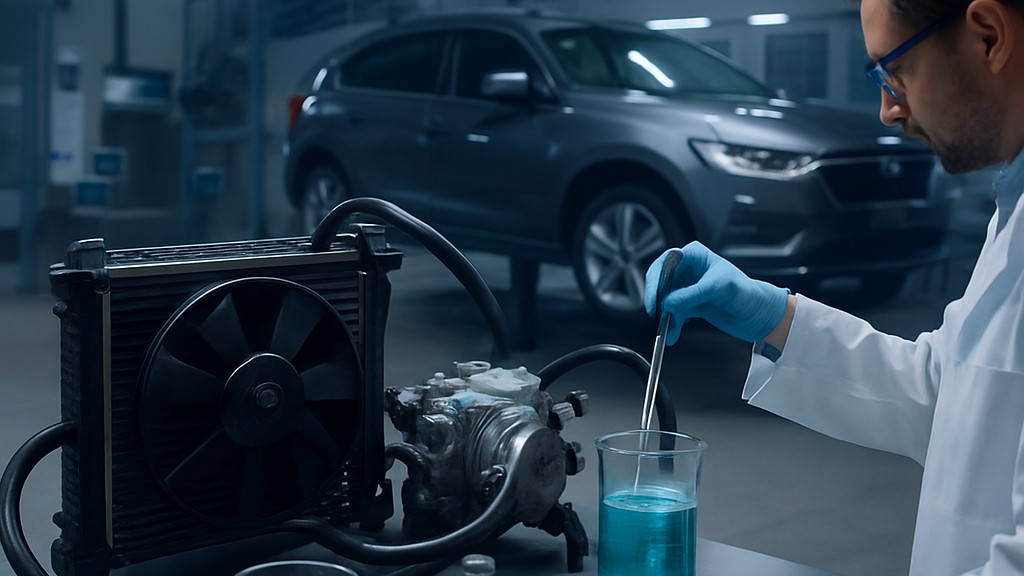
The freezing point of an engine coolant indicates the coolant's freeze resistance. The freezing point of an engine coolant can be used to determine the approximate glycol or glycerin content, provided the glycol type is known.
The ASTM D1177 standard is widely used in the automotive, industrial, and aerospace sectors to ensure the reliability and safety of cooling systems in cold weather. The purpose of the method described is to accurately measure the temperature at which a coolant mixture begins to freeze. This property is critical for preventing engine and radiator damage in cold climates. Knowing the freezing point helps determine the correct coolant formulation that will provide adequate freeze protection for specific environments.
The ASTM D1177 standard test method applies to:
The main areas of use of this standard are:
This test method involves cooling a sample of a coolant-water mixture under controlled laboratory conditions. The sample is continuously stirred as the temperature decreases. The freezing point is determined by determining the equilibrium temperature at which ice crystals begin to form and the temperature stabilizes (a plateau) during cooling.
Typical apparatus used in these tests are:
When performing a test, a known volume of coolant mixture is placed in a test vessel. The vessel is placed in a cooling bath. The sample is stirred to ensure a uniform temperature distribution. The temperature is recorded as it decreases. When the freezing point is reached, a plateau in the temperature curve indicates the equilibrium freezing point. The temperature at this plateau is reported as the result.
However, this test does not account for long-term coolant degradation or contamination. Accuracy may vary slightly depending on equipment calibration and sample preparation. This is a laboratory method and may not always perfectly simulate field conditions.
The ASTM D1177 standard is essential because it provides a reliable and consistent method for determining the freezing point of engine coolants, which is critical for a variety of technical, safety, and economic reasons. This standard is considered important for the following reasons:
The ASTM D1177 standard ensures that coolant has the correct freeze protection for specific climatic conditions.
Without a standard method, test results will vary, making quality assurance unreliable.
This standard is also used in the research and development phase to optimize coolant formulations.
As a result, the ASTM D1177 standard plays a vital role in the quality control and safety assurance of engine coolants. By accurately determining the freezing point of coolant solutions, manufacturers and service providers can ensure reliable engine operation, even in extreme cold conditions. This standard helps protect vehicles, improve product performance, and reduce the risk of costly cold weather failures.
Our organization, which has been serving for many years and meticulously following global developments in science and technology, conducts testing, measurement, and analysis in a wide range of areas for businesses in every sector with a skilled team and extensive infrastructure. In this context, we also provide testing services in accordance with the "ASTM D1177 Standard Test Method for the Freezing Point of Aqueous Engine Coolants."
To get an appointment, to get more detailed information or to request an evaluation, you can ask us to fill in our form and reach you.

