

DIN 55662 Paints and varnishes - Coatings for the automotive industry - Testing of resistance to pressurized water jets, developed by the German Institute for Standardization (DIN), describes a procedure for determining the resistance of coatings to pressurized water jets. This procedure simulates the effects that pressurized water jetting would have on a coating.
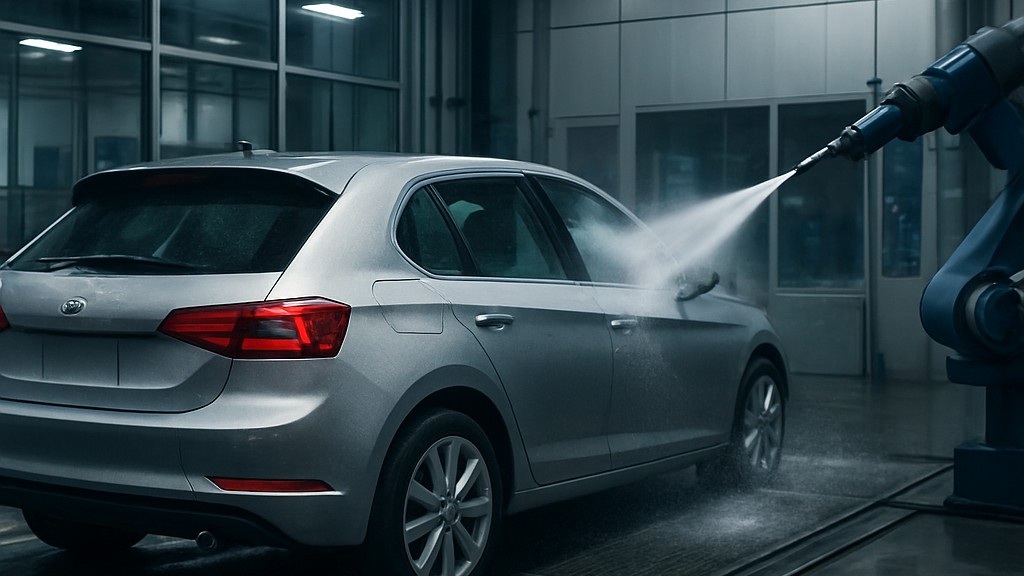
Waterjet has become the most preferred method in the automotive industry, as in many other manufacturing sectors. Resistance to pressurized water jets is an important concept in fields such as civil engineering, coatings, materials science, and cleaning technology. There is no single value for average waterjet pressure due to variations in various variables.
Pressure water jet testing is a type of adhesion test for coatings. For this purpose, samples are scratched and then exposed to a high-pressure water jet with defined parameters. The maximum detachment of the coating from the scratched surface or a characteristic damage value determined by comparative images is presented.
Water jetting, also known as high-pressure water blasting, is a technique widely used in industrial cleaning, surface preparation, and material processing. While this technique is effective at removing dirt, coatings, and corrosion, not all surfaces or materials can withstand the mechanical and abrasive forces of high-pressure water. The term "water jet resistance" refers to a material's ability to withstand these forces without significant deterioration, abrasion, or loss of integrity.
Water jetting involves using water pressurized to between 10.000 and 40.000 bar and sprayed at high speeds through nozzles. At these pressures, the water acts almost like a cutting tool, stripping coatings, removing contaminants, and even cutting metals and concrete.
The main factors affecting resistance are:
Testing for resistance to high-pressure water jets generally involves standard protocols. One of the standards widely used in the automotive industry is DIN 556662, which defines methods for assessing the resistance of coating systems to high-pressure water jets.
Typical test parameters include:
Applications requiring high resistance include:
Recent advances in nanotechnology, hybrid coatings, and high-performance polymers have improved resistance to pressurized water jets. Coatings containing embedded ceramic particles or flexible polymers demonstrate improved adhesion and durability, making them more suitable for such environments.
Consequently, resistance to pressurized water jets is a key performance parameter for materials and coatings used in harsh industrial and infrastructure environments. Understanding the interaction between jet parameters and material properties is crucial for designing surfaces and systems that can withstand the rigors of high-pressure water exposure. As technology advances, more robust, jet-resistant coatings and substrates are being developed.
The DIN 55662 standard defines a standardized test method that simulates real-world cleaning or environmental exposure to assess how well organic coatings, particularly those on automotive parts, resist damage from high-pressure water jets or steam explosions. This standard is specifically designed for coatings, such as paint systems, on plastic or metal parts used in the automotive sector.
These tests use a water jet (or steam jet) device with controlled parameters such as:
Before starting the tests, the sample surface is prepared and exposed to a specific pressurized water or steam jet under controlled conditions. The test method aims to simulate the effects of a pressurized water jet on a coating. The degree of delamination in a scratch immediately after exposure to the pressurized water jet is evaluated or measured. The resistance of a coated sample to adhesion loss is tested using a specific pressurized water jet. In addition to adhesion strength, the extent of damage to the sample depends primarily on the nozzle-to-sample distance, flow rate, test duration, nozzle geometry, impact area, impact angle, water temperature of the test jet, and the cutting or scoring tool. The assessment is based on visual comparison with images, assigning characteristic values to delaminated areas.
The DIN 55662 standard was critical in ensuring that coatings used on vehicles and components could withstand cleaning processes and environmental stress without premature delamination or failure. It provides automotive manufacturers, coating designers, and testing laboratories with information that provides a repeatable way to verify coating durability.
This standard was later replaced by the standard “DIN EN ISO 16925 Paints and varnishes - Determination of resistance of coatings to pressurized water jet”.
For years, our organization has been supporting businesses from all sectors with a wide range of testing, measurement, analysis, and evaluation studies. We have a strong team of employees who closely follow global developments in science and technology and continuously improve themselves. Within this framework, we also provide testing services in accordance with the " DIN 55662 Paints and varnishes - Coatings for the automotive industry - Resistance to pressurized water jet testing " standard.
To get an appointment, to get more detailed information or to request an evaluation, you can ask us to fill in our form and reach you.

