

BMW PR 060 PUR Foam Seat Cover Lifespan Behavior Test
Developed by BMW, a multinational vehicle manufacturer, the “BMW PR 060 Lifetime Behavior Test of Seat Covers Made from PUR Foam” standard focuses on evaluating the long-term durability and performance of seat covers containing or used with polyurethane (PUR/PU) foam materials. These materials are widely used in automotive seats to provide cushioning, comfort, and support in seat covers, backrests, and headrests.
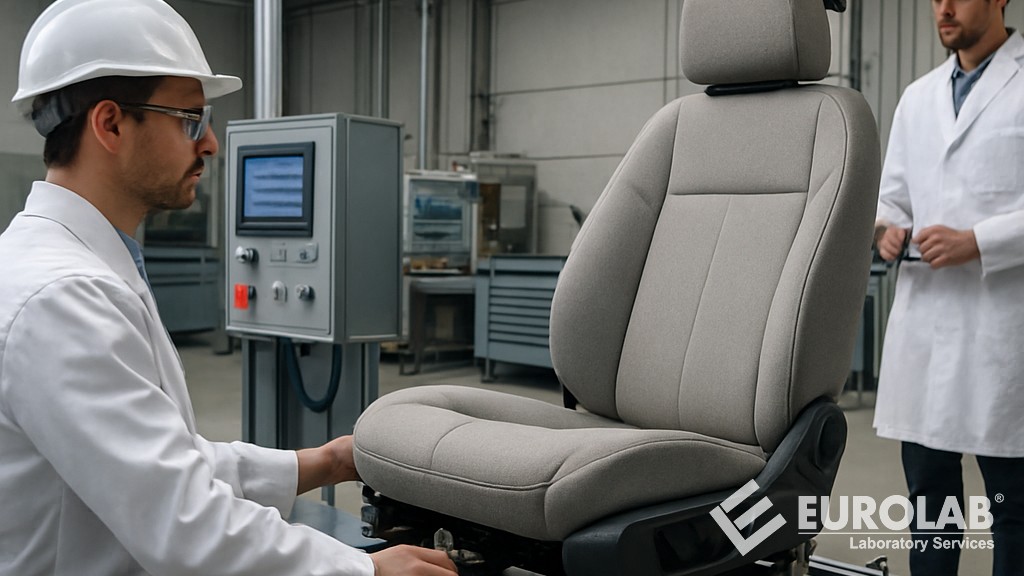
The primary purpose of this standard is to simulate real-world use over a long vehicle lifespan and to evaluate how well seat cover systems (including the outer upholstery fabric/leather and the underlying PUR foam layers) withstand repeated mechanical stress, environmental factors, and aging. Service life behavior refers to the following characteristics:
- Resistance to permanent deformation (e.g., compressive permanent deformation)
- Maintaining flexibility and support.
- Preventing excessive wear, cracking, or foam degradation.
- Maintaining seating comfort and structural integrity.
The PUR foam in the seats is prone to fatigue due to constant compression (sitting, entering, exiting), temperature fluctuations, humidity, and cyclical loading. BMW, like other original equipment manufacturers, requires suppliers to verify materials against strict criteria to ensure the seats meet superior quality expectations for the 10-15 year vehicle lifespan.
BMW and industry-specific durability tests for PUR foam seat components typically include:
- Cyclic compression/cylinder fatigue testing: A drum or cylinder is subjected to repeated pressure to simulate years of use (e.g., simulating 100.000–500.000 passenger load cycles).
- Compression permanent deformation measurement: The return of the foam to its original state after prolonged compression under heat and humidity (e.g., ISO 815 standard or methods adapted to BMW).
- Aging simulations: Exposure to heat, UV, humidity, or thermal cycling (linked to BMW PR 303 or similar climate tests).
- Track/indentation resistance: Checking for persistent tracks or loss of support (relevant to BMW 3.2.10 track behavior tests).
- Combined loading: Tests can integrate vibration, temperature, and mechanical stress.
These comply with broader BMW requirements for PUR foam soft components in seats (for example, referenced in the relevant technical specifications in standards such as BMW QV 52009 or BMW QS 52009 for the quality of PUR foam in seat supports, backrests and headrests).
BMW prioritizes high durability and comfort in its interiors. PUR foam provides excellent cushioning, but if not properly formulated, it can degrade over time. Failures can lead to sagging seats, reduced support, or discomfort. These issues affect the perceived quality in premium vehicles. Tests like the BMW PR 060 help ensure that materials from suppliers meet BMW's rigorous standards before being integrated into the models.
Comparable industry standards include:
- ASTM D3574 Standard test methods for flexible cellular materials - Sheet, bonded and molded urethane foams.
- ASTM D575 Standard test methods for rubber properties under compression.
- Various SAE or original equipment manufacturer-specific protocols for foam fatigue.
This test reflects BMW’s commitment to long-term material reliability in an area critical to passenger experience.
The BMW PR 060 standard is considered important for BMW in high-end automotive production for the following reasons:
- Ensuring long-term durability and perceived quality: BMW vehicles are positioned as high-end products with high expectations regarding longevity (typically 10-15 years or 200.000 km of use). The seat covers and the underlying PUR (polyurethane) foam layers are subjected to constant mechanical stress from passengers getting in and out of the vehicle, prolonged sitting, and dynamic driving conditions. Without rigorous lifecycle testing,
- Foam can undergo permanent compression deformation (sagging or collapsing), leading to reduced support and comfort.
- Seat covers (fabric, leather, or synthetic) may show signs of excessive wear, cracking, wrinkling, or separation of the foam.
- This situation rapidly degrades the superior quality of the interior design, negatively impacting customer satisfaction, resale value, and brand reputation.
This standard simulates accelerated real-world aging and loading to verify that materials maintain their performance throughout the vehicle's lifespan and to prevent premature complaints or warranty claims related to seat sagging or discomfort.
- Maintaining passenger comfort and ergonomics: PUR foam was chosen for its excellent elasticity, vibration damping, and pressure distribution. This contributes to the superior long-distance comfort that is a hallmark of BMW seats. The test evaluates how well the foam upholstery system protects:
- Flexibility (rebound after compression)
- Support features
- Shape retention under repeated cyclic loading.
Poor performance here directly impacts the driving experience by leading to fatigue, poor posture support, or hot spots during driving.
- Supporting safety and structural integrity: Seats are critical safety components (e.g., they must maintain their shape to function in conjunction with airbags and seatbelts in collisions). Degraded foam can alter seat geometry, reduce energy absorption, or compromise headrest/side support effectiveness. This standard ensures that seats remain structurally sound over time and comply with broader safety and homologation requirements by testing their lifecycle behavior.
- Supplier quality control and cost efficiency: BMW outsources the majority of its seat production to first-tier suppliers. This standard provides a standardized, repeatable method for qualifying materials and assemblies before full vehicle integration. Passing this test,
- It reduces the risk of costly recalls or field repairs for seat-related problems.
- It helps control warranty costs (complaints about seat comfort are common in premium segments).
- It ensures consistent quality among global suppliers.
This is particularly important given the widespread use of PUR foam (over 90% market share in automotive seats) and its formulation, density, stiffness, and sensitivity to environmental factors such as heat and humidity.
For many years, our organization, with its competent and experienced staff, has been understanding the needs of its clients, providing the advanced testing services they require, and assisting in the establishment, implementation, and improvement of management systems. Within this framework, we also provide testing services to businesses in accordance with the "BMW PR 060 PUR foam seat cover lifespan behavior test" standard.

