

The standard “SAE J2725 Highway vehicles - Friction materials - Elastic property measurements,” developed by the American Society of Automotive Engineers (SAE), describes a method for testing and measuring elastic constants in friction materials by precise ultrasonic velocity measurements.
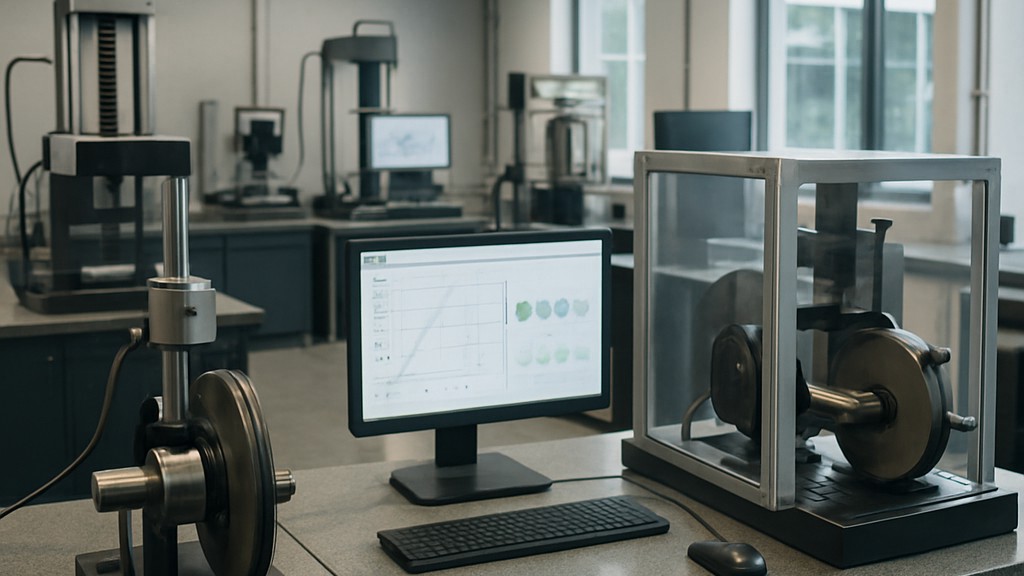
Elastic properties in automotive friction materials refer to the mechanical properties that describe how these materials deform under stress and return to their original shape when the stress is relieved. These properties are critical to brake pads, coatings, and related components because they affect braking performance, noise, vibration, and durability.
In the high-stakes world of automotive braking systems, where performance in fractions of a second can mean the difference between safety and disaster, the materials behind the friction—brake pads, linings, and rotors—must be perfectly engineered. These components endure extreme pressures, temperatures, and vibrations, requiring not only durability but also precise flexibility to ensure consistent stopping power and minimal noise. This is where SAE J2725 comes in. This specialized standard offers a cutting-edge method for measuring the elastic properties of friction materials using ultrasonic velocity techniques.
This standard has become indispensable for brake engineers today, who are trying to characterize how these materials deform under stress. As vehicles become heavier with electrification and autonomy, and sustainability drives the use of advanced composites, this standard offers a non-destructive and highly accurate way to predict long-term performance.
SAE J2725 standard includes a precise test protocol for determining the elastic constants of friction materials. This standard addresses the anisotropic nature of brake pads and linings, which typically vary in their in-plane (parallel to the friction surface) and out-of-plane (perpendicular to the friction surface) stiffness.
Elastic constants such as Young's modulus, shear modulus, and Poisson's ratio are critical for modeling brake behavior, from fading resistance on downhill slopes to vibration damping that silences squealing. This standard uses ultrasonic waves to measure velocity within the material and converts velocity data into hardness measurements without damaging the sample. This distinguishes it from traditional mechanical testing and offers superior sensitivity for thin, heterogeneous friction composites.
This standard covers production-grade friction materials for disc and drum brakes in passenger cars, trucks, and other vehicles. It is particularly valuable for validating new formulations, such as carbon-ceramic hybrids in performance vehicles or environmentally friendly, low-copper pads mandated by regulations.
The SAE J2725 standard methodology is based on ultrasonic principles, which use high-frequency sound waves (typically 2-5 MHz) to measure material hardness. While the process is elegant in its simplicity, it requires precision instrumentation, making it accessible to well-equipped laboratories.
The basic steps in measuring elastic properties are:
Results include estimates of uncertainty with acceptance based on repeatability (e.g., less than 2 percent change across five runs).
This standard mandates calibration against reference blocks and environmental recordings, ensuring traceability. Safety emphasizes acoustic protection to protect hearing from high-decibel impacts.
The SAE J2725 standard for friction materials enables safer and more environmentally friendly braking and reduces stopping distances by up to 5 percent through better material compatibility. It reduces development costs by minimizing physical prototypes, aligning with digital twin paradigms, and supports warranties by predicting 100.000-mile durability. In a carbon-neutral future where bio-based resins replace phenolics, this standard is expected to play a key role in measuring thermoelastic stability.
Ultimately, the SAE J2725 standard transforms the invisible elasticity of brake materials into actionable information, ensuring that every pedal stroke creates a sense of confidence on the road. This standard is an indispensable toolkit for brake engineers and a quiet assurance of control for drivers. As vehicles evolve towards smarter and more sustainable mobility, this standard continues to evolve.
Our organization, which has been operating for many years and meticulously follows global developments in science and technology, conducts testing, measurement, and analysis in a wide range of areas for businesses across all sectors with a skilled team and extensive infrastructure. In this context, we also provide testing services in accordance with the "SAE J2725 Road Vehicles - Friction Materials - Elastic Property Measurements" standard.
To get an appointment, to get more detailed information or to request an evaluation, you can ask us to fill in our form and reach you.

