

Developed by Jaguar, a British multinational automotive company, the “Jaguar STJLR.51.5254 Performance requirements for painted underbody and service parts” standard applies to all Jaguar Land Rover vehicles, including painted chassis, engine bays, underbody, components (assemblies), and service parts such as BIW panels. It does not apply to visible BIW components or cosmetic parts requiring resistance to continuous exposure to ultraviolet (UV) light. BIW refers to welded sheet metal components that form the structure of the vehicle and to which other components will be joined or mounted.
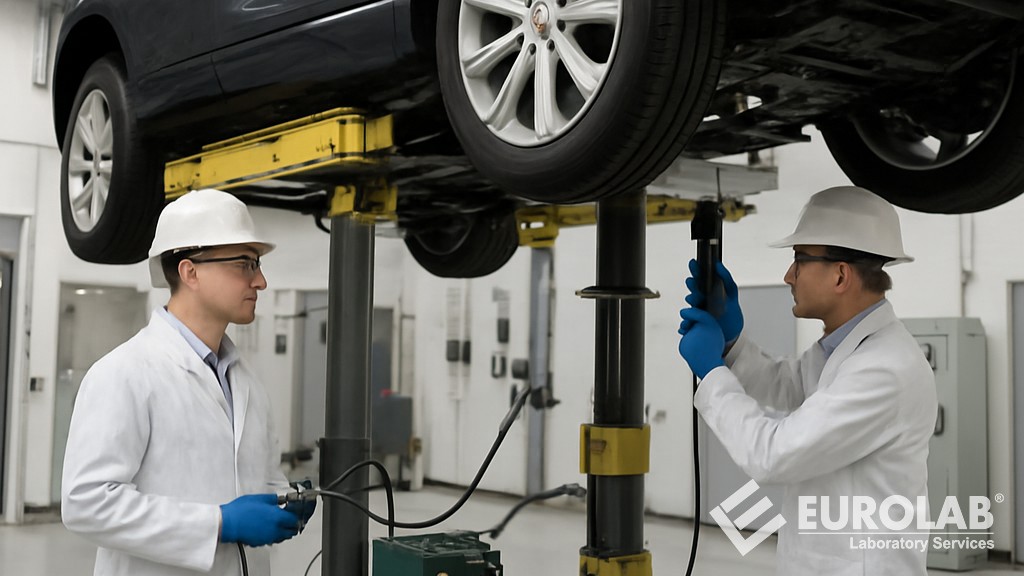
The purpose of this standard is to define the test requirements and acceptance criteria for painted surfaces used on Jaguar Land Rover underbody components, assemblies, and replacement service parts. The requirements in this standard replace the now-expired requirements given in the STJLR.51.5249, STJLR.51.5250, and STJLR.51.5251 standards for extreme, harsh, and moderate environments, respectively.
This standard is required to be reviewed every three years from the date of its last review or update.
The general requirements in the Jaguar STJLR.51.5254 standard are defined as follows:
Components must be specified by referencing this standard and then adding a Type A or Type B designation defining the operating temperature. Other specific requirements, such as color and gloss (if any), must also be stated. Any deviation from this engineering standard must be fully recorded in the relevant engineering permit. STJLR.51.5254 Type B refers to a painted component exposed to operating temperatures below 130 degrees.
The test program and acceptance criteria for painted components are detailed in the tables provided within the standard. It is recommended that at least three samples be prepared for each test requirement listed in these tables.
In the risky world of luxury automotive engineering, where each component must withstand the rigors of global roads—from the salty winters of some regions to scorching deserts—standards are not just a guide, but a lifesaver. Jaguar Land Rover’s (JLR) engineering standard STJLR.51.5254, which sets the benchmark for painted underbody and service parts, is a procedure that ensures the undercarriages of iconic Jaguar Land Rover vehicles withstand extreme conditions without faltering.
Jaguar Land Rover has always prioritized durability. However, as vehicle complexity increased with aluminum-intensive architectures and advanced driver assistance systems, the need for unified performance criteria grew even stronger. Previous standards, such as STJLR.51.5249, STJLR.51.5250, and STJLR.51.5251, each addressing subsets of corrosion and adhesion, became fragmented, leading to inconsistencies in supplier deliveries and field failures. In such an environment, the STJLR.51.5254 standard emerged as a powerhouse, incorporating its predecessors and expanding its scope to include service parts. This standard is designed to align with the company's broader materials strategy, as defined in the accompanying “STJLR.51.5226 Standard requirements for manufacturing materials” standard. At its core, it addresses a simple but true reality: underbody components are not glamorous, but the unsung heroes who battle gravel, saltwater, and extreme temperatures on a daily basis.
The Jaguar STJLR.51.5254 standard is a masterclass in automotive specificity. It categorizes environments into three levels:
This standard also requires specific testing regimes. It explains to suppliers and manufacturers what is to be achieved, as well as how to achieve it, with cross-references to global standards such as SAE J400 for stone impact resistance and DIN ISO EN 2409 for adhesion.
The mechanical, corrosion, and chemical resistance tests included in the annex to the standard form the basis of the standard (Annex A):
Accept conditions:
The aim of the tests is to ensure that the coatings adhere stably, warding off impacts and moisture that could cause rust.
Accept conditions:
The aim of the tests: To simulate real-world de-icing salt and humidity cycles critical for the lower body and to ensure longevity.
Accept conditions:
The purpose of the tests: To provide protection against spills of gasoline, oil, and cleaner accumulating in engine compartments.
Accept conditions:
The aim of the tests: To ensure compatibility with Jaguar Land Rover's service temperature profiles, from Arctic cold to desert ovens.
For many years, our organization, with its competent and experienced staff, has been understanding the needs of its customers, providing the advanced testing services they require, and assisting in the establishment, implementation, and improvement of management systems. Within this framework, we also provide testing services to businesses in accordance with the "Jaguar STJLR.51.5254 Performance requirements for painted underbody and service parts" standard.
To get an appointment, to get more detailed information or to request an evaluation, you can ask us to fill in our form and reach you.

