

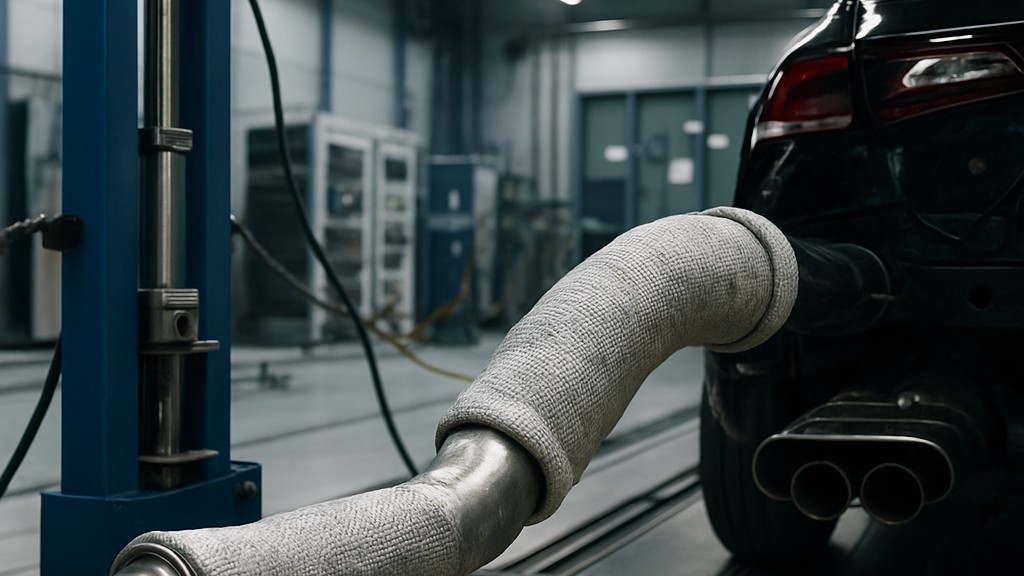
The standard "GMW 15608 Heat-Resistant Jacket," developed by General Motors, specifies the requirements for different types of thermally insulating and reflective jacket materials to protect various components from radiant heat sources. Products complying with this standard are categorized into various material types. Products must consist of a textile-based substrate, a metal foil substrate, or any combination of the two permanently bonded substrates. The material composite must be suitable for use in applications found throughout the vehicle, but primarily in the engine compartment. Depending on the structure of the lamination layers, the types can be used as reflective or insulating thermal jackets.
Material structures conforming to this standard are defined by type and class. The type defines the composition of the protective sheath, and the class defines the ambient temperatures to be withstood for 72 hours. As defined in the table provided in the standard, the excursion temperatures correspond to the temperature classes and are as follows:
Sheathing material construction types meeting higher temperature ratings can also be used for lower temperature applications. The applicable temperature ratings are based on the values in the table. The layers must be mechanically or chemically bonded to prevent separation throughout the life of the sheathing.
Material types should be selected based on the application. Applicable product details, such as material thickness, are specified in the relevant product drawings.
Continuous and cruising temperature limits are defined in the vehicle technical specifications. For all types of hoses, the cold resistance test is defined at minus 40 degrees.
Thermally insulating and reflective jacketing materials used in vehicles are typically used to protect wiring harnesses, hoses, and other components from high-temperature exposure in automotive environments. This standard outlines performance criteria such as thermal resistance, flammability, and durability. Products tested to this standard have demonstrated their suitability for high-temperature applications by undergoing long-term aging tests at elevated temperatures.
Additionally, GMW 15608 standard compliance is often included alongside other industry standards, demonstrating its role within a broader framework of material performance requirements.
Heat-resistant sleeving is a type of protective tubing used to insulate wires, cables, hoses, and other components from high temperatures. It is typically used in automotive, aerospace, industrial, and electronics applications where components are exposed to heat sources such as engines, exhaust systems, or industrial machinery.
Its basic features are as follows:
Common areas of use for heat-resistant covers are:
For automotive applications, thermally resistant sheathing plays an important role in protecting critical components from high temperatures under the hood or near exhaust systems. For example,
Reflective sheathing (e.g., aluminum laminate) is typically used near exhaust manifolds or turbochargers. If the sheathing may come into contact with moving parts or sharp edges, an abrasion-resistant sheath is used. The appropriate diameter is provided to ensure a tight fit but not restrict movement or bend radius.
Popular types of thermal sleeves for automotive use include:
Our organization, which has been supporting businesses across all sectors for years through a wide range of testing, measurement, analysis, and evaluation activities, has a strong team of employees who closely follow global developments in science and technology and are constantly improving themselves. In this context, we also provide testing services to businesses in accordance with the "GMW 15608 Heat-Resistant Sheath" standard.
To get an appointment, to get more detailed information or to request an evaluation, you can ask us to fill in our form and reach you.

