

The ISO 11452-4 standard published by the International Standards Organization (ISO) describes hardware excitation test methods for determining the immunity of electronic components of passenger cars and commercial vehicles, regardless of the propulsion system (e.g. spark ignition engine, diesel engine or electric motor). The full name of this standard is: ISO 11452-4 Road vehicles - Component test methods for electrical disturbances due to narrowband radiated electromagnetic energy - Part 4: Equipment excitation methods.
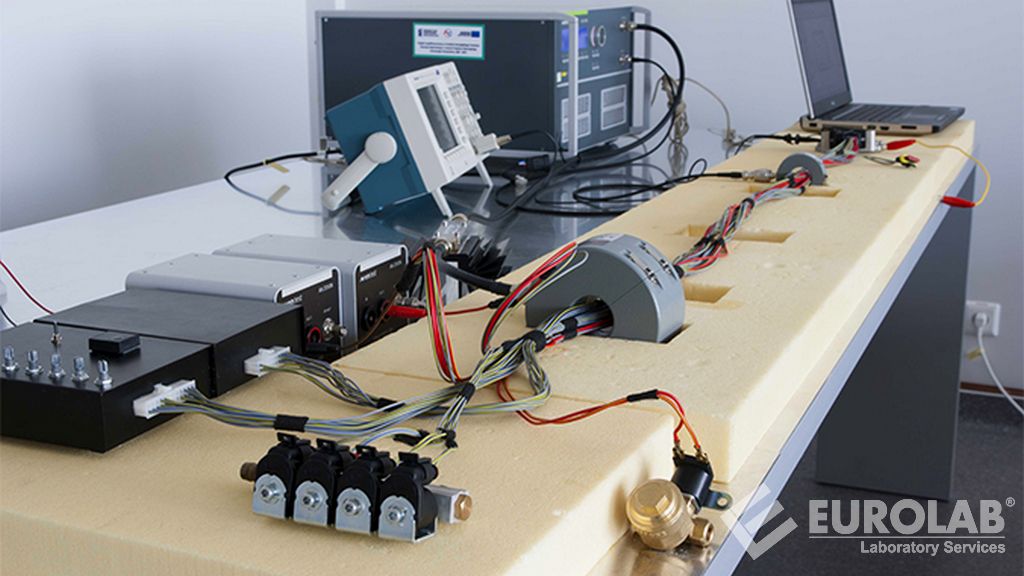
The bulk current injection (BCI) test method is based on the injection of current into the harness using a current probe as a transformer, where the harness forms the secondary winding. The tubular wave coupler test method is based on a wave coupling to the wire harness, using the directional coupler principle. This test method was developed for immunity testing of automotive components to radiated disturbances in the GHz ranges. This method is best suited for the small wavelength and shielded device under test, since in these cases the predominant connection mechanism is via the harness. The electromagnetic disturbances covered in this standard are limited to continuous narrowband electromagnetic fields.
Briefly, the bulk current injection test is performed by injecting forward power (recorded during the calibration procedure) into the current probe clamped on the harness connected to the equipment under test. The forward power is gradually increased until the level used in the calibration is reached.
The collective current injection test helps to detect a faulty or incorrectly set protection circuit or device, thus preventing damage to the system. With the help of current injection tests, the correct operation of the protective device or circuit is ensured.
Bulk current injection testing is a continuous radio frequency immunity test designed to ensure both compatibility and product reliability when exposed to electromagnetic interference disturbances transmitted via an injection probe. This immunity test is typically performed in commercial, military, and automotive applications with varying test levels, frequencies, and requirements.
Our organization also provides bulk current injection (BCI) testing services with its trained and expert staff and advanced technological equipment, among the numerous test, measurement, analysis and evaluation studies it provides for businesses in various sectors.
To get an appointment, to get more detailed information or to request an evaluation, you can ask us to fill in our form and reach you.

