

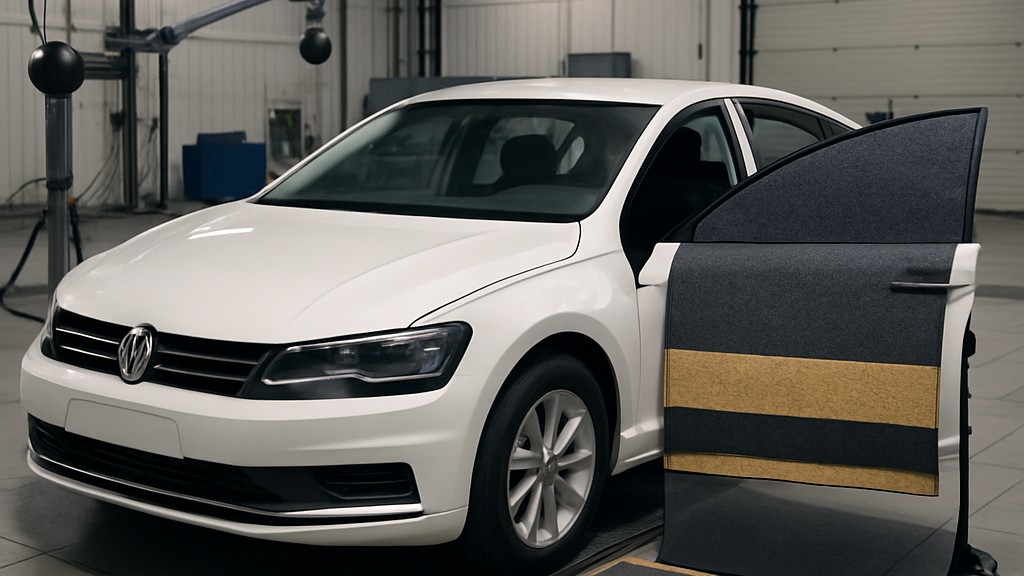
The basic requirements in this standard are determined as follows:
The quality of the parts was determined as follows:
Tests must be initiated no earlier than 72 hours after production. Prior to testing, samples must be conditioned for at least 24 hours at a temperature of 23°C and a standard atmosphere of 50% oxygen, in accordance with VW 50554.
When evaluating the measurement results, the required numerical values apply to each measurement on film and foam parts or components separated from sandwich systems.
Material requirements and requirements regarding part properties are detailed in the tables provided in the standard.
When determining the gross density of polyurethane foam, all sampling locations must be agreed with the supplier and documented on the drawing.
When determining compressive stress, the specimen size is 80 mm x 80 mm, and the specimen thickness depends on the part, but is at least 20 mm. For sandwich structures, the thickness of the incompressible EPDM coating is subtracted from the specimen thickness (EPDM rubber is a type of polymer material produced by the copolymerization of propylene and unsaturated diene). The test speed is 50 mm/min. The compression is 40 percent. The specimen height is determined under a preload (1,2 N) (preload is not reset). The presentation of the results should conform to the example in the table.
Tensile strength and elongation (sound-absorbing film or polyurethane foam) are tested according to DIN 53504. The travel speed is 100 mm/min. All sampling locations must be documented on the drawing.
When performing the post-heat aging odor test procedure, the sample is used after the heat aging process is complete (one sample each held at 90°C for 96 hours and one at 400 hours). The sample is removed from the drying oven and, while still warm, is assessed for odor by at least three people from a distance of 10 to 20 cm. The sample is then stored at 23°C plus/minus 2°C and the odor is re-evaluated after 20 minutes. Compared to the initial condition, there should be no perceptible, offensive odor. An objective odor assessment should not be adversely affected by the internal climate or ambient conditions (e.g., odors emanating from other areas or the test chamber) within the test area.
The ball drop test is performed without a wooden base. The surface facing the vehicle's interior is tested.
In the mold resistance test, a section of a 100 mm x 100 mm sample is sprayed with distilled water on both sides using an atomizer nozzle and allowed to absorb 10 cm3 of water. The sample is then rolled up and placed in a screw-capped jar. The jar must be sterile (rinsing with methylated spirit and evaporation may be necessary). Careful attention must be paid to cleanliness during sample preparation. Sample contamination must be avoided. The closed jar is stored at 23°C (+/- 2°C) and opened every seven days for sample evaluation. Appropriate protective measures must be taken when opening screw-capped glass. Inhalation of spores must be avoided. Additional contamination must be avoided when evaluating the sample. Evaluation is performed visually. Mold growth must be avoided.
The VW TL 52628 standard is particularly important in the context of vehicle and mechanical engineering, particularly in sectors such as automotive, rail, and aviation, where noise reduction is critical. This standard is considered important for the following reasons:
In summary, the VW TL 52628 standard defines performance criteria for acoustic linings, helps control in-car sound levels for comfort and safety, ensures quality, consistency and supplier compatibility, and facilitates lightweight and environmentally friendly construction.
Our organization, which has been operating for many years and meticulously follows global developments in science and technology, employs a skilled team and extensive infrastructure to conduct testing, measurement, and analysis in a wide range of areas for businesses across all sectors. In this context, we also provide testing services in accordance with the standard "VW TL 52628: Acoustically Effective Sound Insulation Coverings for the Passenger Compartment as Sandwich Composites - Material and Part Requirements."
To get an appointment, to get more detailed information or to request an evaluation, you can ask us to fill in our form and reach you.

