

Vehicles must apply for various crash scenarios and meet certain safety criteria to be approved within the EU and in many other countries around the world. Here, the measurement data and image and video material are recorded and analyzed.
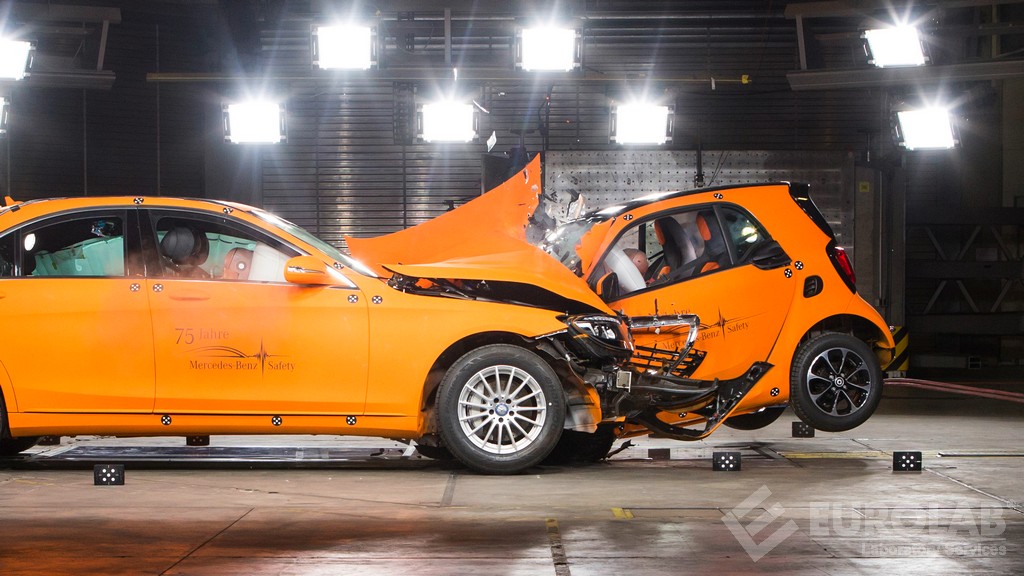
Accredited EUROLAB At our Crash Test Centre, we offer type testing services according to all globally applicable crash standards. In the overview in the table below you can see which standard tests are carried out in our Crash Test Centre.
| DESCRIPTION | Test Description |
| Frontal collision against deformable barriers (ECE-R 94, FMVSS 208 and similar) | Frontal impact, 40% coverage, 0 ° impact angle, deformation element |
| Frontal collision against rigid barriers (FMVSS 208 and similar) | Frontal impact, 100% protection, 0 ° to 30 ° impact angle, rigid, non-deformable barrier |
| Frontal collision according to RCAR | Frontal impact, 40% coverage, 10 ° impact angle, rigid barrier, impact speed 15 km / h |
| Rear collision according to RCAR | Rear impact, 40% coverage, impact angle 10 °, moving barrier, impact speed 15 km / h |
| Mobile barrier side collision (ECE-R95, FMVSS 214, IIHS and similar) | Side impact, 100% coverage, 0 ° impact angle, movable, deformable barrier |
| RCAR buffer test | Front or rear impact, 100% coverage, 0 ° impact angle, impact speed 10 km / h |
| Polar effect (indoor) (FMVSS 214 and similar) | Mast impact, 100% coverage, impact angle adjusted to customer demand, collision speed up to 60 km / h |
| Static rollover in accordance with FMVSS 301 | Tipping, rotation around the x-axis, the vehicle is fixed on a tipping test bench and rolled twice, purpose: to determine the tank tightness |
| Rollover according to FMVSS 208 | Tipping, turning around the x axis, vehicle on sleds, launch angle 23 °, launch speed 48 km / h |
EUROLAB, with its highly expert team and internationally accredited laboratories, Standard Crash Tests It performs all test, analysis, measurement, evaluation and report generation services completely and reliably.
To get an appointment, to get more detailed information or to request an evaluation, you can ask us to fill in our form and reach you.

