

The “BMW AA 0129 Corrosion tests in simulated environments - Salt spray tests (copper chloride-acetic acid salt spray test, CASS test)” standard, developed by BMW, a multinational vehicle manufacturer, describes procedures for the copper accelerated acetic acid salt spray (CASS) test, a highly aggressive accelerated corrosion test specifically designed to simulate challenging environmental conditions that vehicle parts may encounter, such as road salt, moisture, and contaminants. This standard specifies the copper accelerated acetic acid salt spray (CASS) test, a modified version of the internationally accepted ISO 9227 CASS method. This test is typically applied to painted, coated, or plated parts (such as exterior trim, equipment, or underbody components) to simulate aggressive corrosive environments and ensure durability under real-world conditions such as road salt exposure.
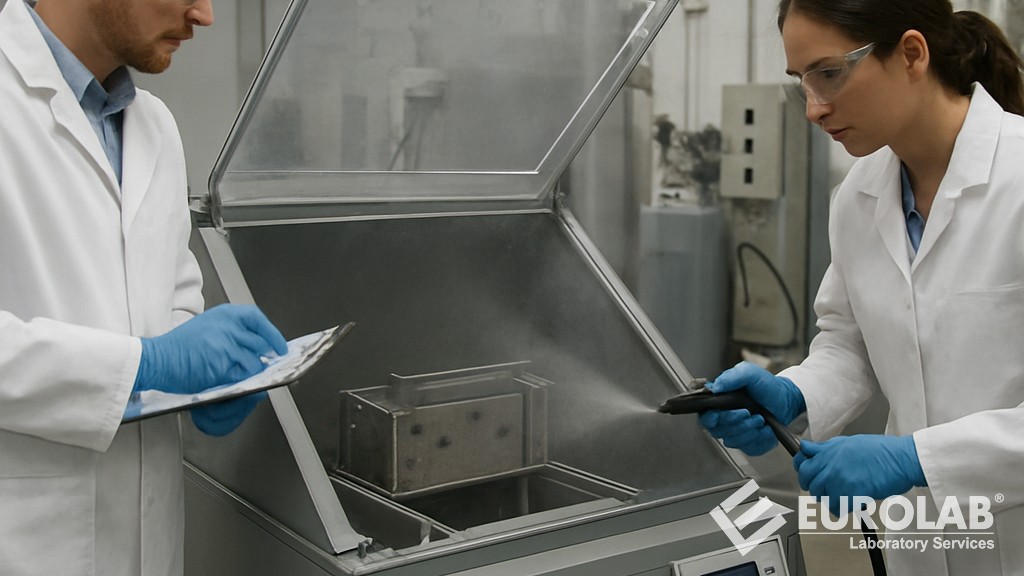
The CASS test is a variant of the traditional salt spray test, but is more severe due to the addition of copper chloride, which accelerates corrosion. It is commonly used in the automotive industry to evaluate protective coatings (e.g., paints, plating, galvanizing) on metal parts such as fasteners, brackets, body panels, and underbody components.
The test solution composition is a mixture of sodium chloride and copper(II) chloride dihydrate, adjusted to a pH of 3,1–3,3 (acetic acid is used for acidification). The sample is subjected to continuous spraying in a controlled chamber at a high temperature (typically around 50 degrees). The duration varies depending on the component requirements, but multiple cycles are usually applied (e.g., 48–96 hours or longer). Evaluation is then performed. This test is more aggressive than neutral salt spray or acetic acid salt spray tests because copper ions catalyze corrosion, making it ideal for testing high-performance coatings in demanding applications.
The CASS test accelerates corrosion to assess how well surfaces can withstand an acidic, copper chloride-enriched salt spray. The addition of copper ions and acetic acid makes it more severe than standard neutral salt spray tests, causing faster pitting and blistering in coatings. BMW uses this standard to qualify supplier vehicle parts to ensure long-term reliability and prevent issues such as rust or paint failure.
BMW requires suppliers to meet stringent durability standards for vehicles exposed to various climates, including winter road salting. The BMW AA 0129 standard helps ensure this:
This standard generally applies to the following:
The evaluation typically involves visual inspection for rust, blistering, or delamination and is usually graded according to BMW's internal scoring systems.
The CASS test, under the BMW AA 0129 standard, provides faster results for coated metals under real-world conditions and shows a good correlation with field performance.
The applications of this standard in the automotive industry are as follows:
The main reasons why this standard is considered important are as follows:
In conclusion, the BMW AA 0129 standard is vital for BMW to proactively ensure that components withstand extreme abrasive stresses, preserving performance, customer satisfaction, and long-term vehicle value. This standard is a crucial part of automotive material verification and is commonly used by manufacturers for coated or painted metals.
For many years, our organization, with its competent and experienced team, has been understanding the needs of its clients, providing the advanced testing services they require, and assisting them in the establishment, implementation, and improvement of management systems. Within this framework, we also provide testing services in accordance with the BMW AA 0129 standard.
To get an appointment, to get more detailed information or to request an evaluation, you can ask us to fill in our form and reach you.

