

The “Ford FLTM BO 160-04 Resistance of Painted Plastic Parts to High-Pressure Cleaning” standard, developed by Ford Motor Company (Ford), describes a test method designed to evaluate the ability of painted plastic automotive parts to withstand high-pressure cleaning processes. This standard primarily applies to exterior vehicle parts such as bumpers, mirror housings, spoilers, moldings, and other painted plastic surfaces that may be exposed to commercial car washes or pressure washing equipment throughout their lifespan.
Modern vehicles contain numerous painted plastic parts that must maintain their appearance and coating integrity over years of use. High-pressure water jets can create significant stress on paint systems, especially around edges, corners, seams, and molded features.
The Ford FLTM BO 160-04 standard was developed to specify the following:
This standard applies primarily to:
The described method evaluates the complete coating system, which includes the following:
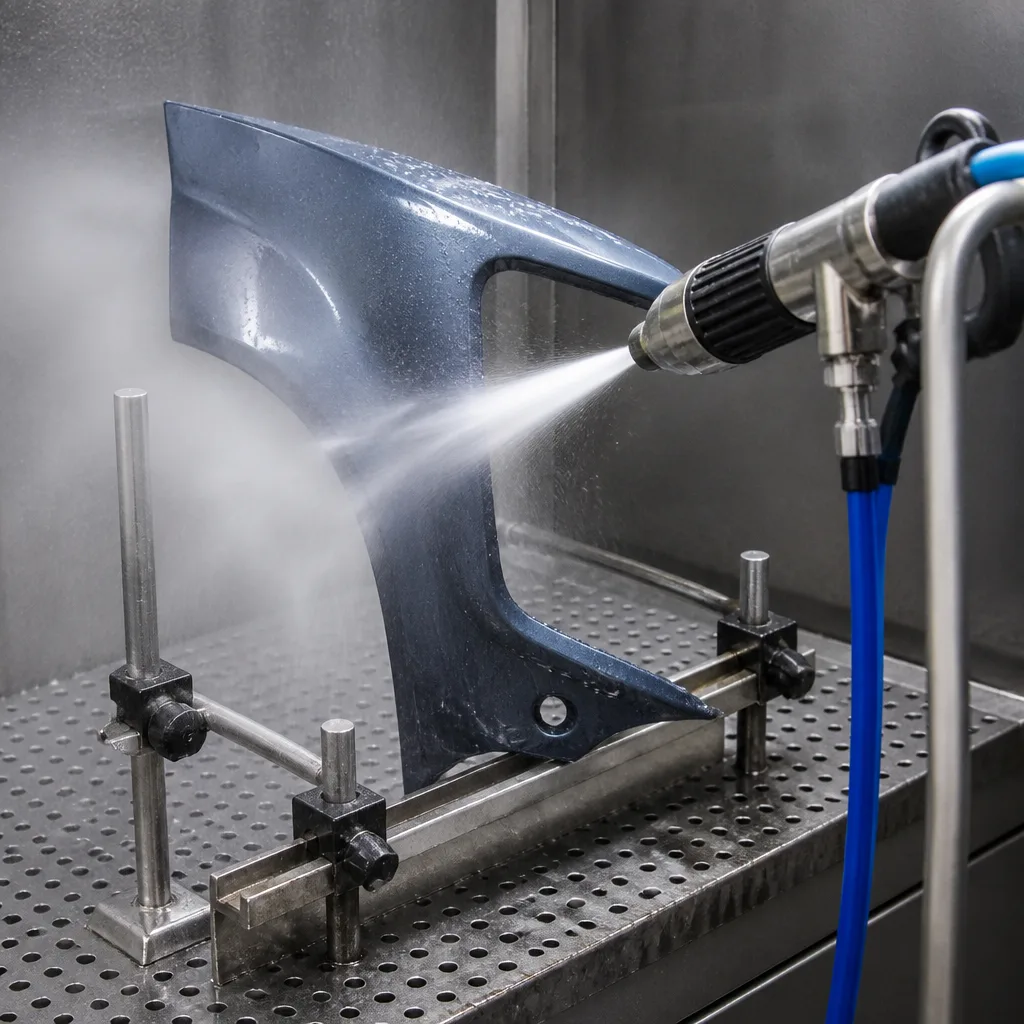
The test method, in principle, simulates real-world high-pressure cleaning conditions by directing a controlled jet of water at specific points on the painted component. The water jet is applied under the following defined conditions:
After testing, inspectors evaluate the sample for the following types of coating defects:
Some laboratories refer to the Ford FLTM BO 160-04-A standard, described as a stationary jet method, for evaluating resistance to high-pressure cleaning processes. This variation focuses on exposing a painted plastic surface to a constant jet of high-pressure water under controlled conditions.
Method A, described in the Ford FLTM BO 160-04-A standard, involves a stationary jet procedure where a high-pressure water jet is directed at a fixed point on a painted plastic part under controlled conditions. This method is designed to determine whether a painted plastic part can withstand high-pressure cleaning without the following conditions occurring:
This method simulates the effects of commercial car wash and pressure washing cleaning that exterior automotive parts might encounter throughout their lifespan. This method is called "fixed jet." In this method, the water nozzle is held at a specific distance from the surface. The spray angle is controlled. Instead of sweeping across the surface, the jet focuses on a specific test area. Critical points such as edges, corners, radii, molding lines, and coating transitions are frequently targeted. This creates a challenging, repeatable test condition for evaluating paint adhesion and coating durability.
The Ford FLTM BO 160-04-A standard is commonly used in the following areas:
These parts are frequently exposed to high-pressure cleaning equipment and must maintain their appearance throughout the vehicle's lifespan.
Following exposure, the test area is examined for the following aspects:
A satisfactory result typically requires the coating system to remain intact without significant visible damage or loss of adhesion.
While Ford's detailed acceptance limits are generally confidential, the evaluation according to the Ford FLTM BO 160-04 standard typically focuses on the following:
The component being tested should retain acceptable appearance and functionality after the cleaning simulation.
Manufacturers typically use the Ford FLTM BO 160-04 standard in the following situations:
This standard is particularly important for components located in areas frequently exposed to high-pressure washing equipment.
Compliance with the Ford FLTM BO 160-04 standard helps to ensure the following:
This standard verifies paint adhesion and coating integrity under demanding cleaning conditions, helping manufacturers offer exterior plastic components that maintain their appearance throughout the vehicle's lifespan.
The Ford FLTM BO 160-04 standard is important because it verifies that painted plastic parts can withstand the harsh conditions created by pressure washers and automatic car washes throughout the vehicle's lifespan. This standard is considered necessary for the following reasons:
In conclusion, the Ford FLTM BO 160-04 standard is a crucial automotive durability standard that evaluates the resistance of painted plastic parts to high-pressure cleaning processes. The described method simulates the mechanical forces generated by pressure washers and assesses whether paint systems can withstand repeated cleaning without peeling, delamination, or cosmetic damage. As vehicles increasingly require painted plastic exterior components, this standard plays a critical role in ensuring long-term appearance quality and coating reliability.
For many years, our organization, with its competent and experienced staff, has been understanding the needs of its customers, providing the advanced testing services they require, and assisting them in the establishment, implementation, and improvement of management systems. Within this framework, we also provide testing services to businesses in accordance with the Ford FLTM BO 160-04 standard.
To get an appointment, to get more detailed information or to request an evaluation, you can ask us to fill in our form and reach you.

