

The standard "BMW GS 97034-2 Surface testing of motor vehicle interior materials - Nail testing," developed by BMW, a multinational vehicle manufacturer, describes the nail testing method using a plastic test object. This method is applicable to painted, coated, uncoated, and laminated surface materials.
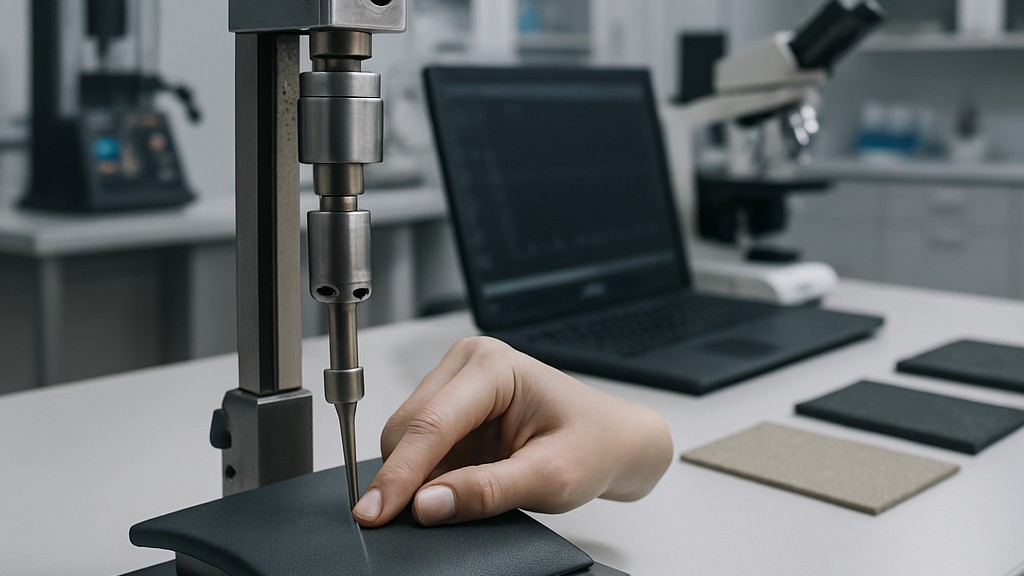
This test procedure is used to determine the resistance of surface materials in the passenger compartment to damage caused by nails. The purpose of this standard is to define a standard method for material suitability. The components to be tested must be defined in agreement with the relevant departments. The requirements applicable to surface materials are defined in the relevant regulations.
Prior to testing, samples must be conditioned for 24 hours in a standard atmosphere according to DIN EN ISO 291. Samples are tested in a standard atmosphere according to DIN EN ISO 291. The specified test sample is moved relative to the test surface at a constant test pressure and constant speed. The test force is gradually increased. Each test force is applied only once to the surface to be tested. Tests should preferably be conducted on flat samples. The test path should be between 60 mm and 100 mm. Any test setup that allows testing within the listed parameters is suitable for the test application.
For foils, leathers, artificial leather and decorative surfaces, the test speed is 200 plus/minus 20 mm/s, the test force is 5 N, 10 N, 15 N, 20 N. For injection molded surfaces, the test speed is 700 plus/minus 20 mm/s, the test force is 2 N, 4 N, 6 N, 8 N, 10 N.
The sample length must be at least 90 mm and the sample width must be at least 40 mm. If the results are uncertain, testing must be performed on BMW equipment. Before testing, samples must be cleaned without pressure using a microfiber cloth moistened with laboratory rinse aid. The sample (original structure) must be placed in the sample holder. Deviations must be documented in the test report.
Tested samples should be cleaned with a microfiber cloth moistened with deionized water without applying pressure. Evaluation is performed after a 24-hour recovery period. The evaluation follows the evaluation matrix according to the BMW AA-0635 standard.
The test report shall refer to this standard and indicate the type, description and construction of the material tested, and the test setup. Test parameters that deviate from this standard shall be documented in the test report.
In the high-stakes world of automotive manufacturing, where every detail, from engine performance to aesthetic appeal, can determine a model's success, BMW has long been a pioneer in setting quality standards. These include the BMW GS 97034 series, which includes a series of features designed to ensure interior surfaces withstand the rigors of daily use. At the heart of this series is the BMW GS 97034-2 standard, a simple yet crucial test known as the nail test.
Developed by BMW, a company known for its engineering precision and luxury vehicles, this standard stems from BMW's commitment to hazardous materials and surface integrity protocols. It is part of the broader BMW GS 97034 family, which addresses a variety of wear and tear scenarios in vehicle interiors.
The BMW GS 97034-2 standard is, in essence, a controlled assessment of a material's resistance to damage caused by a simulated fingernail. This procedure uses a standard plastic test object that mimics a human fingernail and applies controlled force and motion to the surface in question. In general, this method involves the following steps:
This method is not a brute-force durability test. It is a nuanced test that takes into account factors such as surface texture, coating thickness, and material elasticity.
Scratches aren't just cosmetic; they can be a sign of deeper quality issues and lead to costly recalls or warranty claims. With BMW GS 97034-2 standard mandating compliance, BMW suppliers must innovate with advanced polymers, nanocoatings, and self-healing urethanes.
Our organization, with its competent and experienced team, has been understanding the needs of its customers for years, providing them with the advanced testing services they need, and assisting them in the establishment, implementation, and improvement of management systems. In this context, we also provide testing services in accordance with the "BMW GS 97034-2 Surface testing of motor vehicle interior materials - Nail testing" standard.
To get an appointment, to get more detailed information or to request an evaluation, you can ask us to fill in our form and reach you.

