

The “PSA D47 1924 Plastics and rubbers – Occasional contact with vehicle fluids” standard, developed by the French car manufacturer PSA Group (now part of Stellantis), aims to evaluate the effect of various car fluids on parts made of thermoplastic materials, thermosettables, thermoplastic elastomers, and rubber.
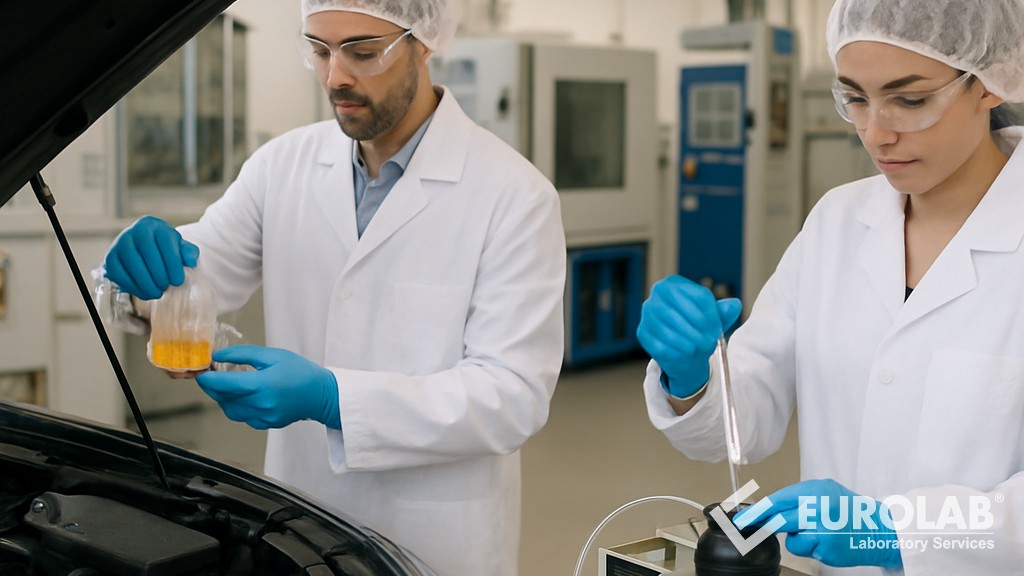
The described method involves exposing parts that are likely to come into contact with various fluids for a specific duration and temperature, and observing any potential deterioration (such as cracking, swelling, dissolution). The test conditions (temperature, contact time) vary as follows:
This process is carried out in three stages:
Test samples must be representative of the scale being characterized. To ensure this representativeness, the baseline characteristics of the population under study must be determined. The selection criteria for test samples must be stated in the test report in accordance with standard A10 0156.
Where possible, tests are performed on a part or a sample cut from a part. Material tests are reserved for specific studies.
The test is conducted in facilities with strict restrictions.
The test is performed according to the PSA D45 1543 standard test method or the previous method. In this case, the dimensions of the test pieces are as follows: thickness 3 mm, length 200 mm plus/minus 1 mm, width 10 mm plus/minus 0,2 mm, and taken perpendicular to the injection molding.
In the high-risk world of automotive manufacturing, where every component must withstand the rigors of daily use, material testing standards play a vital role in guaranteeing safety, reliability, and longevity. One such standard, PSA D47 1924, stands out as a cornerstone for evaluating the performance of plastics and rubbers that occasionally come into contact with automotive fluids. This standard ensures that interior and under-hood materials do not degrade when splashed or exposed to oils, fuels, coolants, and cleaners. It reflects the automotive industry's commitment to innovation in the face of evolving vehicle designs and environmental demands.
The PSA D47 1924 standard essentially provides a rigorous and repeatable method for evaluating how plastics and elastomers react to automotive fluids. The aim is to simulate short-term contact (intrusive contact) while measuring changes in appearance, dimensions, and mechanical properties. The test works as follows:
Samples are exposed to ambient temperature or high temperatures (up to 60 degrees) for specific periods (e.g., 30 minutes to 4 hours) by immersion, wiping, or spraying.
The equipment used includes standard laboratory tools such as immersion baths, spectrophotometers for color analysis, and ambient chambers. The test is performed in triplicate for statistical reliability, and the pass/fail criteria are based on PSA's internal threshold values: typically no higher than Order 2 degradation. This methodical approach ensures that materials do not compromise vehicle integrity, from the aesthetic appearance in cabins to the functional seals in powertrains.
In today's world, dominated by electric vehicles and sustainable materials, fluid resistance is an undeniable issue. While traditional internal combustion engines expose components to hydrocarbons, electric vehicles present new challenges, such as battery coolants and thermal management fluids. The PSA D47 1924 standard adapts to these changes, influencing designs for lightweight composites and bio-based rubbers.
For suppliers, compliance with this standard is mandatory for first-tier contracts. Environmentally, this standard reduces waste from premature part replacements by promoting durable materials. While global regulations such as the EU's REACH tighten chemical use, the PSA D47 1924 standard helps manufacturers select recyclable polymers with low volatile organic compounds without compromising performance.
For many years, our organization, with its competent and experienced team, has been understanding the needs of its clients, providing the advanced testing services they require, and assisting them in the establishment, implementation, and improvement of management systems. Within this framework, we also provide testing services compliant with the PSA D47 1924 standard.
To get an appointment, to get more detailed information or to request an evaluation, you can ask us to fill in our form and reach you.

