

The “VW TL 870 Intake Manifold - Strength and Sealing” standard, developed by the Volkswagen automotive company, applies to all components (connecting pipes) in the intake system (vacuum side) of passenger cars and commercial vehicles. To test and verify the strength and sealing quality characteristics, the following tests must be performed repeatedly on the same samples.
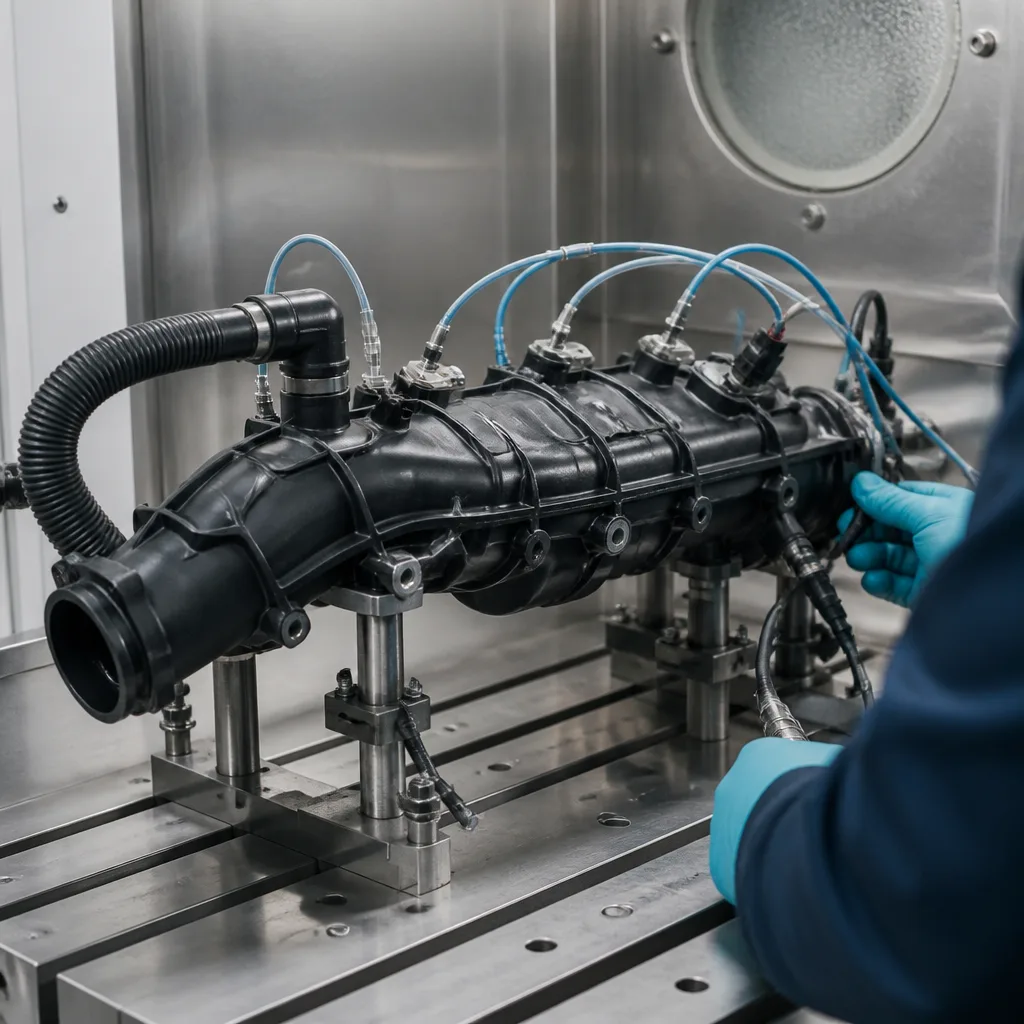
In short, the VW TL 870 standard defines the test methods and requirements for the mechanical strength, sealing/leakage behavior, and durability of air intake ducts (air intake manifolds or related components) and, in some cases, fuel line assemblies in Volkswagen Group vehicles.
This standard covers dynamic testing, operational behavior, strength investigations (including vibration/fatigue tests), pressure testing, and connection integrity (e.g., air-to-fuel line connections). It is part of a broader range of charge air system and hose/fitting requirements.
Automotive suppliers and testing laboratories refer to the VW TL 870 standard for component verification. This standard ensures that parts can withstand real-world stresses such as vibration, pressure cycling, temperature variations, and mechanical loads without failing or leaking.
The main test areas of this standard are as follows:
The VW TL 870 standard is a technical specification that defines the performance, durability, and sealing requirements for intake manifolds used in automotive engines. The intake manifold is a critical engine component responsible for distributing air (or, in some systems, the air-fuel mixture) evenly to the engine cylinders. Because it is exposed to varying temperatures, pressures, vibrations, and chemical effects, the manifold must remain structurally reliable throughout the vehicle's lifespan.
The VW TL 870 standard guarantees that intake manifolds provide the following:
This standard is particularly important because modern intake manifolds are increasingly using lightweight polymer composites instead of metal. This can improve efficiency but also present different durability challenges.
The VW TL 870 standard focuses on two main categories:
These tests confirm that the manifold will not crack or permanently deform under the expected service conditions.
This standard includes leak verification methods to ensure that the manifold and its seals maintain their airtight performance.
Without a specific intake manifold verification standard, component failures can lead to major vehicle problems such as:
The VW TL 870 standard establishes a common technical benchmark for suppliers and manufacturers, ensuring that all intake manifolds used in vehicles meet consistent quality and reliability expectations.
The VW TL 870 standard is typically applied in the following areas:
This standard applies to suppliers who produce the following products:
This standard is considered important for the following reasons:
In conclusion, the VW TL 870 standard is a significant engineering standard that ensures intake manifolds meet stringent requirements for structural strength and airtightness performance. By verifying both strength and sealing, this specification helps guarantee engine efficiency, emissions compliance, and long-term reliability in production vehicles.
For many years, our organization, with its competent and experienced team, has been understanding the needs of its clients, providing the advanced testing services they require, and assisting them in the establishment, implementation, and improvement of management systems. Within this framework, we also provide testing services compliant with the VW TL 870 standard.
To get an appointment, to get more detailed information or to request an evaluation, you can ask us to fill in our form and reach you.

