

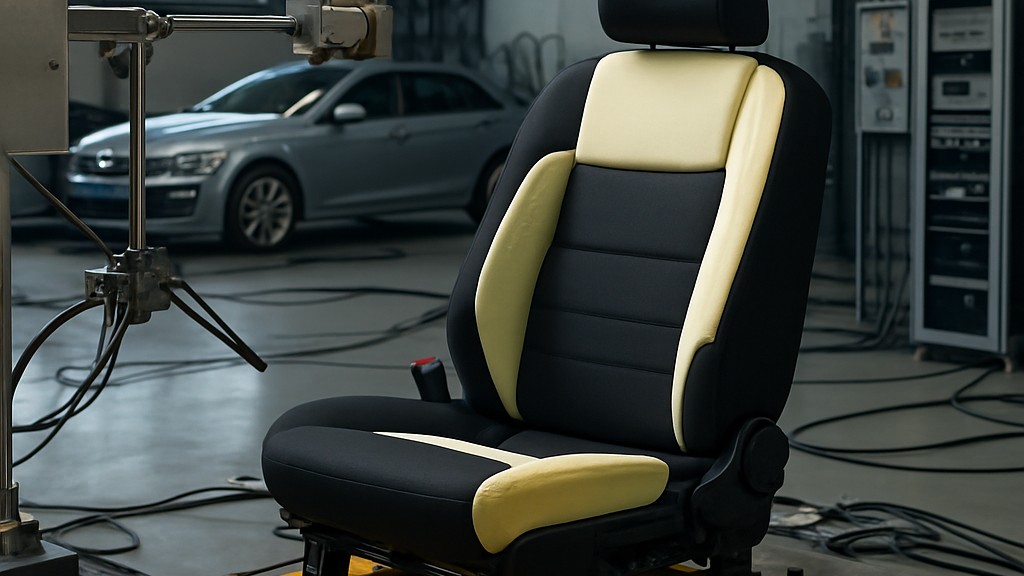
The standard "VW TL 52602 Polyurethane foam for interior equipment - Material requirements," developed by Volkswagen, describes the basic requirements for polyurethane (PUR) foam for foam-backed floor coverings, as well as acoustically effective sound insulation systems in spring-mass systems for interior equipment packages. For example, VW TL 52602-A includes sound insulation requirements for interior firewalls.
The general requirements in this standard are stated as follows:
The features are specified as follows:
Tests must begin no later than 72 hours after foaming. Prior to testing, samples must be conditioned for at least 24 hours in an atmosphere of 23 degrees Celsius and 50 percent relative humidity, in accordance with the VW 50554 standard.
Requirements regarding real estate should be taken from the table given under this title in the standard.
Samples required for determining mechanical/technical characteristics data must be taken from molded parts (components). The minimum foam thickness is 10 mm. Component-specific sampling points and measurement areas required for non-destructive testing must be defined and shown on the relevant component drawing. Sample dimensions for gross density are preferably 70 mm x 70 mm x 30 mm.
For compressive stress, the compressive stress test is performed at 40 percent deformation (thickness reduction), taking into account the VW PV 3919 standard. Evaluations should be made for:
Worn parts should be measured immediately after disassembly.
Aging in humid conditions is defined as one cycle: aging for 5 hours at 120 degrees and 100 percent relative humidity or in saturated steam, followed by drying for 3 hours at 70 degrees.
For pressure testing, non-destructive component testing is performed according to the "Component testing" section of the VW PV 3919 standard. For measurement ranges and requirements, refer to the component drawing.
When measuring thickness, the difference between the initial thickness and the thickness before the fourth compression is considered the extent of the post-loading thickness reduction. The test is carried out in accordance with the VW PV 3919 standard. The requirements apply to both specimen and component tests.
Tensile strength tests are performed using Type 1A barbell specimens. The total length is 103 mm, the specimen thickness is 10 mm, the narrow section width is 10 mm, and the gauge length is 30 mm. Dimensionally modified specimens may be used due to the geometrical conditions of the part, provided they are agreed upon with the relevant department. The test is performed at a travel speed of 100 mm/min.
Adhesion is determined by determining the shear force. Specimens measuring 50 mm x 50 mm x 20 mm are placed between two 50 mm x 100 mm electro-dip-paint-primed sheet metal test panels. The sheet metal test panels used must be degreased and cleaned, for example, with ethanol. The non-adhesive surface of the sample is attached to one of the sheet metal test panels using double-sided tape. The sample is compressed with 10 N for 1 minute on the overlap area (25 cm2) of the sheet metal test panel. The projecting sheet metal test panel ends are then compressed in a tensile testing machine. The shear force is determined at a test speed of 25 mm/min.
In short, “The VW TL 52602 standard applies to PU foam added as support to floor panels and to acoustic insulation elements that form part of the vehicle’s spring mass system.
The VW TL 52602 standard is important because it ensures the quality, safety, performance, and consistency of polyurethane foam materials used in Volkswagen vehicles. The primary reasons for this importance are:
These properties are critical in preventing premature wear, material degradation, or delamination, especially over years of use in changing climates.
Our organization, which has been serving for many years and meticulously following global developments in science and technology, employs a skilled team and extensive infrastructure to conduct testing, measurement, and analysis in a wide range of areas for businesses across all sectors. In this context, we also provide testing services in accordance with the "VW TL 52602 Polyurethane foam for interior equipment - Material requirements" standard.
To get an appointment, to get more detailed information or to request an evaluation, you can ask us to fill in our form and reach you.

