

The “Volvo STD 423-0044 Adhesion, tensile test - Paints and enamels” standard, developed by Volvo, describes a method for determining the adhesion of a coating applied to a hard and flat surface. This method is partly based on and replaces the Renault Trucks D 511755 standard.
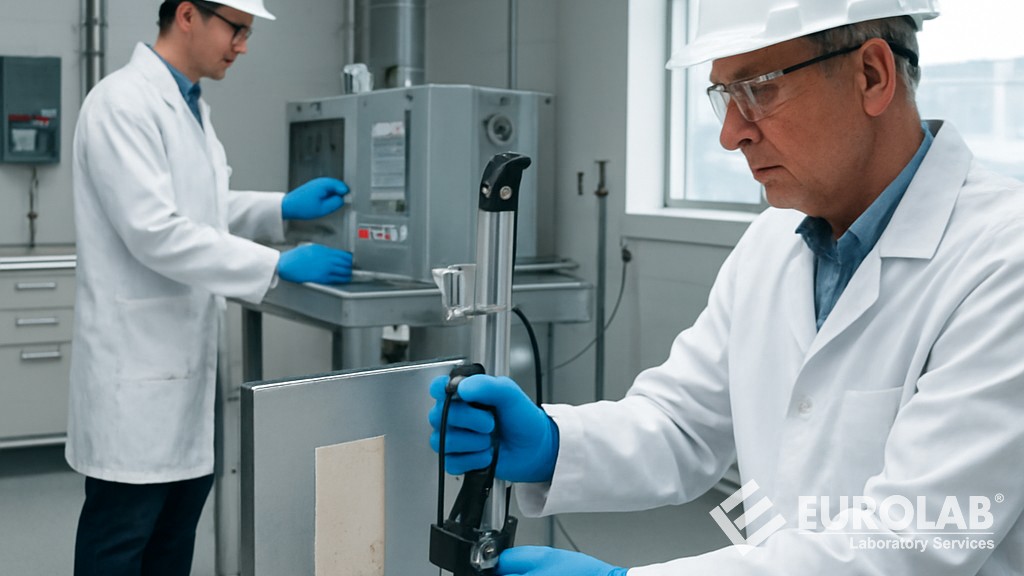
Prior to testing, the test pieces must be conditioned according to the “Volvo STD 1021-0001 Painting Y600 - Metal substrates” standard. The paint film must be applied and cured according to the paint specification. As a general rule, the paint film should be applied at least 7 days before the adhesion test. This is to ensure complete cross-linking before the test pieces are cut. The paint film thickness should be measured. In case of discrepancy, the test is performed according to the microscopic method in the ISO 2808 standard. The test should be performed on test pieces or test panels cut from the flat surfaces of the parts. Minimum dimensions should be 60 mm x 60 mm. The surface of the paint film should be slightly abraded in the area where the stud will be bonded. The area should then be cleaned in two steps, first with paper moistened with heptane and then with paper moistened with methanol.
At least three test pieces are tested. The test piece is placed on the fixed beam of the tensile testing machine. The locking ring is placed around the glued stud, and the assembly is secured to the fixed beam with clamps. The clamp of the movable beam is placed under the top of the stud. A vertical force is applied until the paint film breaks. The breaking stress value and the appearance of the breaking area are noted. The adhesion, expressed in MPa, is the average value of at least three tests. For 20 mm diameter studs, the breaking strength is calculated using the formula given in the standard. The distribution around the average value and the appearance of the area where the paint film breaks should also be noted.
The nature of the fracture should be described as adhesive fracture, cohesive fracture, or adhesive/cohesive fracture. The percentage areas of each fracture type should be specified. Adhesive fracture occurs between layers, while cohesive fracture occurs within layers.
In precision-oriented automotive interiors where every seam and seam contributes to both functionality and luxury, Volvo’s corporate standards are the cornerstone of quality assurance. Part of Volvo’s comprehensive STD 423 series for textile and polymer testing, the Volvo STD 423-0044 standard focuses on determining the seam strength in fabrics and composites used in vehicle upholstery. This standard ensures passenger safety and extended vehicle life by preventing premature seam failure – critical for withstanding the rigors of daily use, from seat adjustments to cargo loading.
The automotive industry is increasingly turning to lightweight and sustainable materials to meet electrification demands and regulatory pressures such as the EU's end-of-life vehicles directive. In such an environment, standards like Volvo STD 423-0044 are indispensable. This standard reinforces Volvo's legacy of innovative and reliable design by guiding suppliers in designing robust interiors that balance performance, aesthetics, and environmental responsibility.
Seam strength testing measures the tensile force required to break a sewn joint in a material, taking into account factors such as thread type, seam density, and fabric composition. In automotive applications, weak seams can lead to unexpected failures, such as seat tears during accidents or upholstery detachment under vibration, creating safety risks and aesthetic drawbacks.
The Volvo STD 423-0044 standard addresses these vulnerabilities by simulating operational stresses and prevents the following:
This standard, compliant with international standards such as ISO 13935-2 for woven fabrics, is integrated into Volvo’s holistic quality framework, including the failure mode and effects analysis processes under Volvo STD 105-0005, to mitigate risks from the design phase to the end of the product's lifecycle.
The Volvo STD 423-0044 standard is mandatory for suppliers of interior textiles. Developed based on the Volvo STD 423 series, which covers color fastness (e.g., Volvo STD 423-0037 standard), light exposure (Volvo STD 423-0047 standard), and scratch resistance (Volvo STD 423-0040 standard) tests, this standard provides comprehensive material validation.
This standard defines a strip method for assessing seam strength applicable to woven, knitted, and nonwoven fabrics used in seats, headliners, and upholstery. The basic elements of this method are:
Tests are carried out under standard atmospheric conditions (23 degrees Celsius and 65 percent relative humidity), and the results will affect material approvals under Volvo STD 5036 for the initial samples.
In conclusion, the Volvo STD 423-0044 standard is a testament to the company's unwavering focus on seam integrity, transforming potential weak points into pillars of reliability. By meticulously measuring tensile strength, it ensures a flawless experience for Volvo owners. For engineers and suppliers, compliance is more than just a contract; it's a commitment to producing vehicles built to last.
For many years, our organization, with its competent and experienced staff, has been understanding the needs of its customers, providing the advanced testing services they require, and assisting in the establishment, implementation, and improvement of management systems. Within this framework, we also provide testing services to businesses in accordance with the "Volvo STD 423-0044 Adhesion, tensile test - Paints and enamels" standard.
To get an appointment, to get more detailed information or to request an evaluation, you can ask us to fill in our form and reach you.

