

The “VW PV 3435 Non-metallic, non-magnetic materials - Transmittance test of substrates and paints from 76 GHz to 81 GHz” standard, developed by the Volkswagen automotive company, covers transmittance testing of plastics, substrates, paints, and similar coatings in the 76 GHz to 81 GHz frequency range for automotive radar applications. These tests can be used in the development of exterior parts, sample tracking, and monitoring production suitability.
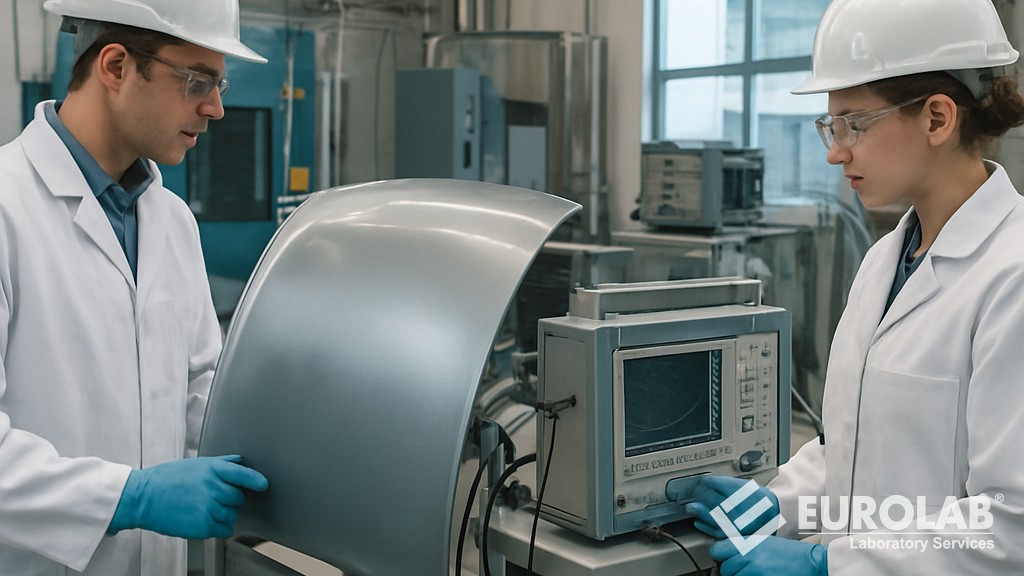
Automotive radar sensor covers (radomes) affect the propagation of electromagnetic waves emitted by the radar sensor and can lead to attenuation or interference due to reflection or angular errors. To analyze this effect using computational models, it is necessary to know the electrical material parameters of the materials used (plastics and paints).
When evaluating a paint's radar suitability, the determining factor is not the color description, but its composition (pigments, binders, etc.). The color effect may be the same, but electrical material parameters may differ, for example, due to different pigments. Therefore, a radar suitability declaration for a substrate paint applies only to the applied paint structure. Among other things, primer application, substrate, and layer tolerances must be considered for the declaration. For example, the paint layer thicknesses and tolerances required in the painting process to be able to use the painting system and maintain the color impression must be taken into account when deciding on radar suitability. The painting method also plays a role in a paint's radar suitability.
In principle, the relative electrical permittivity parameter of a material is a defining parameter for characterizing individual materials. It is a complex and dimensionless parameter that defines the dielectric polarization of materials.
The measurement principle used to determine relative permeability relies on the experimental determination of scattering parameters. These scattering parameters can be used to characterize the electromagnetic transmission properties of electrical circuits or materials. Scattering parameters reflect the behavior of a two-port network or component/material according to its waveform values, i.e., the reflected waveform values/transmitted waveform values originate from the incident waveform values at the input and output ports.
For radomes, this describes the transmittance (i.e., power transmission coefficient) and reflection (i.e., power reflection coefficient) as a function of frequency when excited by an electromagnetic wave. Since this is a passive component, reverse transmission can be ignored. The aim of the measurement is to determine at least one of these two scattering parameters. The transmittance is then estimated from the measurement data using computational models.
To ensure comparability of results, the response of the sample to electromagnetic wave excitation is normalized with respect to the transmitter power output. Scattering parameters are frequency-variable and therefore must be represented over a frequency range (frequency response). Complex scattering parameters should be determined in at least the frequency band between 76 GHz and 77 GHz.
Volkswagen, one of the world's leading automotive manufacturers, applies a rigorous set of internal standards to ensure the quality, reliability, and safety of its vehicles and components. Among these, the VW PV 3435 standard stands out as a specific test procedure focusing on technical cleanliness in automotive production.
The VW PV 3435 standard is a test specification developed to evaluate the technical cleanliness of engine and powertrain components during assembly. Introduced as part of Volkswagen's evolving quality management systems, this standard builds upon the "ISO 16232 Road vehicles – Cleanliness of fluids in engine lubrication systems" and "VDA 19 Technical cleanliness during assembly" standards. This standard is particularly important for suppliers producing parts such as cylinder heads, pistons, and fuel systems.
The primary purpose of the VW PV 3435 standard is to measure and control particulate contamination that occurs during production and assembly. This includes:
Tests under VW PV 3435 typically involve washing the component with a solvent (e.g., isopropanol), filtering the extract, and analyzing the residue. Results are reported as numbers per particle mass or size class, thus ensuring compliance with Volkswagen's strict limits to prevent problems such as injector clogging or reduced engine efficiency.
Suppliers must prove their compliance with the VW PV 3435 standard through accredited laboratories. The process typically follows these steps:
Advanced laboratories offer VW PV 3435 standard testing services, emphasizing non-destructive methods to minimize costs for suppliers. Non-conformity can lead to production stoppages or requalification, highlighting the economic impact of the standard.
In conclusion, the role of the VW PV 3435 standard in ensuring technical cleanliness is vital for producing reliable and high-performance vehicles. For suppliers and engineers, mastering this standard is not only a requirement but also a competitive advantage.
For many years, our organization, with its competent and experienced staff, has been understanding the needs of its customers, providing the advanced testing services they require, and assisting in the establishment, implementation, and improvement of management systems. Within this framework, we also provide testing services to businesses in accordance with the "VW PV 3435 Non-metallic, non-magnetic materials - Transmittance testing of substrates and paints from 76 GHz to 81 GHz" standard.
To get an appointment, to get more detailed information or to request an evaluation, you can ask us to fill in our form and reach you.

