Renault D27 1380 Accelerated Weathering Test Method (Xenon)
The "Renault D27 1380 Accelerated Weathering Test Method (Xenon)" standard, developed by the French automobile company Renault, describes a test method designed to assess the weatherability of body paint under light and precipitation conditions using a xenon weathering tester. The accelerated weathering test was conducted to assess the weatherability of body paint.
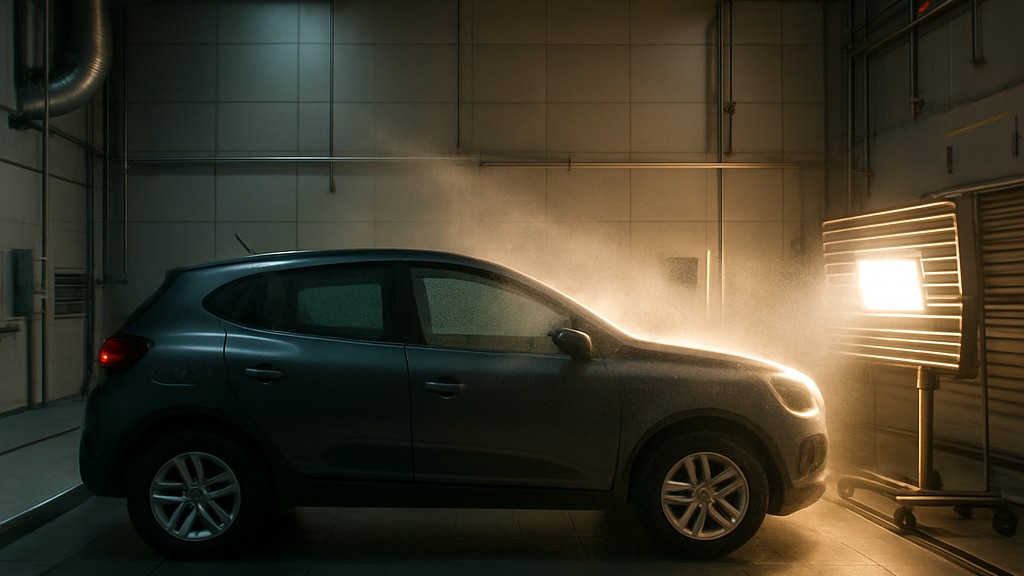
The accelerated weather resistance (xenon) testing method is a laboratory procedure that uses a xenon arc lamp to simulate the full spectrum of sunlight along with controlled temperature, humidity, and water spray, predicting how materials will perform when exposed to outdoor environments over time. It is commonly used in the automotive industry to evaluate color fastness, gloss retention, chalking, cracking, and loss of adhesion.
The purpose of these tests is to accelerate natural weathering so that weeks or months of outdoor exposure can be simulated in the laboratory in days or weeks. This method evaluates the durability of paints, plastics, rubber, coatings, textiles, and other materials.
These tests generally use a xenon arc weather meter or similar device, filters suitable for specific daylight or window glass transmittance spectra (such as daylight, long-term UV), temperature, humidity and spray control systems, and a rotating sample rack for uniform exposure.
The Renault D27 1380 standard includes a laboratory procedure for evaluating the resistance of coatings, plastics, elastomers, external coatings, and painted components to sunlight, heat, humidity, and water spray using a xenon arc weather meter. This procedure is used for design validation, supplier approvals, and material change control in situations where appearance or functional performance may be degraded by outdoor exposure.
This method aims to correlate with mid-latitude outdoor service by controlling spectral power distribution, irradiance, black panel temperature, room air temperature, humidity, and periodic water spraying. Xenon arc and weather meters are standard instruments in automotive wear.
Test samples are generally sheet metal with a width of 70-90 mm, a length of 150-190 mm, and a thickness of 0,8-0,95 mm. If the test piece is to be tested shortly after painting, it should be stored for 1 day for 1K materials and 5 days for 2K materials at a temperature of 23 degrees Celsius plus/minus 2 degrees Celsius and a relative humidity of 50 percent plus/minus 5 percent.
This standard defines two test methods:
- Method A: This method is based on SAE J2527, Performance-Based Standard for Accelerated Exposure of Exterior Automotive Materials Using Controlled-Ray Xenon Arc Apparatus, developed by the American Society of Automotive Engineers (SAE). This SAE standard specifies operating procedures for a controlled-radiation xenon arc apparatus used for accelerated exposure of various exterior automotive materials.
The Renault D27 1380 standard defines one or more loops (outer and inner, light and dark) selected for application. In this method, the conditions are as follows:
- Irradiance: 0,55 W m2 at 340 nm.
- Black panel temperature: 70 degrees Celsius plus/minus 3 degrees Celsius in dry cycle.
- Room temperature: 47 degrees plus/minus 3 degrees in light and dry cycle, 38 degrees plus/minus 3 degrees in dark cycle.
- Humidity: Light and dry cycle 50 percent plus/minus 5 percent relative humidity, darkness and 95 percent plus/minus 5 percent relative humidity in a water spray cycle.
- Water spray cycle:
- 60-minute dark cycle with water spray on panels (front and back), 95 percent plus/minus 5 percent relative humidity.
- 40-minute non-spray light cycle, 50 percent plus/minus 5 percent relative humidity.
- 20 min light cycle with water spray on panels (front side), 95 percent plus/minus 5 percent relative humidity.
- 60-minute non-spray light cycle, 50 percent plus/minus 5 percent relative humidity.
- Filters: Daylight or window glass type (exterior or interior) based on component location.
The demonstration of the test cycle is included in the standard appendix (Annex A).
- Method B: In this method, the conditions are as follows:
- Irradiance: 180 W/m2 (400 nm or shorter). The illumination uniformity rating should be plus/minus 10 percent within the effective evaluation area.
- Initial wavelength: 290 nm.
- Temperature: 63 degrees plus/minus 3 degrees in light emission (black panel temperature), 28 degrees plus/minus 3 degrees in precipitation (atmospheric temperature).
- Humidity: 50 percent plus/minus 5 percent relative humidity in lighting, 95 percent or higher relative humidity in precipitation.
- Precipitation cycle: 24 minutes during 360 minutes of lighting time.
The demonstration of the test cycle is included in the standard appendix (Annex A).
The testing steps for each method are as follows:
- The initial color on the painted surface is measured.
- Place the test piece into the test piece holder with the painted surface facing the lamp. If empty test piece holders are available, they should be completely covered with stainless steel or aluminum sheeting.
- Test conditions are entered into the device.
- It runs for the specified period of time.
- The test piece should be moved to a different test piece holder every week.
- The test piece is removed from the device.
- The painted surface is cleaned with a mild detergent using a soft cloth and rinsed with tap water.
- The final color on the painted surface is measured.
- The adhesion test is performed 24 hours after removing the test piece from the device.
The Renault D27 1380 standard is important because it provides Renault and its suppliers with a controlled and repeatable way to predict how materials and coatings will withstand years of sunlight, heat, and humidity—in weeks rather than years. The key reasons for this standard are:
- Ensures long-term durability of parts: Exterior paints, plastics, and elastomers are constantly exposed to UV rays, temperature fluctuations, and rain. This test simulates these conditions to ensure the parts don't fade, crack, chalk, or lose their adhesion prematurely.
- Accelerates real-world weathering: Instead of waiting 3-5 years of outdoor exposure, xenon arc testing can reproduce equivalent damage in hundreds of hours. This accelerates product development and approvals.
- Maintains brand quality and aesthetics: Color and gloss balance is crucial for visible parts like body panels, upholstery, and interior surfaces. Consistency throughout the vehicle's lifespan supports the brand's reputation for quality.
- Supports global market requirements: Different markets have significantly different UV and climate stresses. The method's control over spectral power, temperature, and humidity helps validate performance for all target regions.
- Prevents costly failures and recalls: Identifying weaknesses in materials or coatings before mass production prevents warranty claims, repainting programs or field parts replacements.
- Complies with international standards: This standard is closely aligned with ISO 4892-2 and ASTM G155, ensuring results are reliable and comparable to other original equipment manufacturers and suppliers worldwide.
Our organization, which has been serving for many years and meticulously following global developments in science and technology, conducts testing, measurement, and analysis in a wide range of areas for businesses across all sectors with a skilled team and extensive infrastructure. In this context, we also provide testing services in accordance with the Renault D27 1380 Accelerated Weather Resistance Test Method (Xenon) standard.



