

The “GMW 14124 Automotive Environmental Cycles” standard, published by General Motors (GM), describes various environmental cycles and aging conditions that can be performed before testing or as a full test. This standard does not include standard test conditions or preconditioning before testing. These requirements are included in the material specification or in the GMW 3221 standard.
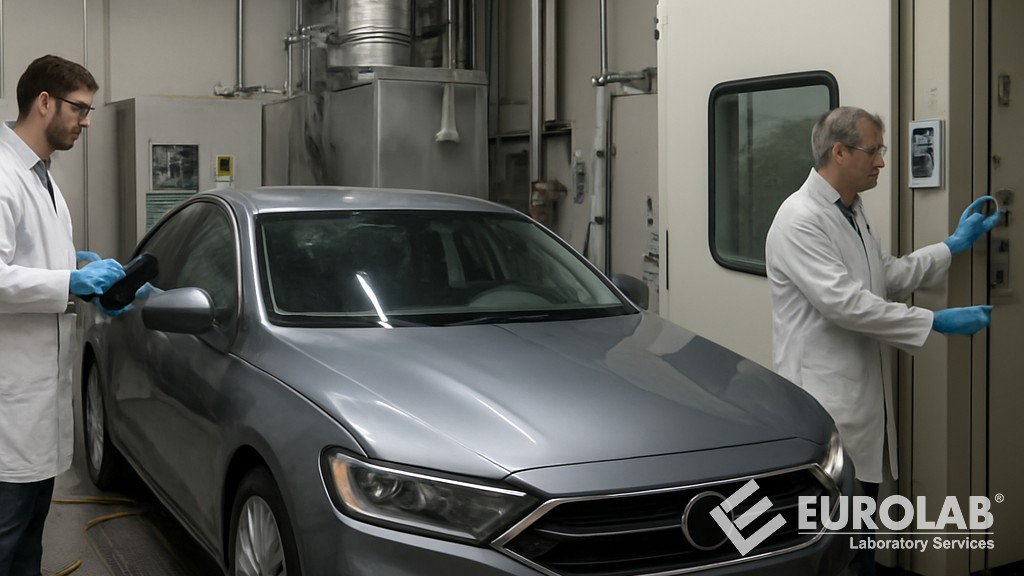
In the high-risk automotive manufacturing world, where vehicles must withstand extreme temperatures, humidity, vibrations, and abrasive elements, rigorous testing standards are essential. One of these critical specifications, the GMW 14124 standard, incorporates a series of standard test cycles designed to simulate real-world environmental stresses on vehicle components. Regularly updated, this standard helps engineers ensure that parts, from plastics and electronics to paints and adhesives, perform reliably throughout the vehicle's lifespan, which can exceed 240.000 km or 10 years. This standard remains a cornerstone of GM's quality assurance processes.
The GMW 14124 standard addresses the need for consistent and repeatable testing to assess how automotive materials and components respond to a combination of environmental factors. Unlike single-parameter tests (e.g., pure heat exposure), these cycles combine multiple stress factors—such as temperature fluctuations, humidity, salt spray, and mechanical vibrations—to simulate the diverse climatic conditions a vehicle might encounter (from scorching desert summers to freezing Arctic winters).
This standard covers a wide range of components, including:
The GMW 14124 standard standardizes these tests, reducing variability in supplier qualifications, accelerating development times, and minimizing costly field failures. This is particularly vital in the age of electric vehicles (EVs), where battery packs and power electronics require even higher reliability under thermal extremes.
This standard defines more than a dozen environmental cycles, each tailored to specific failure modes. These are typically performed in climate chambers, corrosion cabinets, or vibration tables for durations ranging from hours to weeks. Some key cycles are as follows:
These cycles are modular and allow customization according to component location (e.g., engine compartment or passenger compartment). For example, thermal shock testing according to the GMW 14124 standard is typically carried out in accredited laboratories using liquid-air or air-air chambers for precise control.
The GMW 14124 standard is not just an internal GM tool, but a global benchmark. Suppliers providing fibrous sound-absorbing materials (GMW 14194 standard) or plastic roll products (GMW 14122 standard) must comply to secure contracts.
Implementing the GM 9505P standard presents some challenges. For example, high-accuracy tests require specialized equipment and incur significant costs for laboratories. Smaller suppliers in developing regions may face compliance difficulties, leading to supply chain bottlenecks. Furthermore, accelerating test times (e.g., through higher intensities) risks overtesting and may result in the rejection of viable designs.
In the coming period, as autonomous vehicles and connected technologies become more widespread, the GMW 14124 standard could be expanded to include electromagnetic interference (EMI) loops or cyber-physical stress tests. Integration with AI-powered predictive modeling could reduce physical testing time from months to days, aligning it with industry goals.
In conclusion, the GMW 14124 standard is an example of how rigorous environmental testing protects the safety, performance, and longevity of automobiles. By simulating the challenging real world in controlled cycles, it enables engineers to meet customer expectations.
For many years, our organization, with its competent and experienced staff, has been understanding the needs of its customers, providing the advanced testing services they require, and assisting them in the establishment, implementation, and improvement of management systems. Within this framework, we also provide testing services in accordance with the "GMW 14124 Automotive Environmental Cycles" standard.
To get an appointment, to get more detailed information or to request an evaluation, you can ask us to fill in our form and reach you.

