

The “GME 60301 Test Method for Determining Weight Per Unit Area” standard, developed by General Motors Europe (GME), is a materials testing standard. This standard specifies a laboratory procedure for measuring the mass per unit area (area density or basis weight) of sheet materials used in automotive applications. It is commonly applied to textiles, nonwoven fabrics, coated fabrics, leather substitutes, films, and other flexible materials used in vehicle interiors.
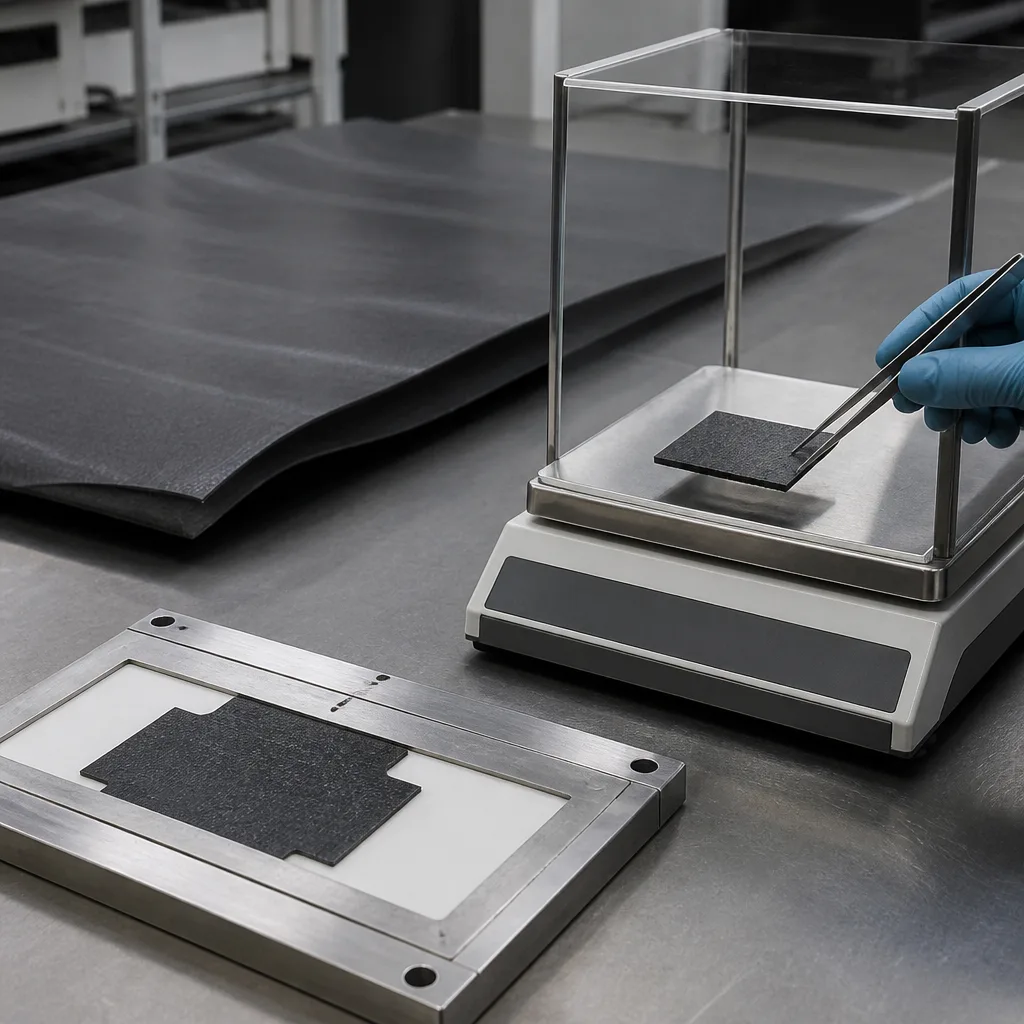
Weight per unit area is one of the most fundamental physical properties of a material and directly affects component weight, thickness, strength, durability, cost, and manufacturing consistency.
The primary purpose of the GME 60301 standard is to establish a uniform method for determining the weight per unit area of automotive materials. By using the same procedure across suppliers and manufacturing facilities, General Motors ensures:
The GME 60301 standard applies to numerous automotive materials, including:
The described test method is designed for flat sheet materials where weight can be expressed in grams per square meter (g/m²). This test is based on a simple measurement principle :
This standardized approach minimizes measurement variations between laboratories.
Equipment used in tests typically includes the following:
The sample cutter ensures the same sample size for every measurement.
To obtain reliable results, the sample is prepared as follows:
Testing several samples helps to account for material variability.
The standard defines precise dimensions and conditions for testing, and the general procedure includes the following:
Weight per unit area is calculated according to the following formula: Weight per unit area = Area * Mass.
Area density affects many engineering properties:
The GME 60301 standard is commonly used in the following automotive components:
The GME 60301 standard is often used in conjunction with other General Motors Europe material standards for complete material characterization. Testing organizations also note its similarity in purpose to international methods such as EN 12127 (mass per unit area of textiles), ISO 2286-2 (coated fabrics), and ISO 29073-1 (nonwoven fabrics), depending on the type of material.
Implementing the GME 60301 standard offers several advantages:
Although developed for General Motors Europe, this testing method is applicable to all industries that use sheet metal materials, including:
Independent testing laboratories list the GME 60301 standard among the original equipment manufacturer methods they support for evaluating automotive textiles and plastic films.
In conclusion, the GME 60301 standard is a fundamental material testing standard used to determine the weight per unit area of automotive sheet materials. While the process is simple, this standard provides critical data for quality assurance, supplier verification, material specification compliance, and vehicle weight optimization. Consistent measurement of area density helps manufacturers ensure uniform performance and supports the production of durable, lightweight automotive interior components.
For many years, our organization, with its competent and experienced staff, has been understanding the needs of its clients, providing the advanced testing services they require, and assisting them in the establishment, implementation, and improvement of management systems. Within this framework, we also provide testing services compliant with the GME 60301 standard.
To get an appointment, to get more detailed information or to request an evaluation, you can ask us to fill in our form and reach you.

