Fiat LP-7M057 Steering Rod and Washer Holder
The “Fiat LP-7M057 Stem and Washer Retention” standard, developed by Fiat Chrysler Automobiles (FCA) (now Stellantis), an Italian-American automotive company, belongs to the company’s internal laboratory procedures (LP) series, which define standardized test methods for materials and components used in vehicle manufacturing. These specifications ensure consistent quality, safety, durability, and performance across suppliers and production lines.
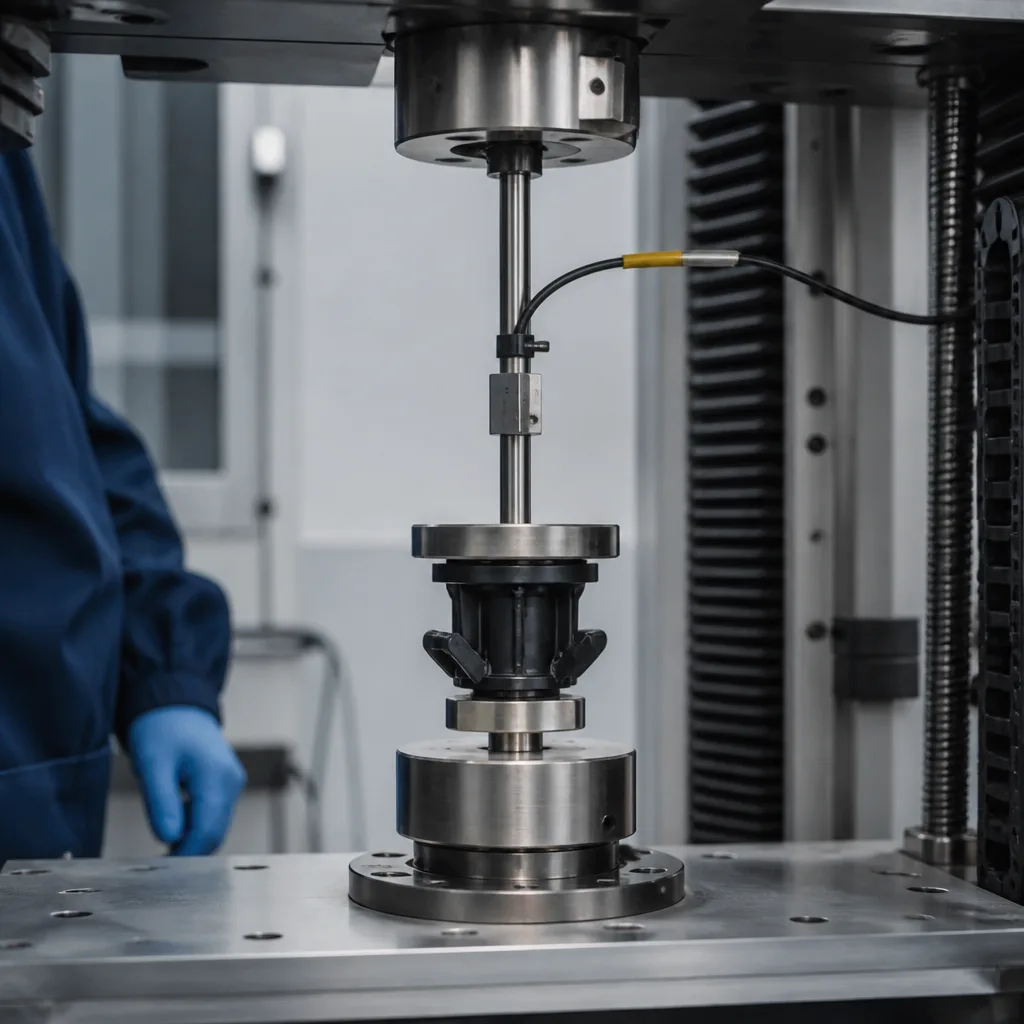
The Fiat LP-7M057 standard includes various test sections related to linkage retention systems:
- Vertical push (insertion) test: Measures the force required to insert fastening posts into washers or retaining holes. This test method is a mechanical evaluation used to measure the force required to insert a fastening element, such as a plastic clip, post, stud, or mat holder, into its corresponding washer, hole, or recess. The test verifies that a fastening system can be easily assembled and provides adequate retention once installed. This method is designed to ensure:
- The fastener can be installed without applying excessive force.
- Assembly line workers or automated equipment can reliably assemble the part.
- The fastener will not break, deform, or crack during assembly.
- Consistent fastening forces are achieved across production batches.
- The fastening system strikes the right balance between ease of assembly and secure hold.
- Vertical pull (removal) test: Evaluates the removal force required to vertically remove a fastening system after assembly. This test method is a mechanical test used to measure the force required to remove a fastener, clip, pin, or retaining device from its mating component by pulling it straight along the mounting axis. The test is performed after the fastener has been correctly assembled to assess its holding strength and resistance to accidental separation. This method determines:
- How securely the fastener is held after assembly.
- The maximum force required to remove the component.
- Whether the gripping system provides sufficient holding power.
- Whether the fastener or surrounding parts were damaged during disassembly.
- Consistency of holding performance among production parts.
- Snap-in/offset pull test: Examines the durability of the fastener and its behavior under sudden snap-in or offset pull. This test method is a mechanical durability test used to evaluate the performance of snap-in fastener systems when subjected to tensile forces that are not perfectly aligned with the mounting axis. The test aims to simulate real-world conditions where clips, retainers, or connecting posts may be subjected to off-center loads during use, maintenance, or accidental pulling.
A snap-fit connector is a component that locks into place through elastic deformation and recovery. Examples include:
- Floor mat holders
- Plastic trim clips
- Push-type internal fasteners
- Snap-on covers and panels
When installed, the flexible locking tabs deform and then move into their locked position.
Offset tensile load occurs when the tensile force is applied away from the centerline of the fastener. The force is applied not in the vertical direction, but at a specific angle or with a deflection. This creates both tensile stress (tension) and bending stress (lateral loading). This test more closely represents real service conditions. This test evaluates the following:
- Resistance to accidental pulling.
- Durability of snap lock features
- Ability to withstand misaligned loads.
- Structural integrity of clips and retainers
- Risk of breakage or separation
Lateral holding strength test: Determines the resistance of a fastening system to lateral forces. This test method is a mechanical test used to measure the resistance of a fastener, clip, retainer, or snap-fit assembly to lateral forces after installation. By simulating real-world conditions such as vibration, load shift, and accidental side impacts, the test evaluates how well a fastening system remains fixed under forces applied perpendicular to the mounting axis. The purpose of the test is to determine:
- The resistance of the fastener to lateral movement.
- The maximum lateral force that the balancing mechanism can withstand before failure.
- Whether the fastener remains securely attached under service conditions.
- Durability of interlocking properties when subjected to shear-type loads.
These tests are particularly important for components subjected to repeated user interaction and vibration, such as those listed below:
- Floor mat retention systems
- Interior trim clips
- Plastic mounting pins
- Carpet fasteners
- Snap-on assemblies
- Cabinet mounting components
In short, the Fiat LP-7M057 standard focuses on the mechanical holding performance of fasteners commonly used in vehicle floor mats and interior trim components. This standard defines tensile and holding force tests to ensure fasteners remain securely attached during vehicle operation and prolonged use. It emphasizes the evaluation of how fasteners and washers behave under insertion, removal, lateral loading, and repeated sudden-motion stresses.
Test methods essentially follow these steps:
- The sample is mounted in a controlled fixture.
- Applying tensile or lateral force using a universal testing machine.
- The following measurements must be taken:
- Insertion force
- Tensile force
- Holding strength
- Fault mode
- Recording of deformation or fracture.
- Comparing the results with the stated acceptance criteria.
Tests are typically conducted under the following controlled environmental conditions:
- Standard laboratory temperature
- Heat aging
- Moisture exposure
- Thermal cycle
The Fiat LP-7M057 standard applies to suppliers producing the following products:
- Automotive carpets
- Injection molded plastic clips
- Interior trim systems
- Holding fasteners
- Snap-on fasteners
- Polymeric coupling devices
The materials most frequently tested in these tests include:
- Polypropylene (PP)
- Polyamide (PA/nylon)
- ABS plastics
- Thermoplastic elastomers
- Reinforced engineering polymers
This standard is often used in conjunction with broader automotive quality frameworks such as:
- IATF 16949 quality management
- FCA supplier verification requirements
- Interior trim durability programs
- Original equipment manufacturer component approval processes
Compliance helps suppliers demonstrate that their linkage systems meet Fiat's expectations for mechanical reliability.
In short, the Fiat LP-7M057 standard is a specific FCA engineering specification focusing on the mechanical performance and holding strength of fastening systems used in automotive interiors, particularly floor mat holder assemblies. Through installation, removal, sudden movement, and lateral force tests, this standard helps ensure safety, durability, assembly consistency, and long-term interior quality in Fiat vehicles.
For many years, our organization, with its competent and experienced staff, has been understanding the needs of its customers, providing the advanced testing services they require, and assisting them in the establishment, implementation, and improvement of management systems. Within this framework, we also provide testing services in accordance with the Fiat LP-7M057 standard.



