

GMW 14134 Softness / Leather Pit Test
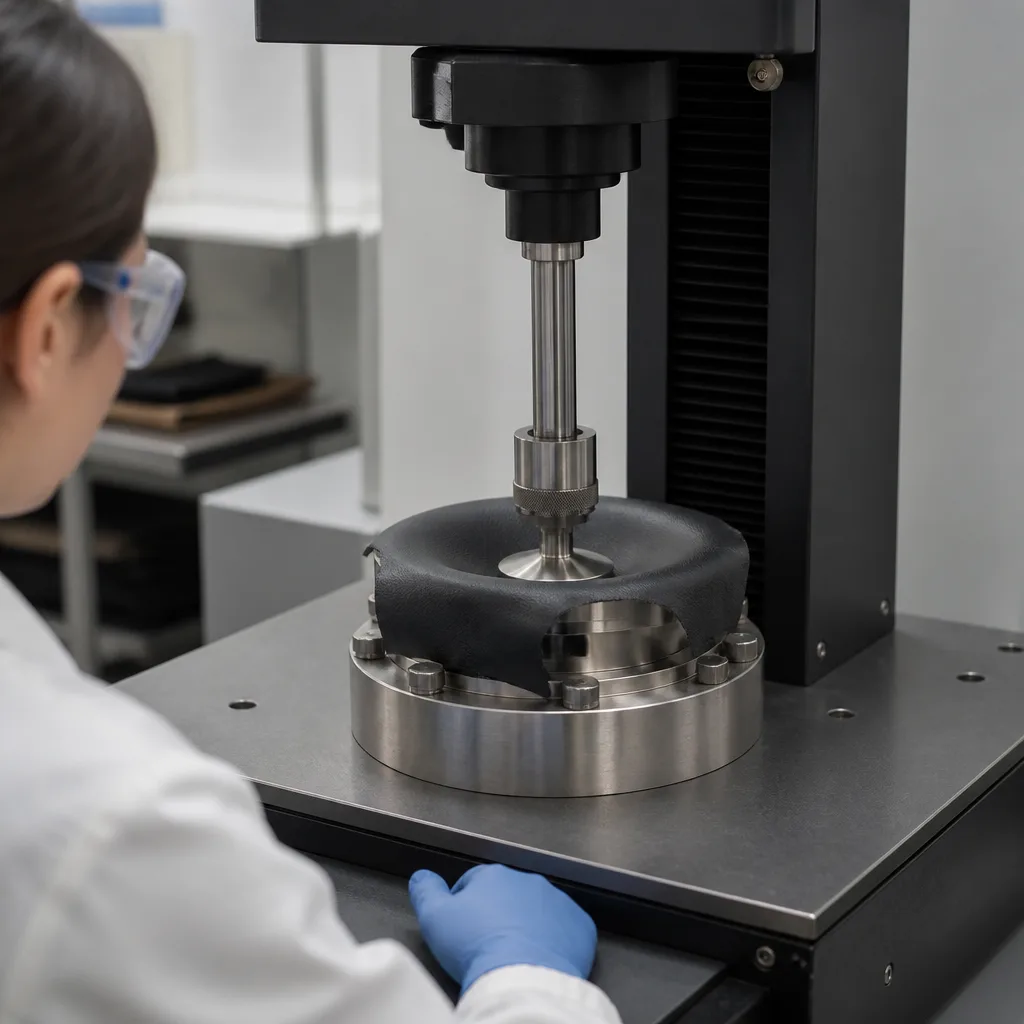
The “GMW 14134 Softness/Leather Pit Test” standard, developed by General Motors Worldwide (GMW), is a test standard used to evaluate the softness and deformation behavior of automotive leather, particularly that used in vehicle interiors and upholstery. In this test method, the leather is subjected to controlled pitting/indentation, and its response is evaluated as an indicator of softness.
The primary goal of the GMW 14134 standard is to provide a consistent method for evaluating the softness of leather designed for automotive applications. Leather softness is an important property because it directly contributes to:
While excessively stiff leather can feel uncomfortable and cheap, excessively soft leather may have poor dimensional stability or fail to maintain the desired appearance. Therefore, the GMW 14134 standard provides a controlled way to compare leather materials and production batches.
The term skin collapse refers to the response of the skin when a controlled force is applied to its surface. Simply put, this test evaluates how easily the skin surface bends or collapses under a given load. Softer skin will generally produce a larger collapse under the same test conditions, while harder or more rigid skin will produce a smaller collapse. Therefore, this method transforms the subjective concept of softness into a measurable physical property.
In automotive manufacturing, the GMW 14134 standard applies specifically to leather used in the following areas:
In this test, the sample is placed in the testing device and subjected to a controlled mechanical effect. The resulting deformation is measured and used to characterize the softness of the material. The key variables in this type of test are:
The precise device configuration, dimensions, forces, and acceptance criteria are specified in the GMW 14134 standard.
The GMW 14134 standard is important because softness is a critical functional and perceived quality characteristic of automotive leather. This standard is considered important for the following reasons:
The GMW 14134 standard is part of a larger General Motors testing group that addresses automotive interior materials. For example,
Independent laboratories define the GMW 14134 standard as a softness test and distinguish it from the GMW 14132 standard, which addresses blocking resistance.
Softness alone does not determine whether automotive leather is acceptable. Leather specifications for manufacturing purposes may require a combination of various characteristics, such as:
Consequently, the GMW 14134 standard should be considered a component of a broader leather qualification program, rather than a complete assessment of leather quality.
For a leather supplier, compliance with the GMW 14134 standard helps demonstrate that the material possesses the necessary tactile properties for its intended General Motors application. A typical quality control program might use the test for the following purposes:
In short, the GMW 14134 standard is a General Motors automotive material test related to the evaluation of leather softness. This method provides an objective mechanical assessment of a property that is difficult to consistently evaluate by touch alone.
This standard is particularly important for automotive seats and interior leathers. Here, softness affects both passenger comfort and the perceived quality of the vehicle interior. Combined with abrasion, stretch, staining, chemical resistance, and other material tests, the GMW 14134 standard contributes to a comprehensive assessment of automotive leather performance.
For many years, our organization, with its competent and experienced staff, has been understanding the needs of its clients, providing the advanced testing services they require, and assisting them in the establishment, implementation, and improvement of management systems. Within this framework, we also provide testing services in accordance with the GMW 14134 standard.
To get an appointment, to get more detailed information or to request an evaluation, you can ask us to fill in our form and reach you.

