

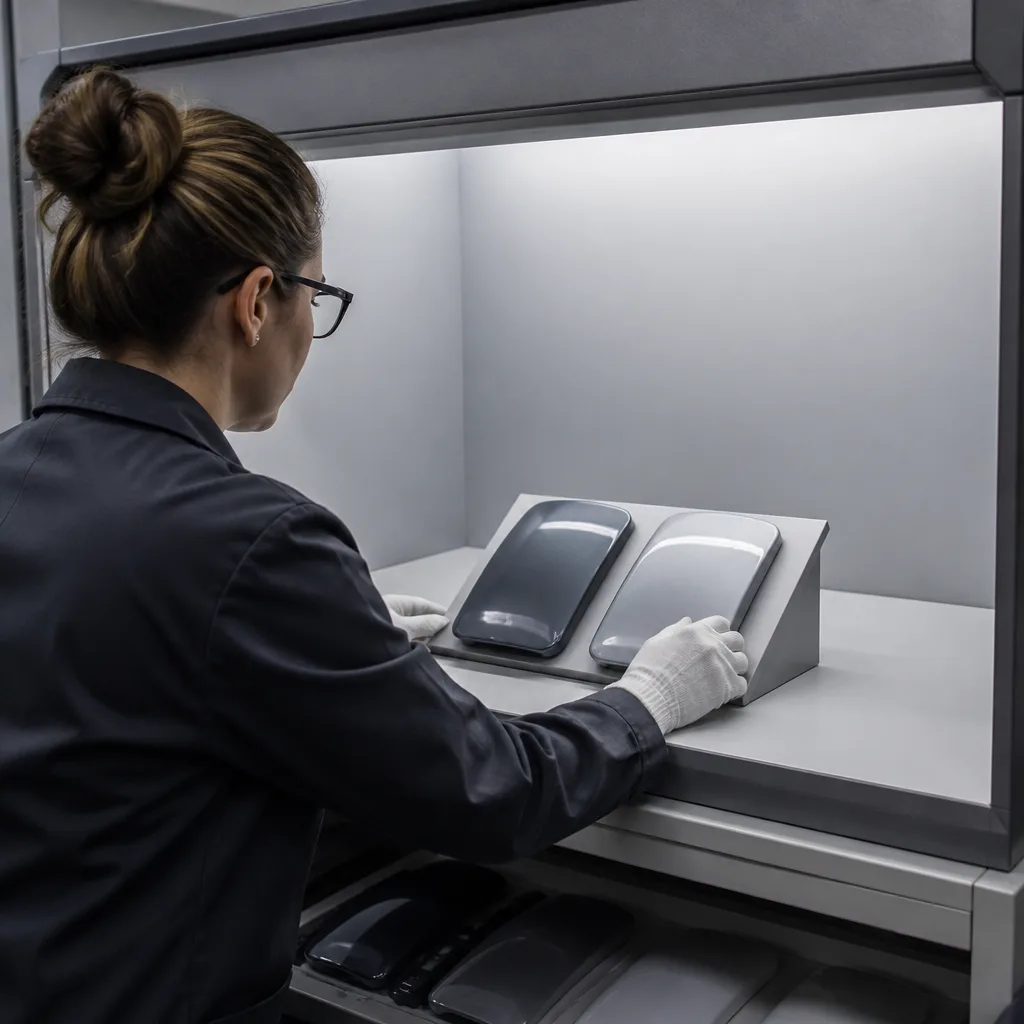
The “PSA D15 1343 Colored Materials – Visual Comparison of Images in a Lightroom” standard, developed by the French car manufacturer PSA Group, now part of Stellantis, describes a method that defines the conditions to be met for a visual comparison of the appearance of a colored material with a standard (or an original sample of the material). This standard applies to all colored materials. Specifically,
The areas of application for this standard are as follows:
This method consists of visually comparing the color impressions obtained by placing a piece of the same color, exposed to the illumination of a specific light source, side-by-side with a standard (or reference) piece. To detect metamerism, this comparison should also be performed under artificial light with different lighting conditions (daylight, fluorescent, incandescent lamp). A comparison can also be made under ultraviolet light (or black light) to highlight fluorescence.
The PSA D15 1343 standard outlines a method for visually comparing the colors of colored materials in a light chamber (light booth or color evaluation booth). This standard defines controlled conditions for visually comparing the color of a test sample (colored material or part) against a reference color standard. It provides consistent and reliable color evaluation in the automotive industry, where accurate color matching is critical for interior and exterior components, paints, coatings, plastics, textiles, and decorative parts.
This standard focuses on subjective visual assessment under standardized lighting to detect any color differences, shifts, or discrepancies that might not be visible under normal room lighting. This test often complements instrumental methods such as color measurement (e.g., the PSA D15 5084 standard using CIELAB).
The basic test conditions are as follows:
This method generally follows these steps:
This standard provides reproducible imaging conditions, including ambient light control and observer positioning, to minimize metamerism (the phenomenon where colors match under one light but differ under another).
Common applications of the PSA D15 1343 standard include:
In short, the PSA D15 1343 standard includes a material test developed for the visual evaluation of colored materials under controlled lighting conditions.
The primary objectives of the PSA D15 1343 standard are as follows:
This standard is particularly critical for:
In automotive manufacturing, even minor color discrepancies between parts can lead to customer complaints and rejection.
This method relies not only on instrumental measurement but also on human visual assessment. Samples are compared side-by-side in a standardized light booth. The assessment includes:
This visual comparison complements instrumental methods such as spectrophotometry (e.g., PSA D15 5084 standard).
The test conditions were defined as follows:
The PSA D15 1343 standard is used in many automotive verification steps:
This standard is frequently referenced in other PSA tests to assess changes in appearance after aging.
The PSA D15 1343 standard is commonly used with the following:
Human color perception is subjective and influenced by lighting. The PSA D15 1343 standard standardizes the process to ensure color decisions are consistent across suppliers, laboratories, and manufacturing. It helps prevent visible discrepancies in vehicles (e.g., between adjacent parts) and ensures long-term color fastness.
For many years, our organization, with its competent and experienced team, has been understanding the needs of its clients, providing the advanced testing services they require, and assisting them in the establishment, implementation, and improvement of management systems. Within this framework, we also provide testing services compliant with the PSA D15 1343 standard.
To get an appointment, to get more detailed information or to request an evaluation, you can ask us to fill in our form and reach you.

