

The standard “VW PV 2005 Vehicle parts – Environmental cycle resistance testing of specific parts, new developments and solutions” developed by the Volkswagen automobile company is used for sample monitoring tests and production conformity monitoring tests and defines the quality testing of vehicle parts, especially bonded parts, both in the unused state and in environmental cycle testing after component-specific pre-aging.
For this purpose, the behavior of the parts during environmental cyclic loads should be evaluated (e.g., susceptibility to cracks, deformation, debonding). Metallic components should not be evaluated unless they have been marked as relevant for testing by the purchaser.
Two types of tests are applied:
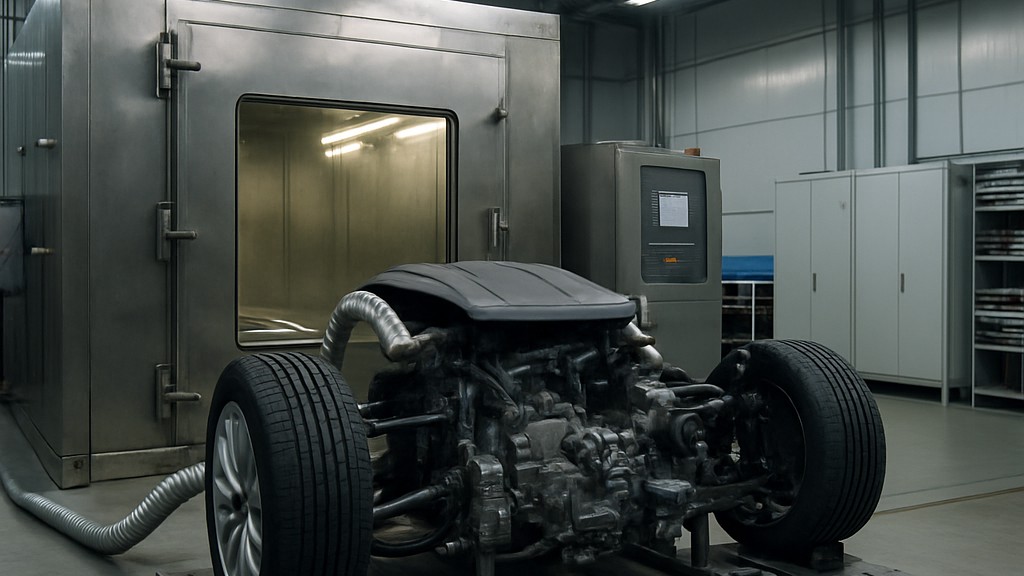
During testing, the parts to be tested (individual parts or entire seats) or the vehicle are placed in the prepared climatic chamber and evaluated after the required number of cycles. Aging is carried out according to the technical supply specifications or drawing. Environmental aging is then carried out for the number of cycles specified in the specifications or drawing. Holding times are always adhered to. Cooling and heating phases may be varied depending on the performance capacity of the climatic chamber used, even if this extends the specified cycle time for each variant by a maximum of 1/3. Any deviations are noted in the test record. Humidity control during the cold phases (temperature no more than 10 degrees Celsius) is not possible due to the chamber's technical conditions. The chambers are loaded at 23 degrees Celsius and 30 percent relative humidity during the holding phase.
Variant A (individual parts), 1 cycle lasts 12 hours and includes the temperature and climatic conditions specified in the standard.
Variant B (entire vehicle, with infrared radiator support), 1 cycle lasts 24 hours and includes the temperature and climate conditions specified in the standard.
The holding phase at 23 degrees Celsius and 30 percent relative humidity can be used to charge the chamber or to perform intermediate assessments and measurements. Additionally, during the heating phase (42 degrees Celsius and 30 percent relative humidity), the vehicle is irradiated with medium-wave infrared radiators (no more than 400 nm, without radiation in the ultraviolet range), resulting in an external temperature of 90 degrees Celsius on the roof and in the area of the door belt rails. During outdoor wear, the maximum temperatures specified for the relevant vehicle type must be reached for the following components or areas within the vehicle interior. The temperatures should be agreed upon with the buyer:
The radiators can be used at a lower power setting during the heating phase and the humidification phase (temperature from minus 35 degrees to plus 45 degrees, relative humidity from 30 percent to 95 percent) and can heat the vehicle and compartments evenly.
In short, the VW PV 2005 standard is used to assess how vehicle components withstand environmental stressors such as temperature fluctuations and humidity. This standard is particularly important for components such as interior trim, exterior panels, and assemblies that are exposed to changing climate conditions.
The purpose of this standard is to evaluate the durability and performance of vehicle components under simulated environmental conditions, ensuring their resistance to cracking, deformation, or bond failure. Components are subjected to cycles of temperature and humidity changes in a controlled climate chamber, simulating the real-world environmental stresses that components may encounter throughout the life of a vehicle.
This testing standard is part of extensive quality assurance measures and helps evaluate individual vehicle parts and assemblies for climate resistance and material durability before they are approved for production.
A general breakdown of the VW PV 2005 test procedure is as follows (specifically for the commonly referenced PV 2005-A variant):
A complete cycle usually takes 24 hours.
Additional optional tests include:
Common components typically tested to this standard are:
instrument panels
Our organization, which has been supporting businesses across all sectors for years through a wide range of testing, measurement, analysis, and evaluation activities, boasts a strong team of employees who closely follow global developments in science and technology and are constantly improving themselves. In this context, we also provide testing services in accordance with the "VW PV 2005 Vehicle Parts - Environmental Cycle Resistance Testing of Special Parts, New Developments, and Solutions" standard.
To get an appointment, to get more detailed information or to request an evaluation, you can ask us to fill in our form and reach you.

