GMW 18165 Plastic Plumbing for Water/Cooling Water Application - Verification of Low Temperature Cooling Water Circuit Assemblies
General Motors standard "GMW 18165 Plastic piping for water/coolant application - Verification of low-temperature cooling water circuit assemblies," describes design verification and product validation requirements for plastic cooling piping assemblies in low-temperature cooling circuits outside of rechargeable energy storage systems. This standard is applicable to all thermoplastic glycol/water cooling lines for low-temperature circuits, such as external battery cooling lines and drive unit cooling lines.
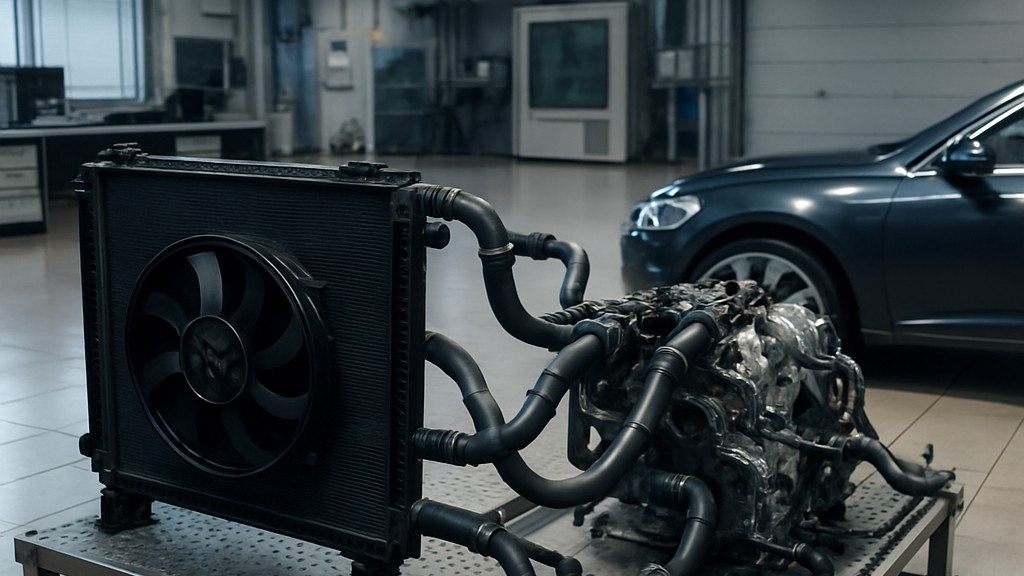
The requirements in this standard are specified as follows:
- Facilities and equipment: Test facilities and equipment must be in good working order and have a valid calibration label. Alternative test facilities and equipment may be used. However, all measurement variables specified in this standard must be accurately determined according to their physical definitions.
- Requirements on test specimens: Standard GMW 3221 applies. Unless otherwise specified, the shape and size of the test pieces shall conform to the relevant test method. The minimum number of specimens (hose assemblies) per test is defined in the table provided in the standard. Specimens are finished parts or must be taken from finished parts. If the dimensions of the finished parts do not allow for the preparation of test pieces, tests must be performed on material from the same production batch. To test a hose assembly to the performance characteristics specified in the table, any type of quick connector, in-line, T-connector, or Y-connector used in a design released to this standard shall be included in the tested specimens.
- Reliability: This standard provides a test exposure representing a reliability assessment point required by GM. This standard supports the demonstration of a required reliability of 99 percent or greater at a 50 percent confidence interval at the reliability assessment point for coolant pipe connections. The supplier must use vehicle-equivalent laboratory test fixtures to simulate in-vehicle orientations. If the orientation may differ from one vehicle to another, the orientation that will provide the worst-case loads is used for all physical-level reliability demonstration tests. Reliability demonstration is provided by the design verification endurance tests specified in the table. Failure is defined as, but is not limited to, loss of function, unacceptable performance deterioration, and non-compliance of the component as specified in this standard.
GM encourages the use of appropriate accelerated testing methods wherever possible, such as accelerated stress testing to reduce test time. For example, if running 23 samples is impractical, the required number of test samples can be negotiated. Sample size negotiation should consider test equipment limitations, the physical size of the test samples, and the test duration. However, reducing sample size may require longer test times or the use of other test methods, such as high-accelerated stress screening, high-accelerated stress testing, calibrated accelerated life testing, or high-accelerated life testing.
- Identification and marking: All assemblies must be prominently labeled with the GM part number, date code, and tool/cavity number. All labels must comply with GMW 14573.
- Recycling: Materials must be recyclable according to standard GMW 3116. To make recycling more feasible, efforts should be made to minimize the variety of materials used.
If there is a break, leak or anything outside the acceptance criteria in the test, the GM must be notified within 24 hours.
To prepare for all tests, the supplier should bend the hose 180 degrees at the crimped section and hold it in that position for 1 hour at standard ambient temperature, then return the section to its original position to begin testing. If the hose assembly has multiple crimped sections, the bend should be made at only one section, selecting the bend with the largest angle.
Testing time depends on the number of samples tested. However, testing is typically completed within 20 testing days, typically 30 calendar days.
Performance measurements and durability test results must be summarized and reported to GM on supplier form (GM 1829) for the component or components tested.
The tests performed are as follows:
- Vacuum collapse test: All hoses are subjected to a vacuum pressure of 2kPa (absolute pressure) for 30 seconds. The test can be considered passed if:
- The minimum outside diameter should not decrease by more than 20 percent while vacuum pressure is applied.
- There is no evidence of stability between the plastic layers.
- There should be no permanent deformation of the hose inner diameter after vacuum pressure is applied.
- There should be no swelling or cracking on the outer surface of the hose.
After the vacuum pressure is completed, the leak test is performed.
- Leak test: The complete assembly is mounted on a bench using interfaces/taps made of aluminum or thermoplastic with a geometry that complies with VDA standards. Aluminum is used if the interface within the vehicle is metal, and thermoplastic is used if the interface within the vehicle is plastic. The assembly is connected to a pressure drop system, and an internal pressure equal to 1,20 times the maximum continuous system operating pressure is applied and held for 5 minutes. If no pressure value is specified, a pressure of 200 kPa is applied. The temperature must be maintained at 23 degrees Celsius. There must be no decrease in internal pressure that could indicate a leak.
- Cold leak testing: The assembly is placed on a bench using interfaces/taps made of aluminum or thermoplastic with a geometry that complies with VDA standards. If the vehicle interface is metal, use aluminum; if the vehicle interface is plastic, use thermoplastic. If the assembly includes intermediate connections or plumbing branches, ensure that the branch is included and tested with its corresponding tap, as shown in the figure. These tests follow the procedure specified in GMW 18152. There should be no stains that could indicate leaks. Inspection using ultraviolet (UV) light equipment is recommended.
- Pressure Pulsation Temperature: This test is only applicable to parts subject to relative motion between the interface components. Before testing, all hoses are visually inspected for efflorescence, cuts/damage, or oil or other residue from the manufacturing process, and any findings are noted. Samples for this test should be identical to those used for the tests described above.
Our organization, which has been supporting businesses across all sectors for years through a wide range of testing, measurement, analysis, and evaluation activities, has a strong team of employees who closely follow global developments in science and technology and are constantly improving themselves. In this context, we also provide testing services in accordance with the GMW 18165 standard for plastic installations for water/cooling water applications - Verification of low-temperature cooling water circuit installations.



