

The “GMW 3182 Mass per Area” standard, developed by General Motors Worldwide (GMW), outlines a method for determining the mass of a material relative to a defined surface area, typically expressed in g/m² . This standard is particularly important for automotive interior materials, where material weight and area density are crucial properties for product design, quality control, and manufacturing consistency.
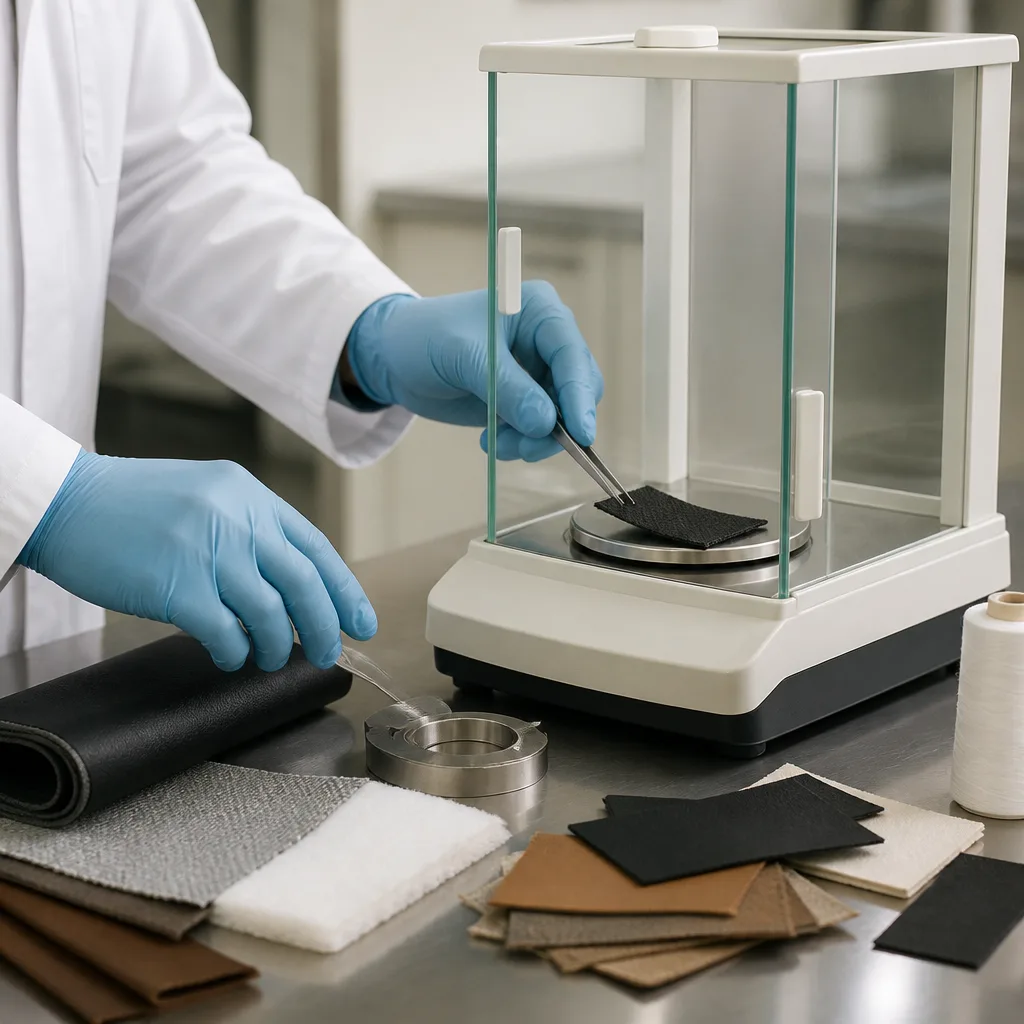
The GMW 3182 standard is used for a variety of materials including coated textiles, artificial leather, leather and leather fiber materials, textiles and yarns, plastics, elastomers, and films.
The primary goal of the GMW 3182 standard is to provide a consistent method for measuring mass per unit area. Two materials may have the same dimensions, but their weights can differ significantly due to variations in structure, coating, fiber content, backing, or formulation. A standardized measurement allows manufacturers and suppliers to verify that a material meets the specified weight and remains consistent from one production batch to another.
This information is important for automotive applications because material mass can affect:
The GMW 3182 standard has a relatively wide range of material applications. This standard generally applies to the following materials:
This wide range of applications makes the test useful in the field of automotive interior material development, where fabrics, synthetic leather, films, and flexible polymeric materials are frequently used.
The basic principle of the described test method is simple: a representative sample with a known or controlled area is weighed, and its mass is related to this area. The basic calculation is as follows: Mass per unit area = Mass of sample / Area of sample.
Sample preparation, dimensions, conditioning, weighing procedure, sample quantity, and reporting requirements are all included in the GMW 3182 standard.
Since the test is essentially mass-field determination, the equipment typically includes the following:
The laboratory testing program should ensure that the balance has the appropriate resolution and calibration for the expected sample mass.
The GMW 3182 standard, along with other automotive mass/weight methods, has been included in accredited laboratory scopes, demonstrating its use as a recognized automotive material testing method.
A typical mass-field assessment follows these steps:
GMW 3182 standard is considered important for the following reasons:
The GMW 3182 standard typically forms part of a broader automotive materials qualification program. For example, laboratories list it alongside the following standards:
This shows that mass per area is generally evaluated in conjunction with mechanical, strength, and appearance properties, rather than being considered as an isolated characteristic.
The GMW 3182 standard is particularly useful in the development and production of automotive interior materials. Potential applications include:
Measurement can also be used during supplier qualification assessment, incoming material inspection, process validation, and production quality monitoring.
While interpreting the results,
However, mass per area alone does not determine material quality. A lighter material is not necessarily better than a heavier one. The result must be evaluated in conjunction with the required performance characteristics of the material.
For automotive suppliers, mass-per-area control can be an effective way to identify production variation. If the mass per-area of a material deviates from the agreed-upon specification, this may indicate a process change that could affect other properties as well. For example, a change in coating application could simultaneously affect:
For many years, our organization, with its competent and experienced staff, has been understanding the needs of its clients, providing the advanced testing services they require, and assisting them in the establishment, implementation, and improvement of management systems. Within this framework, we also provide testing services in accordance with the GMW 3182 standard.
To get an appointment, to get more detailed information or to request an evaluation, you can ask us to fill in our form and reach you.

