

In the standard “VW PV 3937 Amine emissions from PUR flexible foam – Indicator method” developed by Volkswagen automobile company, the indicator method is described as a procedure for identifying gaseous amine catalysts of polyurethane foam (PUR) flexible foams.
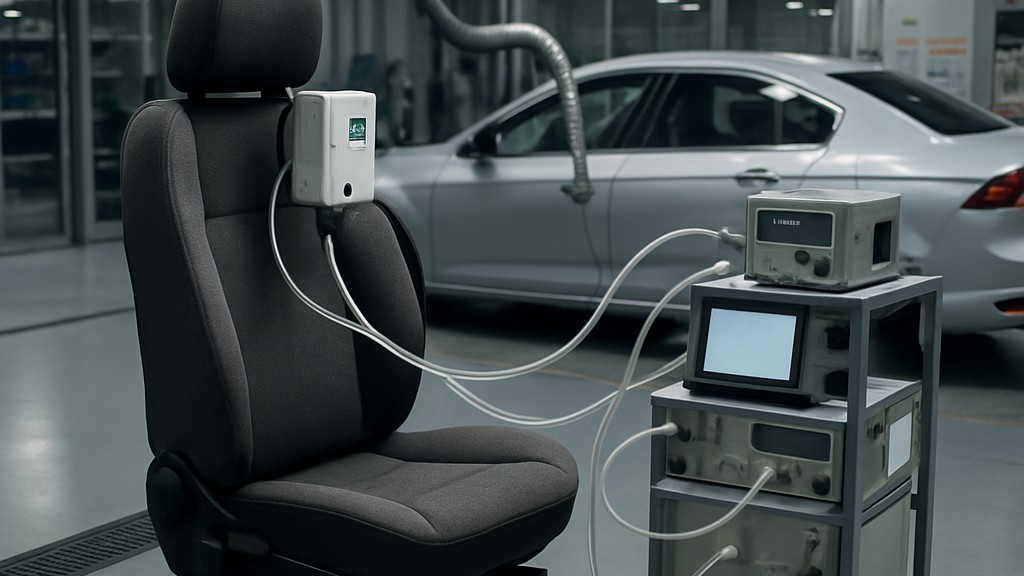
The VW PV3937 standard is designed to assess primary amine emissions from soft polyurethane foam materials used in vehicle interiors. It specifically targets odorous amines that could affect vehicle air quality or occupant comfort.
Some automotive materials, particularly flexible foam, can emit volatile amines that can cause odor problems or be health hazards for occupants. This testing helps manufacturers screen and verify the compatibility of interior components.
This standard is primarily used by original equipment manufacturers and suppliers. It is part of Volkswagen's material qualification testing and is often required in supplier quality control and pre-production verification programs.
These tests typically involve incubating polyurethane foam samples under controlled conditions and then using an indicator method to detect and quantify amine emissions.
Manufacturers must ensure that flexible foams used in seats, headrests, armrests, or interior panels meet passenger comfort and safety criteria. The VW PV 3937 standard specifically addresses odor-causing amine emissions, a critical subset of overall emissions compliance in automotive interiors.
The test method described in the VW PV3937 standard is a qualitative screening test used to detect amine emissions from flexible polyurethane (PUR) foams, particularly those used in vehicle interiors. The purpose of this test is to detect low molecular weight amines (often used as catalysts in PUR foam production) that may be released at high temperatures. It also aims to ensure that no visible contamination or odors are produced that could compromise indoor air quality or customer satisfaction.
The test is performed as follows:
The main advantages of this standard are:
However, the limitations of this standard are:
The VW PV 3937 standard is typically used in the early stages of material verification, before proceeding to:
Flexible polyurethane foam is produced by reacting isocyanates with polyols, and amine catalysts are often used to accelerate the cure. Some amine catalysts are volatile and can outgas after the foam cures, especially under heat or in enclosed environments such as vehicle cabins.
Residual aromatic or aliphatic amines, usually decomposition or unreacted byproducts, may remain in the foam matrix and slowly migrate or diffuse over time.
In a study on commercial flexible PUR foams, residual toluene diamine (TDA) and methylene dianiline (MDA) ranged from approximately 10-59 mg/kg (TDA) and 7-26 mg/kg (MDA).
Emission tests have shown that release rates are typically below 0,008-0,07 µg/m2h and rapidly decline below measurable levels after a few days.
These amines can cause odor problems and indoor air quality issues, which are critical for automotive interiors where comfort and safety standards are high. Tertiary amines often cause strong odors or fogging, which is a problem in new vehicles and materials.
Automotive manufacturers are now adopting emission-free or reactive amine catalysts that chemically bond to polyurethane, significantly reducing off-gassing and odors. For example, polyols are being introduced that enable foam production without external amine catalysts, effectively eliminating amine emissions from seat foams.
While fully cured polyurethane is generally inert, isocyanates and residual amines can cause respiratory irritation if inhaled during manufacturing or in poorly ventilated areas. Some flexible foam products have been known to initially emit strong odors, sometimes causing mild irritation, but the risks diminish once off-gassing subsides.
Screening methods, such as the VW PV 3937 standard, detect visible amine gas emissions or odors, but are qualitative rather than quantitative. For accurate exposure assessments or compliance verification, laboratories typically perform GC-MS emission testing or extraction methods.
In the automotive sector, stringent original equipment manufacturers now prefer the use of reagent- or amine-free formulations to meet indoor air quality and odor standards.
As a result, the VW PV 3937 standard test method performs as a rapid and reliable emission screening tool for amine gas release in flexible polyurethane foams. While not designed for detailed chemical analysis, it is an effective first step in ensuring interior odor neutrality and comfort in accordance with Volkswagen original equipment manufacturer standards.
Our organization, which has been operating for many years and meticulously follows global developments in science and technology, employs a skilled team and extensive infrastructure to conduct testing, measurement, and analysis in a wide range of areas for businesses across all sectors. In this context, we also provide testing services in accordance with the "VW PV 3937 PUR flexible foam amine emissions - Indicator method" standard.
To get an appointment, to get more detailed information or to request an evaluation, you can ask us to fill in our form and reach you.

