

The “GMW 14357 Resistance of Cellular and Similar Materials to Moisture Aging” standard, developed by General Motors Worldwide (GMW), is particularly important for cellular materials such as automotive foams, where prolonged exposure to moisture and high temperatures can cause changes in their physical properties.
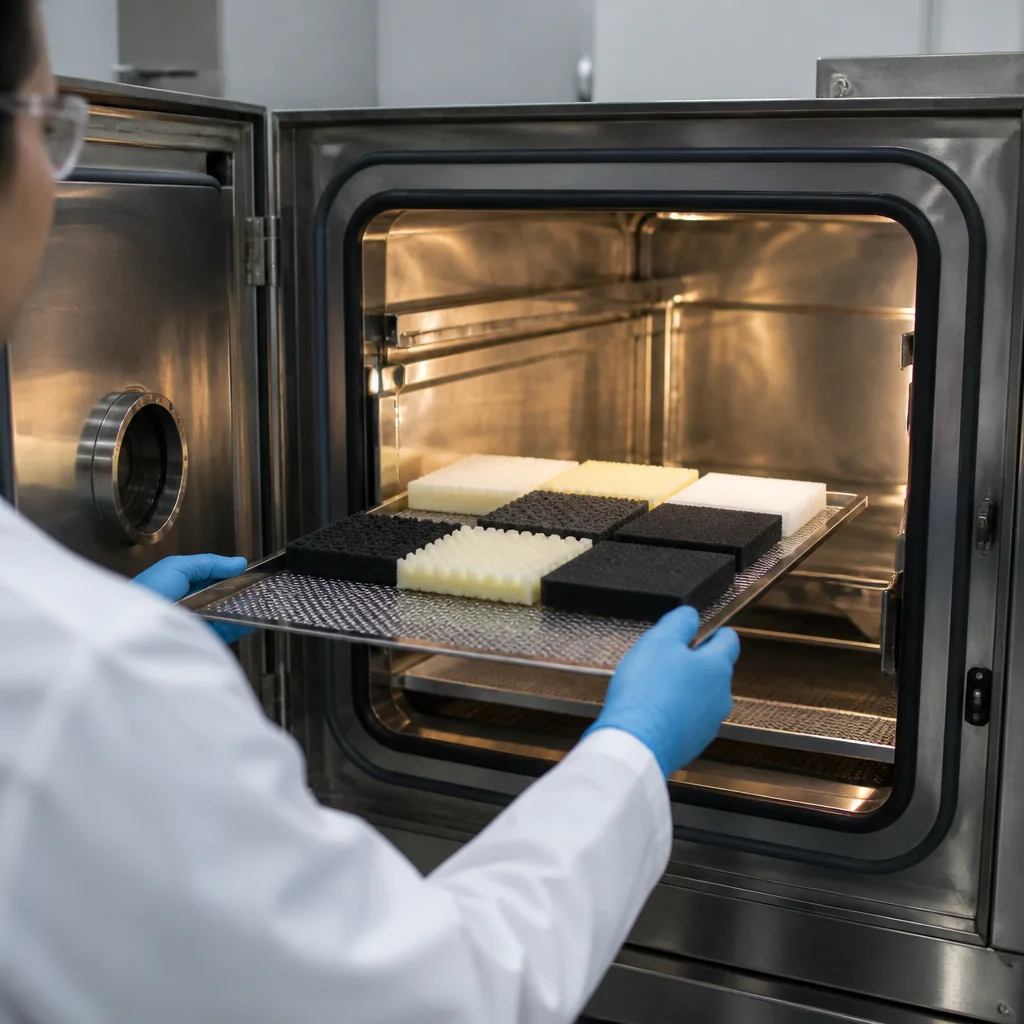
The primary objective of this standard is to determine how cellular materials withstand moisture aging. The method uses high-temperature water vapor to accelerate degradation mechanisms that might naturally occur over a much longer period. The main mechanisms of interest are:
The material is evaluated before and after exposure to measure changes resulting from the humidity and aging environment.
The GMW 14357 standard is designed for cellular and related materials. In automotive applications, this may include various types of flexible or semi-flexible foams. Typical applications may include:
Therefore, the method is particularly useful for evaluating materials that are expected to retain their mechanical properties throughout the vehicle's service life.
The basic concept of the test is relatively simple. First, a sample is characterized in its initial/sumed state. Then, it is exposed to a controlled moisture-aging environment containing high temperature and water vapor. After aging, the sample is conditioned and the relevant physical properties are measured again. The results are compared. The process generally proceeds as follows: initial properties - moisture-aging - final properties - property change. This approach makes it possible to determine whether the exposure has led to unacceptable deterioration. This method is described as a moisture-aging/autoclave test at temperatures above 100 degrees and demonstrates the accelerated nature of the exposure.
Moisture, especially when combined with high temperatures, can be a significant source of material degradation. For polymeric cellular materials, moisture and heat can contribute to:
Consequently, a foam that performs satisfactorily when new may not necessarily remain suitable after prolonged environmental exposure.
One of the key features of the GMW 14357 standard is that deterioration is assessed not merely by visually observing the sample, but through measurements of physical properties before and after aging.
Depending on the material specification and application, interesting properties may include:
Precise acceptance criteria are generally determined according to the relevant material or component specification, rather than treating environmental exposure alone as a universal pass/fail requirement. For example, an automotive laboratory's accreditation document lists the GMW 14357 standard among the methods used for moisture aging of urethane foam and also associates it with wet-aged compressive strength deflection assessment.
In general, this testing method follows these steps:
The exact dimensions of the sample, exposure conditions, duration, conditioning requirements, and characteristic measurements are specified in the GMW 14357 standard.
The GMW 14357 standard is particularly important for automotive polyurethane and other cellular foams. Foams are widely used in vehicle interiors, especially for seats and cushions. Their performance depends largely on their cellular structure and polymer chemistry. A foam may initially have excellent properties:
However, prolonged exposure to heat and humidity can alter these properties. Therefore, moisture aging provides an accelerated method for identifying materials that may experience unacceptable deterioration during vehicle servicing.
The GMW 14357 standard should not be confused with ordinary heat aging tests:
This distinction is important because temperature alone does not reproduce the same degradation mechanisms as temperature combined with water vapor.
For suppliers of automotive foam or other cellular materials, the GMW 14357 standard can be important because it provides a standardized way to assess environmental durability. This standard helps manufacturers in the following areas:
Therefore, the test could be part of a broader material validation and durability program.
The GMW 14357 standard is necessary because automotive materials must perform not only when new, but also after exposure to severe environmental conditions. For cellular materials, the combination of moisture and high temperature can accelerate chemical and physical degradation that would otherwise take years. In practical terms, this standard reveals whether the cellular material retains its required physical performance after prolonged exposure to hot and humid conditions. This makes the GMW 14357 standard a crucial durability test for automotive foam and related cellular materials.
In short, the GMW 14357 standard is an accelerated environmental durability test designed to reveal how cellular automotive materials withstand hot and humid conditions and whether their physical performance degrades after aging.
For many years, our organization, with its competent and experienced staff, has been understanding the needs of its clients, providing the advanced testing services they require, and assisting them in the establishment, implementation, and improvement of management systems. Within this framework, we also provide testing services in accordance with the GMW 14357 standard.
To get an appointment, to get more detailed information or to request an evaluation, you can ask us to fill in our form and reach you.

